On this page
AI in Spare Parts: ERP Data Standards
Managing spare parts efficiently starts with clean and accurate ERP data. Many companies struggle with duplicate records, missing details, and manual errors, which lead to inflated costs and operational inefficiencies. AI-powered tools are transforming this process by automating data cleaning, standardization, and enrichment.
Key takeaways:
- Data issues like duplicates and incomplete records disrupt inventory management and inflate costs.
- AI tools solve these problems by identifying duplicates, enriching records, and ensuring consistent naming conventions.
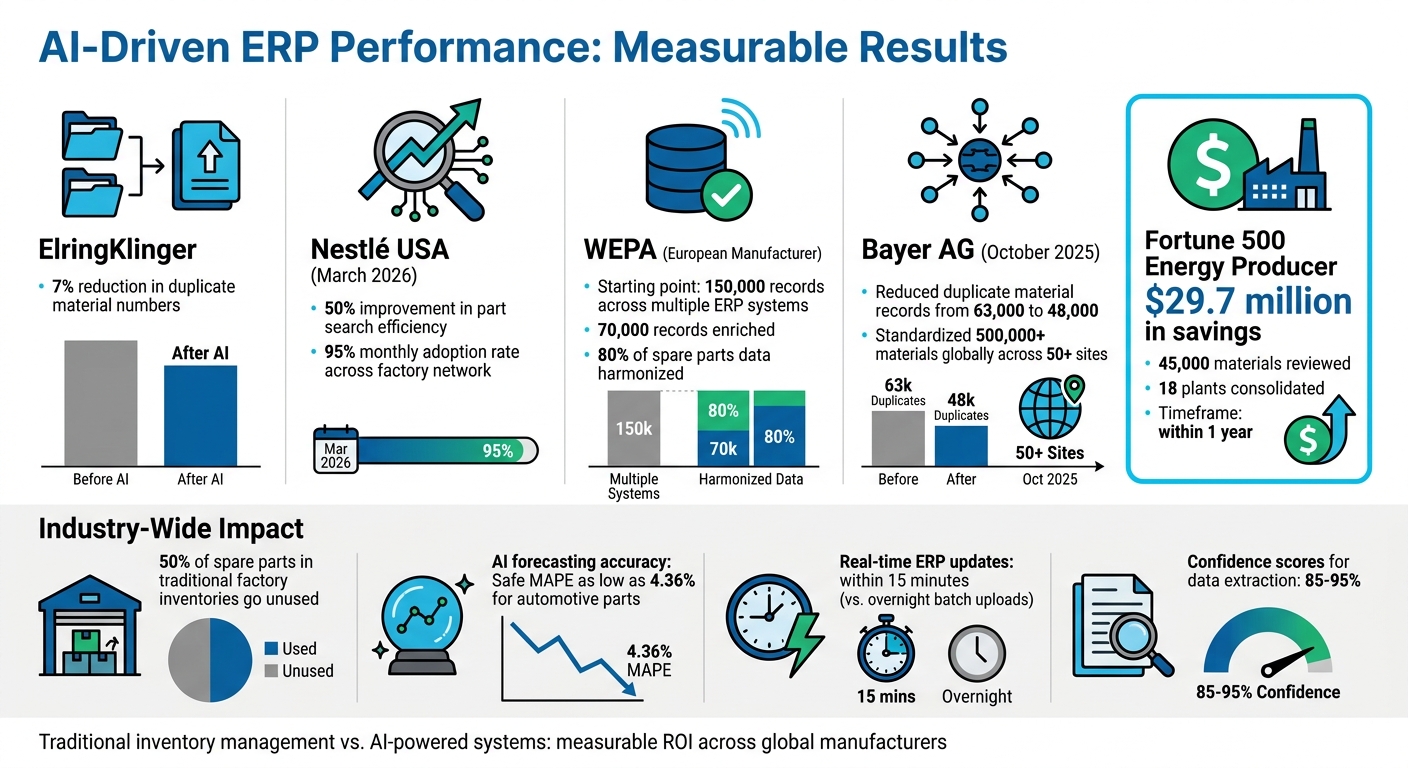
- Examples of success: ElringKlinger reduced duplicate material numbers by 7%, and Nestle USA improved part search efficiency by 50%.
- AI’s impact: Predictive analytics optimize stock levels, reduce waste, and enable real-time ERP updates.
The result? Businesses save time, reduce costs, and improve inventory visibility with AI-driven ERP systems. Dive into the article to learn how companies are leveraging AI to transform spare parts management.
AI Methods for Cleaning and Enriching Spare Parts Data
Data Cleaning and Harmonization
Managing spare parts data can be a mess, especially when inconsistencies like duplicates, mismatched entries, or incomplete records creep into ERP systems. This is where AI steps in. By using tools like semantic matching and probabilistic modeling, AI identifies when different labels - say, “Hex Bolt” and “M10 Bolt” or “TI GRADE 5” and “Titanium” - actually refer to the same item. This reduces redundant entries and helps cut down inflated inventory costs.
Modern AI systems even prevent duplicates in real time. As new parts are added to a database, these systems scan for similar records and alert users immediately, stopping redundant entries before they happen.
Take WEPA, a European sanitary paper manufacturer, as an example. After acquiring eight plants, they found themselves with 150,000 records spread across various ERP systems and languages. By leveraging AI tools, they enriched 70,000 records and harmonized 80% of their spare parts data. This effort not only improved their data quality but also set a stronger foundation for managing spare parts effectively. Beyond harmonization, AI also automates data extraction, making it easier to digitize and validate critical information.
Automated Data Extraction and Enrichment
AI doesn’t just clean data - it makes it richer. Using Optical Character Recognition (OCR) and image recognition, AI can digitize text from smartphone photos of nameplates, even when the labels are worn or damaged. Convolutional Neural Networks (CNNs) take this a step further by isolating parts in images, removing shadows, and creating clean, catalog-ready visuals. Techniques like semantic segmentation and alpha matting ensure even the smallest details are captured with precision.
Once the data is extracted, AI cross-references it against global databases containing millions of OEM products. This allows systems to automatically fill in missing details like technical specifications, drawings, or part numbers. Confidence scores - usually between 85% and 95% - are assigned to the extracted data. High-confidence matches are approved automatically, while anything lower is flagged for human review, speeding up the entire intake process.
For instance, AutomaSnap simplifies inventory management by extracting structured details from nameplate images and generating ERP-ready spreadsheets. This makes the process of cataloging and organizing spare parts much smoother and more efficient.
AI-Powered Predictive Analytics for Inventory Optimization
Using Historical Data for Demand Forecasting
Accurate ERP data is the backbone of predictive analytics. Traditional inventory planning often relies on outdated “min/max” rules, which fail to adapt to changing circumstances. AI, on the other hand, learns from historical data like consumption trends, warranty failures, and equipment lifecycle details. Instead of applying a one-size-fits-all approach, these models analyze thousands of parts individually. They even account for attrition-adjusted fleet estimates, helping predict how demand shifts as machines age.
Take frameworks like Decay-Function-Blended Machine Learning (DFB-ML), for instance. By combining physical degradation insights with data-driven algorithms, this method becomes crucial in end-of-life (EOL) scenarios. Manufacturers often face the challenge of forecasting 10-15 years of service demand after production ceases. AI techniques like Random Forest have shown impressive results here, achieving forecasting accuracy with a Safe MAPE as low as 4.36% for automotive spare parts.
Beyond forecasting, AI delivers real-time, dynamic recommendations. It predicts when parts are likely to fail and factors in supplier lead times, ensuring inventory aligns closely with actual demand. This smarter, predictive approach not only improves accuracy but also minimizes unnecessary stock.
Optimizing Stock Levels and Reducing Waste
Once demand forecasts are in place, AI can tackle another big challenge: overstocked inventories. Many factories maintain excessive parts, tying up valuable capital and generating waste. But with clean, harmonized data, AI can drive efficiency like never before.
For example, AI tools can detect duplicate records and uncover hidden inventory across multiple sites. Instead of purchasing new parts, companies can transfer stock between locations to meet demand. A Fortune 500 energy producer used this strategy, consolidating inventory across 18 plants. The result? $29.7 million in savings and a review of 45,000 materials - all within a year.
“In the past, spare parts purchasing was a safety net against machine downtimes, leading to overstocked warehouses. With the help of AI, inventories can be tracked and connected so that MRO procurement teams buy only what’s truly needed”
- Felix Dosch, Senior Account Executive, SPARETECH
Integration of AI with ERP Systems
Automating ERP Data Validation
Keeping ERP data clean is a major hurdle in spare parts management, but AI is stepping in to simplify this task. Acting as a gatekeeper, AI checks new entries against existing records and enforces industry standards before saving them.
Take Nestle USA, for instance. In March 2026, they integrated SPARETECH’s AI tool with their SAP system to prevent duplicate parts. Steven Gould, Senior Engineering Maintenance Manager, explained how it works:
“The system searches existing SAP entries for matches. The duplicates are displayed beneath the current records”.
This real-time validation sped up part-finding by 50% and achieved a 95% monthly adoption rate across their factory network.
Bayer AG also embraced AI for data validation during their “CORE” SAP S/4HANA transformation in October 2025. Using SPARROW, they harmonized MRO data across more than 50 sites. Dirk Herbrich, Data Value Stream Lead, emphasized their goal:
“We want one material master for the same physical item… Each should have only one data representative in the system”.
This initiative reduced duplicate material records from 63,000 to 48,000 and standardized data across their operations.
Jack Reinke, Senior Account Executive at SPARETECH, highlighted the broader impact:
“AI can correct humans when they aren’t setting up the parts correctly. If someone sits down at a computer and begins to enter a part, AI can check that it’s not a duplicate”.
By automating these checks, AI minimizes errors and prevents data clutter in the material master. Once validated, AI ensures that ERP data stays accurate through continuous, real-time updates.
Real-Time Data Synchronization
After cleaning and validating data, AI takes it a step further by keeping ERP platforms updated in real time. Instead of relying on overnight batch uploads, modern AI integrations push updates within 15 minutes of creating or modifying materials. This transforms the ERP into a reliable, up-to-date source of information across all locations.
Bayer’s SPARROW integration is a great example. The system synchronizes validated material data between SPARROW and SAP S/4HANA, standardizing over 500,000 materials globally. This gives factories visibility into each other’s inventories, making it easier to transfer parts internally instead of placing redundant orders.
For companies managing nameplate data directly from the shop floor, tools like AutomaSnap offer seamless integration. These tools automatically extract structured data - like brand names, manufacturer part numbers, and serial numbers - from photos and generate ERP-ready spreadsheets. This eliminates manual errors and ensures smooth data transfer to systems like SAP, Odoo, or Dynamics 365. With these capabilities, technicians can search for parts using manufacturer numbers or technical attributes, making inventory management as straightforward as a Google search.
MRO360 - AI Native Spare Parts Management
Error Reduction and Results from AI Adoption
Before and After AI: ERP Performance Metrics
AI-powered systems are changing the game when it comes to ERP performance. Companies using these technologies are seeing measurable improvements, including fewer duplicate records, quicker part searches, and better user adoption rates.
The benefits are clear across multiple areas: improved data quality, faster searches, and boosted productivity for technicians working across multiple locations. Here’s a striking example: about 50% of spare parts in traditional factory inventories go unused. With AI-driven tools for deduplication and demand forecasting, businesses are cutting down on redundant stock, freeing up working capital that would otherwise be tied up unnecessarily.
These advancements are more than just numbers - they’re setting the stage for smoother, error-free ERP systems that are essential for managing spare parts efficiently.
Success Stories in Spare Parts Management
AI adoption is making life easier for maintenance teams everywhere. Features like automated validation, duplicate prevention, and real-time synchronization are simplifying how parts are tracked and managed. These tools eliminate the manual entry errors that Martin Weber, CEO of SPARETECH, highlights as a major pain point:
“The biggest issue is human error. The human needs to key in every part themselves without making mistakes. At that scale, it makes sense that there are errors.”
For organizations managing nameplate data directly from the shop floor, tools like AutomaSnap are stepping in to help. By pulling structured data - such as brand names, manufacturer part numbers, and serial numbers - from photos, these platforms significantly cut down on manual entry mistakes and ensure consistent formatting right from the start.
This shift from reactive to predictive inventory management isn’t just about saving money - it’s also a step forward in sustainability. For manufacturers with multi-site operations, AI-driven solutions are delivering daily efficiencies while optimizing spare parts inventory on a broader scale.
Conclusion and Future Outlook
AI is transforming how businesses handle spare parts data within ERP systems. By shifting from manual processes to automated tools, companies are seeing real improvements: faster part searches, fewer duplicate entries, and less working capital tied up in excess inventory. A great example is Nestle USA, which achieved a 50% boost in part search efficiency and over 95% adoption of new tools across its factory network.
The next phase of advancement promises even greater capabilities. Autonomous data governance is set to replace periodic cleanups with ongoing, real-time monitoring that prevents errors before they happen. Jack Reinke, Senior Account Executive at SPARETECH, highlights this potential: “AI can correct humans when they aren’t setting up the parts correctly… It can ensure good governance and check that every record aligns with industry standards”. Technologies like advanced computer vision will soon identify unrecorded parts in inventory through visual cues that humans might miss, creating accurate records automatically - no manual input required.
For companies managing nameplate data directly from the shop floor, tools like AutomaSnap are already making a difference. These platforms extract structured data from photos and generate ERP-ready spreadsheets, eliminating errors from the start and ensuring clean data from day one.
The direction is clear: businesses are moving away from isolated, plant-specific inventory systems toward coordinated, market-wide visibility. This shift enables centralized management of high-cost, critical spare parts. Instead of relying on static min/max levels, AI-driven predictive restocking uses actual lead times and failure probabilities to calculate dynamic reorder points. The most effective strategy treats spare parts data as part of a continuous lifecycle - from clean data creation to data-driven planning and ongoing quality maintenance - rather than a one-off cleanup effort.
The future of spare parts management goes beyond just improving data. It’s about creating systems that learn, adapt, and optimize themselves, allowing teams to focus on strategic decisions instead of tedious manual tasks.
FAQs
What ERP data fields matter most for spare parts?
The essential ERP data fields for spare parts include serial numbers, MPNs (Manufacturer Part Numbers), and brands. These fields play a crucial role in accurately identifying parts, validating their details, and managing inventory efficiently.
How does AI detect duplicate spare parts in ERP?
AI helps spot duplicate spare parts in ERP systems by examining the semantic similarity between material records. It employs machine learning methods, such as probabilistic neural networks, to compare keywords and attributes, identifying near-duplicates effectively. This process improves data accuracy and minimizes redundancies in managing spare parts inventory.
How can AI improve reorder points beyond min/max?
AI improves reorder points by leveraging predictive analytics and real-time data to fine-tune inventory management. Unlike fixed min/max thresholds, AI takes into account variables like usage trends, demand forecasts, and lead times to adjust stock levels more effectively. It also automates the reorder process by generating purchase orders based on anticipated needs. This reduces manual work, enhances inventory accuracy, and helps avoid both stockouts and overstocking.