On this page
AI in Spare Parts Intake: What Distributors Need to Know
AI is reshaping spare parts intake by replacing slow, error-prone manual processes with efficient, automated systems. Here is why it matters:
- Manual inefficiencies: Errors in transcription (4-5%) and high labor costs (~$28,500 annually per employee) lead to delays and financial losses.
- AI advantages: Tools using Vision-Language Models (VLMs) accurately read damaged or obscured nameplates, extracting key data like Brand, MPN, and Serial Number in seconds.
- Real-world results: Companies using AI have seen faster processing, fewer errors, and improved revenue. For example, Parts Town reported a 54% boost in conversion rates after upgrading their AI system.
With AI, distributors can speed up inventory intake, reduce costs, and maintain cleaner data, all while integrating seamlessly into ERP systems like SAP or Odoo.
Use case of AI in Procurement - Spare-Parts Automation!
Core AI Technologies Behind Spare Parts Intake
Understanding the mechanics behind these technologies can help you make informed decisions about integrating them into your processes and set realistic expectations for their capabilities.
How AI Reads Industrial Labels and Nameplates
Modern AI systems are capable of reading and interpreting label text with impressive accuracy. This is largely due to Vision-Language Models (VLMs), which do not just identify individual characters - they analyze the entire layout of a nameplate. By leveraging context clues like label position, surrounding text, and field headings, they can accurately classify data.
For instance, if a string of numbers follows “Model No.”, the system identifies it as a Manufacturer Part Number (MPN). Similarly, text near “S/N” is flagged as a Serial Number. Even labels that are damaged or partially obscured can be processed effectively by these models.
Take TUEG Schillings GmbH, a German SME, as an example. In 2026, the company implemented AI-powered image and natural language processing for identifying assets in chemical plants. Despite dealing with aggressive vapors and heavy corrosion on nameplates, they managed to cut asset identification time by 50%.
This ability to interpret context is the foundation for more advanced techniques discussed in the next sections.
OCR, Computer Vision, and Machine Learning in Intake
AI-driven spare parts intake relies on a combination of technologies:
- OCR (Optical Character Recognition): Converts image pixels into text.
- Computer Vision: Enhances and isolates label images for better readability.
- Vision-Language Models (VLMs): Adds contextual understanding to the extracted text.
“The 2026 standard is fundamentally different, shifting from simple character recognition to contextual understanding.” - Automa.Net
Traditional OCR systems struggle in less-than-perfect conditions - think dirty or poorly lit labels. In contrast, VLMs excel in these scenarios thanks to zero-shot learning, which enables them to adapt to new fonts, languages, and layouts without prior training.
| Feature | Traditional OCR | Vision-Language Models (VLM) |
|---|---|---|
| Dirt Resilience | Very Low | Very High |
| Field Structure | None (Context-blind) | Full (Contextual understanding) |
| Lighting Adaptability | Requires external light | Photometric AI compensation |
| Language/Fonts | Requires mapping | Adaptive (Zero-shot learning) |
Tools like AutomaSnap leverage VLM technology, making them ideal for shop-floor photos taken in challenging conditions.
Photo and Data Requirements for Accurate AI Results
The quality of photos plays a crucial role in the success of AI-driven spare parts intake. While standard smartphone cameras are sufficient, blurry or poorly lit images can lower confidence scores and reduce accuracy. Tools like AutomaSnap simplify this process by running directly in web browsers, eliminating the need for additional hardware or app installations.
AI systems assign a confidence score to the extracted data, showing how certain the model is about its accuracy. These scores are essential for deciding whether human intervention is needed. Here is a quick reference for interpreting confidence levels:
| Confidence Score | Action Recommended |
|---|---|
| 0.95+ | Auto-approve for ERP import |
| 0.80 - 0.94 | Auto-approve with occasional spot checks |
| 0.65 - 0.79 | Route for quick human review |
| < 0.64 | Route to specialist or re-scan |
For U.S. distributors, it is especially important to ensure that AI outputs are formatted correctly for ERP systems. This includes adhering to date formats (MM/DD/YYYY) and standardizing part number conventions to avoid errors.
AI-Driven Intake Workflows for Spare Parts Distributors
AI is reshaping how spare parts distributors handle intake workflows, eliminating manual delays and streamlining processes from the moment a part arrives to when its data integrates into your ERP system. The magic lies in how seamlessly AI fits into daily operations, transforming what used to be tedious tasks into quick, efficient actions.
Label Recognition Directly on the Warehouse Floor
One of the most noticeable changes AI brings is cutting out unnecessary trips to a workstation. With tools like AutomaSnap, technicians can snap a photo of a nameplate directly on the warehouse floor using a smartphone. In just seconds, critical details like Brand, MPN, and Serial Number are extracted and ready for use.
Warehouse environments are rarely ideal for scanning - think reflective metal surfaces, grease marks, dim lighting, and awkward label angles. AI systems equipped with photometric compensation handle these challenges effortlessly, correcting for glare and uneven lighting without requiring users to reposition parts or search for better lighting conditions. Vision-Language Models, which interpret context rather than just raw pixels, play a key role here, outperforming traditional OCR tools in these tough conditions.
The result? Processing times drop from minutes to seconds, and transcription errors are significantly reduced - even when you are handling hundreds of parts each week.
Getting AI-Generated Data into Your ERP
Once the label data is captured, it needs to seamlessly integrate into your ERP system. AI-powered tools simplify this step by generating ERP-ready files that eliminate the need for manual reformatting.
AutomaSnap, for example, exports structured data in formats like CSV, JSON, and XLSX, which are compatible with popular systems such as SAP, Odoo, and Dynamics 365. For U.S.-based distributors, the output is already tailored to domestic standards: dates in MM/DD/YYYY format, part numbers aligned with your catalog, and clear separation of fields like Brand, MPN, and Serial Number. Each entry also comes with a confidence score, helping your team quickly identify which records can be auto-approved and which might need a second look.
This streamlined approach has a measurable impact. Poor data quality costs organizations an average of $15 million annually, often due to errors introduced during manual data entry. By standardizing output at the source, AI tools address this issue head-on, freeing up resources and enabling faster, more accurate decision-making.
Using Market Data During the Intake Process
AI does not stop at data capture - it also connects intake workflows to real-time market insights. After extracting an MPN, the system can instantly query global marketplaces and databases for pricing and demand trends, providing actionable insights before the part even hits the shelf.
This means warehouse teams can make smarter decisions on the spot. For instance, if a surplus part’s market value does not justify the cost of photographing, listing, and storing it, that decision can be made immediately rather than weeks later. Tools like AutomaSnap even provide direct links to platforms like eBay and Automa.Net within the same interface, so pricing data is just a click away.
The benefits extend to inventory management as well. Studies show that 30-50% of MRO parts in most organizations have not moved in over two years. By integrating market demand signals during the intake process, distributors can prioritize high-value items for listing while flagging others for liquidation or disposal, saving both time and storage costs.
Benefits and Limitations of AI in Spare Parts Intake
Key Benefits for Distributors
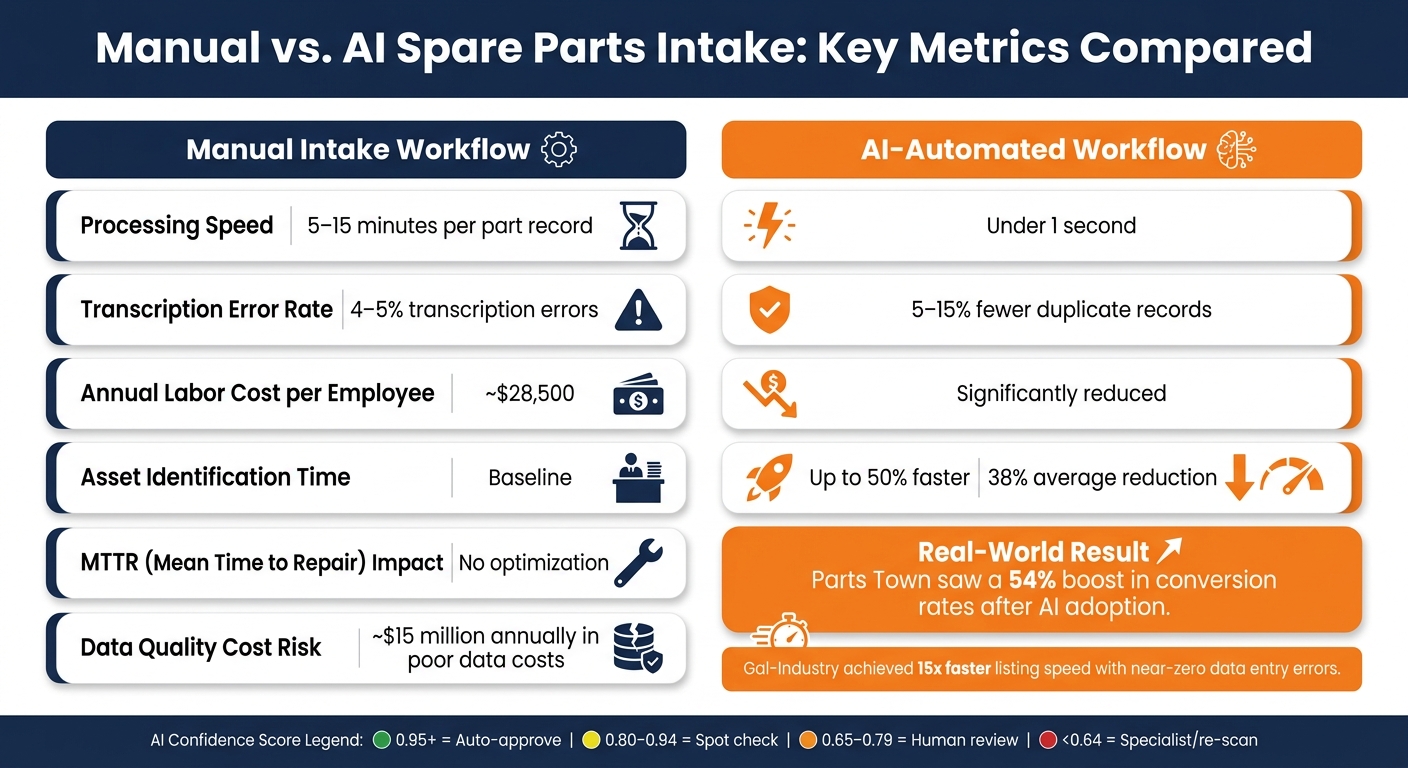
Manual data entry is expensive and error-prone, with an average annual cost of $28,500 per employee and transcription errors ranging from 4-5% in tough warehouse conditions. AI-assisted intake addresses these issues by significantly reducing duplicate records - by 5-15% - and cutting overall intake effort by about 80%. Speed is another major advantage: while manual workflows take 5-15 minutes to process a single part record, AI can handle the same task in less than a second. For distributors managing hundreds of parts weekly, these time savings quickly translate into operational efficiency. Additionally, integrating AI into maintenance workflows can lower Mean Time to Repair (MTTR) by an average of 38%.
| Feature | Manual Intake Workflow | AI-Automated Workflow |
|---|---|---|
| Processing Speed | 5-15 minutes per part record | Under 1 second |
| Error Rates | 4-5% transcription errors | 5-15% fewer duplicates |
| Annual Cost per Employee | ~$28,500 | Lower |
While these benefits are significant, AI does come with its own set of challenges.
Where AI Falls Short and How to Handle It
AI is not perfect, especially when dealing with heavily damaged nameplates, corroded labels, or handwritten and nonstandard formats. Even advanced Vision-Language Models can struggle to interpret such data accurately. A practical solution is to implement a confidence-score-based review system. For example, tools like AutomaSnap assign confidence scores to extracted data, enabling teams to prioritize their focus:
| Confidence Level | Action |
|---|---|
very_high (0.95) | Auto-approve and sync to ERP |
medium (0.65) | Route for quick human review |
low (0.40) | Route to a technical specialist |
very_low (0.25) | Require manual entry or re-scan |
This tiered system ensures that employees spend their time reviewing only the entries that genuinely need attention, rather than manually verifying every record. Another challenge is organizational resistance, particularly among traditional distributors who may fear disruption or lack digital expertise. Starting with a small, well-defined pilot project can help ease these concerns and build confidence in the technology before scaling up.
Technical issues aside, ensuring data accuracy and security is critical for long-term success.
Data Governance and Risk Management
Speeding up data capture is only valuable if accuracy, traceability, and security are preserved. Each intake record should include a clear audit trail, detailing who captured the data, when it was captured, and the AI-assigned confidence level. This not only ensures data integrity but also supports compliance with emerging regulatory requirements.
“With the help of AI, inventories can be tracked and connected so that MRO procurement teams buy only what is truly needed based on real-world demand.” - Felix Dosch, Senior Account Executive, SPARETECH
Strong access controls are equally important. Limiting ERP write access to high-confidence records while flagging low-confidence entries for specialist review helps maintain clean inventory data from the outset. This minimizes the risk of costly errors and corrections later in the process.
How to Implement AI for Spare Parts Intake
Auditing Your Current Intake Process
Before diving into new technology, it is essential to understand how your current process works. Start by mapping out each step your team follows - from reading labels and identifying the Brand, MPN (Manufacturer Part Number), and Serial Number, to manually entering data into spreadsheets or ERP systems, and managing associated photos. Then, quantify the time spent: manual intake typically takes about 8 minutes per part. Multiply that by your weekly intake volume and average warehouse wages, and you will see how quickly the costs add up.
Beyond time and labor, take note of any record fragmentation and calculate how often errors occur. This baseline error rate will be key to evaluating the improvements AI can bring. Once you have documented your current process and identified inefficiencies, you are ready to design a more efficient, AI-driven workflow.
Building an AI-Enabled Intake Workflow
After analyzing your current setup, creating an AI-enhanced workflow becomes much simpler. The process boils down to: take a photo of the nameplate -> extract structured data -> review based on confidence level -> send to ERP.
Tools like AutomaSnap fit seamlessly into this system. A warehouse worker just needs a smartphone to snap a photo of the nameplate - no fancy equipment required. The AI then extracts key details like the Brand, MPN, and Serial Number. The system generates an ERP-compatible spreadsheet that works with platforms like SAP, Odoo, and Dynamics 365. It even includes built-in market checks so your team can validate pricing and demand without disrupting the workflow. Depending on the AI’s confidence score, the data is either sent straight to your ERP or flagged for manual review. Once this workflow is set up, test its effectiveness with a controlled pilot program.
For example, in 2025, TUEG Schillings GmbH adopted an AI system that combined OCR and Natural Language Processing to identify assets in harsh industrial environments. The result? They cut asset identification time by 50%.
Running a Pilot and Scaling Up
This streamlined workflow directly tackles the errors and delays found in manual processes. Start with a pilot program using 20 parts from your highest-turnover category. Compare the results to your manual baseline to measure improvements. Then, roll out the system in stages:
- Begin with high-turnover consumables (Tier 1), where labels are generally easier to read and volume is high.
- Move on to standard rotatables (Tier 2).
- Finally, address critical or life-limited parts (Tier 3), which require extra care.
Most organizations achieve measurable ROI within 60-90 days of implementation. Typically, the first 30 days focus on spotting duplicates and understanding demand trends. The next 30 days are used to fine-tune stocking levels. By the final 30 days, the system is scaled across all warehouse locations and part categories.
Conclusion: Moving Spare Parts Intake Forward with AI
Errors and poor data quality are more than just inconveniences - they are costly. Manual spare parts intake often leads to significant resource drains, with poor data quality costing businesses around $15 million annually. On top of that, transcription errors, which occur at rates of 4-5%, result in incorrect orders and delays. These are not just numbers; they represent real challenges that disrupt operations.
AI offers a way to address these issues head-on. By transitioning from manual entry to an AI-driven, photo-based system, companies can significantly cut identification time, eliminate transcription errors, and ensure clean, structured data flows directly into their ERP systems. There is proof that this works: Gal-Industry, an industrial reseller, switched to an AI-powered intake process and saw a 15x increase in listing speed while virtually eradicating data entry mistakes. This kind of efficiency does not just save time - it transforms how operations run.
AutomaSnap makes this transition easy. It is browser-based, works with a standard smartphone, and does not require any hardware installations or drastic changes to existing processes. This simple integration streamlines inventory management and ensures accuracy, as highlighted above. Plus, AutomaSnap offers a free trial with no credit card required, so you can test it with your own inventory risk-free.
FAQs
What is the minimum photo quality AI needs to read a nameplate?
High-quality photos make all the difference when working with AI. Aim for images at 300 DPI resolution, with good lighting and minimal shadows. This becomes even more crucial if the nameplate is worn, dirty, or angled. Clear, sharp images improve the chances of accurate data extraction.
How do I route low-confidence reads without slowing intake down?
To handle low-confidence reads effectively, assign confidence scores such as very high, high, medium, or low. High-confidence data can be automatically routed into your ERP system, while fields with medium or lower scores should be flagged for manual review. By setting clear decision rules based on these confidence thresholds, you ensure that only dependable data is processed automatically. This approach keeps the intake process efficient by separating uncertain data for additional review.
What is the fastest way to get AI-captured fields into SAP or Odoo?
The quickest method involves using AI tools like AutomaSnap. These tools can create ERP-ready spreadsheets that work perfectly with systems like SAP and Odoo. Once you have extracted key data - such as Brand, MPN (Manufacturer Part Number), and Serial Number - you can export it in formats like CSV, Excel, JSON, or XML. Afterward, simply import these files using your ERP system’s built-in tools. This approach streamlines data transfer while reducing the need for manual input.