On this page
AI product attribute mapping automates the extraction of product details like brand names, MPNs, and serial numbers from images or documents, organizing them into standardized formats for e-commerce and inventory systems. This process reduces errors, saves time, and improves efficiency in industries managing large inventories, such as spare parts distribution and manufacturing. Here’s how it works:
- Step 1: Take photos of product labels, even if damaged or dirty.
- Step 2: AI extracts key data like Brand, MPN, and Serial Number in seconds.
- Step 3: Backgrounds are removed for clean, professional product images.
- Step 4: Data is exported into ERP-ready spreadsheets for seamless integration.
- Step 5: Market insights, including pricing and demand, are provided instantly.
Compared to manual processes, AI reduces listing creation time by up to 85%, cuts data entry errors, and ensures consistent, searchable product information. For businesses managing large inventories, this shift accelerates workflows and improves product visibility online.
Key Benefits:
- Faster product listing creation (from 20 minutes to ~3 minutes).
- Reduced product returns by 40–50%.
- Increased conversion rates by 15–25%.
- Saves up to $28,500 annually per employee in labor costs.
If you’re handling high-volume inventory, AI tools like AutomaSnap can simplify operations and improve accuracy for as little as $0.38 per part.
How AI Maps Product Attributes: Step-by-Step Process
Step 1: Capture Nameplate Photos
Start by snapping photos of nameplates using a smartphone - no need for fancy cameras or elaborate setups. Modern AI systems are designed to handle tough conditions, like reading labels that are dirty, scratched, or even corroded. This is especially helpful in industrial environments such as warehouses or manufacturing plants, where parts often arrive coated in dust or grease.
For instance, in 2026, TUEG Schillings GmbH introduced an AI solution in chemical plants where nameplates were frequently damaged by harsh vapors and corrosion. The AI successfully extracted data from these compromised labels, slashing asset identification time by half. The best part? There’s no need to clean or prep the parts - just take the photo as is, and the AI handles the rest.
Step 2: Extract Product Data Automatically
Once the image is uploaded, the AI gets to work using Vision-Language Models (VLMs). These models excel at understanding context, identifying key details like a part number listed after “Model No.” - essentially replicating human reading but at lightning speed.
This process takes roughly 40 seconds per part, a massive improvement over the 10–20 minutes typically required for manual data entry. Take AutomaSnap’s nameplate scanner, for example. It automatically extracts critical details like Brand, MPN, and Serial Number from nameplate photos and organizes them into structured fields. For businesses managing large inventories, this time savings translates into substantial cost reductions - up to $28,500 annually per employee.
Step 3: Remove Image Backgrounds
AI also simplifies image preparation by automatically removing backgrounds, leaving you with clean, professional-looking photos ready for marketplace listings. This eliminates the need for manual photo editing or expensive studio setups. AutomaSnap’s background remover does this in one click, with a white or transparent result.
Gal-Industry, an industrial reseller, adopted AutomaSnap in 2026 to replace their manual intake process (read the case study). The result? A 15x boost in listing speed and the complete elimination of data entry errors. With this streamlined process, they could publish listings instantly without worrying about additional image edits.
Step 4: Export ERP-Ready Spreadsheets
After extracting data and cleaning up images, the AI generates spreadsheets formatted specifically for ERP systems like SAP, Odoo, Dynamics 365, and BaseLinker. Each row includes structured product data - Brand, MPN, and Serial Number - along with the corresponding photo for verification. These spreadsheets integrate seamlessly into existing inventory workflows, eliminating the need for manual re-entry. The system even performs automatic pricing and demand checks to ensure accuracy.
This step bridges the gap between physical inventory and digital catalogs, making it easier to manage inventory and streamline operations.
Step 5: Run Quick Market Checks
The final step involves tapping into instant market insights. AI provides price ranges based on product condition and links to sold listings on platforms like eBay. This feature helps businesses gauge demand and set competitive prices before committing to a full listing. In AutomaSnap this is the Quick Market Check step.
For example, in early 2026, an auto parts marketplace implemented an AI-powered listing generator that used computer vision alongside GPT-4. This tool cut listing creation time from 20 minutes to just 3 minutes while achieving an 87% accuracy rate in classification. As a result, click-through rates increased by 19%.
AICA Agentic AI for SKU Standardisation | Automate Product Data Creation & Attribute Mapping
Manual vs. AI Attribute Mapping
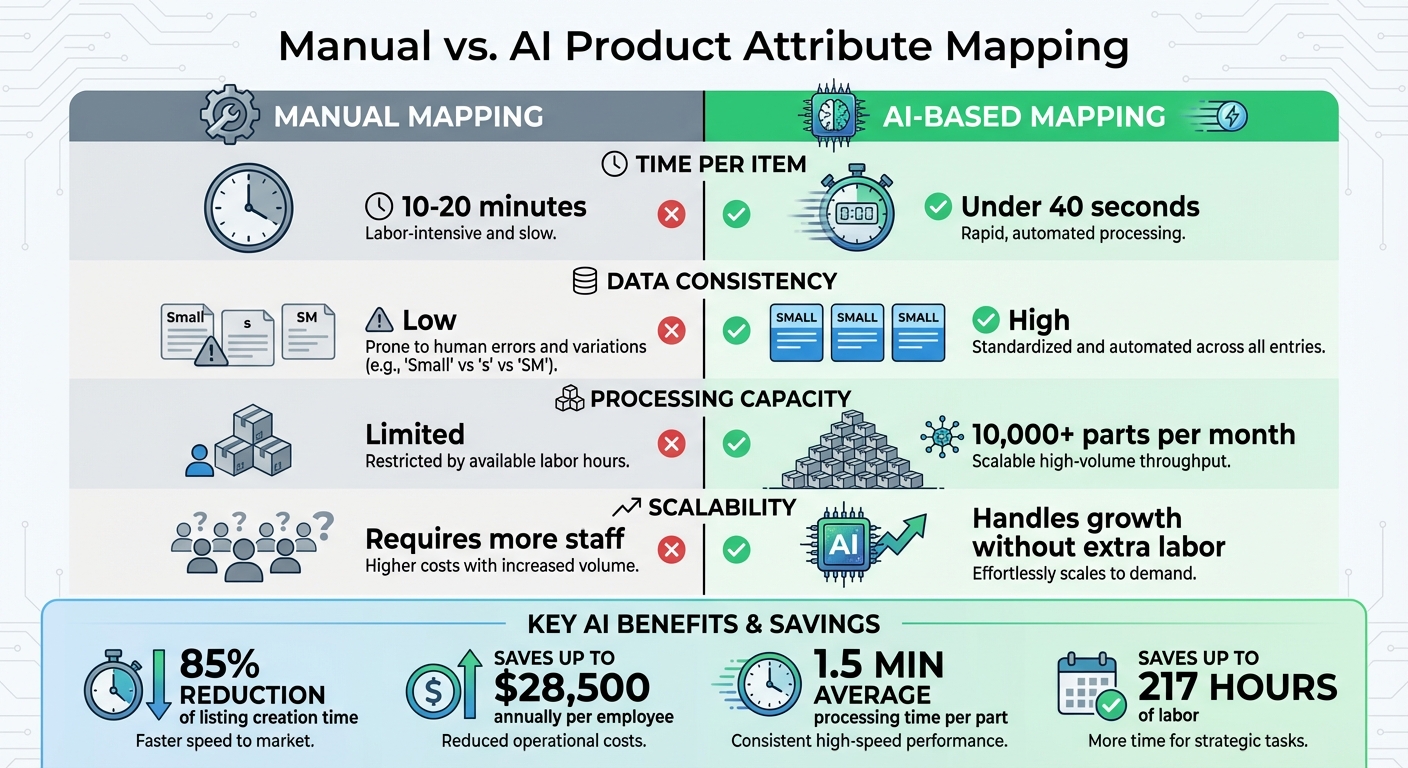
Looking at the detailed steps involved in AI attribute mapping alongside manual methods, it’s easy to see how AI offers operational advantages.
Time Savings and Accuracy Improvements
AI mapping processes each item in under 40 seconds, a huge leap compared to the 10–20 minutes manual methods typically take. This speed difference becomes even more noticeable when dealing with large inventories, where every second counts.
Accuracy is another area where AI stands out. Manual work often leads to inconsistencies - one person might enter “Small”, while another uses “s” or “SM” to represent the same size. AI, on the other hand, relies on standardized schemas and normalization techniques, ensuring uniformity across entries. This eliminates the subjective variations that are common in manual processes.
On top of speed and accuracy, AI mapping offers scalability that manual methods simply can’t match.
Handling Large Inventories at Scale
Manual mapping works fine for small batches, but as inventory sizes grow, it becomes less practical. A single employee can only process a limited number of items per day, and scaling up requires hiring more staff, which increases costs. AI systems, however, can normalize data at scale, automatically aligning mismatched fields and converting inconsistent values. For example, AI can recognize that “Material” and “Composition” refer to the same attribute.
Tools like AutomaSnap showcase this efficiency by processing large inventories at an average rate of 1.5 minutes per part. This allows businesses to save up to 217 hours of labor. The result? Companies can allocate their workforce to higher-priority tasks without adding headcount.
Comparison Table: Manual vs. AI Mapping
| Performance Metric | Manual | AI-Based |
|---|---|---|
| Time per Item | 10–20 minutes | Under 40 seconds |
| Data Consistency | Low; prone to variations | High; standardized and automated |
| Processing Capacity | Limited by labor hours | 10,000+ parts per month |
| Scalability | Requires more staff | Handles growth without extra labor |
Benefits of AI Mapping for Spare Parts and E-commerce
AI mapping is reshaping inventory management and e-commerce by streamlining processes and improving decision-making. From organizing inventory to creating faster listings and refining pricing strategies, AI-driven tools are helping businesses enhance their operations and connect with customers more effectively.
Better Inventory Organization
AI simplifies inventory management by turning unstructured data into a well-organized, searchable system. For example, when AI extracts details like Brand, MPN, and Serial Number from nameplate photos, it ensures every part is tagged with standardized information. This eliminates the inconsistencies that often come with manual data entry.
For warehouse teams, this means finding specific parts in seconds instead of minutes. Plus, ERP systems like SAP, Odoo, and Dynamics 365 can easily integrate this clean, structured data. The result? Faster searches, fewer fulfillment errors, and improved inventory turnover - directly boosting operational efficiency.
Faster Marketplace Listing Creation
Quickly listing items online is essential for moving inventory. In early 2026, an auto parts marketplace adopted an AI-powered listing generator that cut listing creation time from 20 minutes to just 3 minutes - a 65% time savings - and led to a 19% increase in click-through rates.
“AUTNEX’s AI listing generator has been a game-changer for our sellers. What used to take 20 minutes now takes 3 minutes - snap a photo, review, publish.” – David Park, VP of Product, Auto Parts Marketplace
AI-assisted listings also sell up to 20% faster than manually created ones. This is partly because the system automatically fills in 16 out of 18 item-specific fields, compared to just 8 fields typically completed manually. That level of automation ensures listings are not only quicker to create but also more complete and appealing to potential buyers.
Improved Pricing and Demand Insights
AI mapping doesn’t just speed up processes - it also helps businesses make smarter pricing decisions. Pricing spare parts without reliable market data can feel like guesswork. AI eliminates that uncertainty by analyzing recently sold comparable items and suggesting prices that balance profitability with faster sell-through rates. Tools like AutomaSnap even provide direct links to platforms like eBay and Automanet, making it easy to verify pricing and demand trends.
“The AI prices based on data, not intuition. Sellers consistently underprice or overprice; the AI splits the difference with data-backed pricing that optimizes for both margin and sell-through velocity.” – Sarah Jenkins, Marketplace Expert
Additionally, AI-generated titles that include high-volume keywords can boost impressions by 12–18%, helping spare parts get discovered more quickly and turning idle inventory into revenue.
Conclusion
Key Takeaways
AI-powered attribute mapping is changing the game for businesses managing inventory and creating marketplace listings. With AI tools, processing a single item takes just 40–90 seconds, compared to the 10–20 minutes it would take manually. This efficiency makes it possible to scale operations smoothly, no matter the inventory size. Plus, AI eliminates inconsistencies in data entry, cleaning up variations like “HP” versus “hp” or “Small” versus “s” into standardized, uniform records. The impact isn’t just operational - AI-generated listings boast a 19% higher click-through rate, directly boosting visibility and sales.
For businesses handling large inventories, AI removes the delays that leave valuable stock sitting idle in warehouses. It can even pull details from damaged nameplate photos and export ERP-ready spreadsheets, making integration seamless. This shift from manual processes to AI-driven solutions highlights the importance of efficiency when managing spare parts. These improvements offer a clear path to optimizing operations and driving growth.
Next Steps for Businesses
If you’re ready to leave manual mapping behind, consider adopting AI-based solutions. Try AutomaSnap’s free trial to simplify inventory intake and streamline marketplace listings. Pricing starts at around $0.55 per part for smaller batches and drops to $0.38 per part for orders exceeding 500 items.
The platform is user-friendly - no special hardware or complex setup needed. With just a smartphone camera and a web browser, shop-floor workers can capture nameplate photos, extract data, remove backgrounds, and create listings in under two minutes. For spare parts distributors, asset recovery teams, and eBay sellers managing high-volume inventory, switching to automated processing can cut costs and accelerate workflows. This isn’t just a time-saver - it’s a smarter way to handle inventory.
FAQs
How accurate is AI at reading damaged or dirty nameplates?
AI systems can reach an impressive 98.99% accuracy in recognizing obsolete parts, even when dealing with damaged or dirty nameplates. This high level of precision not only boosts efficiency but also ensures greater reliability compared to traditional manual approaches, making it an essential solution for tackling tough inventory challenges.
What photo quality is needed for reliable attribute extraction?
When capturing images of a nameplate for attribute extraction, clarity is key. AutomaSnap is designed to work seamlessly with regular phone photos, so there’s no need for professional-grade images. Instead, concentrate on ensuring the nameplate is legible and well-lit, even in challenging lighting situations. Clear and detailed photos enable the AI to accurately pull out crucial details such as the Brand, MPN, and Serial Number.
How does AI map extracted fields to my ERP’s required format?
AI leverages field mapping to match extracted data with your ERP’s specific format. AutomaSnap streamlines this process by taking images of nameplates, pulling out critical details like the brand, MPN (Manufacturer Part Number), and serial number, and arranging them into spreadsheets ready for ERP integration. Users have the option to review and adjust these fields, guaranteeing accuracy before the data is seamlessly imported. This approach minimizes manual errors while ensuring the data adheres to ERP requirements.
Try it yourself
Scan your first nameplate free — no card required
Open the scanner in your browser, photograph a label and watch Brand, MPN, Designation Code and Serial come back as an ERP-ready row. No install, no credit card.