On this page
Manually entering data from spare parts nameplates is slow, error-prone, and expensive. AI tools like AutomaSnap solve this by processing nameplate photos in seconds using Vision-Language Models (VLM). These models understand context, reducing errors and speeding up workflows. For example, Nestlé USA cut identification time by 50% in March 2026, while TUEG Schillings GmbH achieved similar results even with damaged labels.
Key Benefits:
- Faster Processing: AI reduces time per part from 10–20 minutes to 40 seconds–1.5 minutes.
- Higher Accuracy: Error rates drop significantly, even with corroded labels.
- Scalability: Handles thousands of parts monthly without extra labor.
- Lower Costs: Manual entry costs $28,500 per employee yearly; AI costs under $100 per 1,000 items.
AI tools also integrate with systems like SAP and Odoo, making them ideal for distributors aiming to save time and money while improving data quality. Want to see the difference? Try tools like AutomaSnap today.
Super.AI Customer Stories: Automating Nameplate Extraction with Bureau Veritas
1. AI Nameplate Recognition (e.g., AutomaSnap)
AI-powered nameplate recognition can transform a task that typically takes 10–20 minutes into a quick 40-second to 1.5-minute process per part. Tools like AutomaSnap use Vision-Language Models (VLM) to push past the limits of traditional OCR. These systems understand technical context, such as identifying “kW” as a power output instead of mistaking it for a serial number.
Accuracy
AI-driven computer vision tackles common industrial hurdles like metallic glare, dust, vibrations, and poor lighting conditions. These systems are designed to minimize transcription errors, even when dealing with corroded or damaged labels. This level of precision ensures data is captured correctly, and the resulting accuracy directly supports faster processing times.
Processing Time
Manual data entry is a time sink, but AI changes the game. Tasks that once required extensive effort can now be completed in under two minutes. By letting technicians confirm AI-extracted data in seconds rather than painstakingly entering each character, these tools speed up the onboarding of legacy equipment by as much as 80%.
Scalability
AI systems thrive in high-volume environments. They can process bulk data at speeds manual workflows can’t touch. For instance, AutomaSnap handles over 10,000 parts per month. This capability allows distributors to digitize entire production lines or large inventories in a single day. Plus, its mobile-first approach enables technicians to use standard smartphones for data capture right at the job site, eliminating the need for expensive, specialized hardware and cutting down on administrative tasks.
Cost
When it comes to pricing, AutomaSnap charges $0.55 per part for volumes under 500 and $0.38 per part for larger batches. Compare that to the $28,500 annual cost of manual data entry per employee, and the savings add up quickly. For example, Nexi Group reported saving 400 hours every month by automating their documentation processes. These cost efficiencies make AI solutions a practical choice for businesses looking to streamline operations.
2. Manual Data Entry
AI tools have made significant strides in reducing errors and speeding up processes, but many industries still rely on outdated manual methods. Entering nameplate information manually is a slow and resource-intensive task. Technicians often spend 15–30 minutes per asset trying to decipher worn or damaged labels and then inputting alphanumeric data into spreadsheets. When you add in the challenges of working with corroded plates in dusty or greasy factory settings, that time quickly becomes a major drain on productivity. These inefficiencies impact accuracy, speed, scalability, and overall costs.
Accuracy
Manually transcribing data in tough industrial environments comes with an error rate of 4–5%. Even a single mistake, like misreading a character in a model number, can create significant problems. As Alexandra Vazquez, Content Marketing Manager at Limble, explains:
“One typo in a model number can lead to a technician ordering the wrong replacement motor during a breakdown. When the foundation of your maintenance asset data is flawed, trust in the system falls apart.”
These errors aren’t just inconvenient - they’re expensive. Correcting a single data entry mistake can cost between $50 and $200, factoring in labor, shipping, and potential damage to customer relationships. On a larger scale, bad data costs businesses about $15 million annually.
Processing Time
Manual data entry takes 10–30 minutes per part, depending on how legible the nameplate is. Technicians have to locate the plate, interpret the information, and manually input it into the system. This process severely slows down digitization efforts. For example, in January 2026, an industrial plant replaced its two-person transcription teams with a single technician equipped with AI scanning tools. The result? A 70% reduction in the time needed to digitize legacy equipment.
Scalability
Manual data entry doesn’t scale well. Each part takes 10–30 minutes, meaning that as inventory grows, so does the required time and workforce. Technicians spend over 9 hours per week transferring data, creating a bottleneck that worsens as the workload increases. This repetitive, time-consuming task contributes to burnout, with 56% of employees reporting exhaustion from such activities. High turnover rates and training new hires only add to the costs.
Cost
The financial impact of manual data entry is staggering. On average, it costs U.S. companies $28,500 per employee annually. With labor rates around $24/hour (converted from €25/hour), the time spent on manual entry quickly adds up. Beyond labor costs, the inefficiencies caused by manual processes lead to errors, delays, and missed opportunities for 50.4% of professionals. On a broader scale, bad data costs organizations an estimated $12.9 million annually.
Pros and Cons
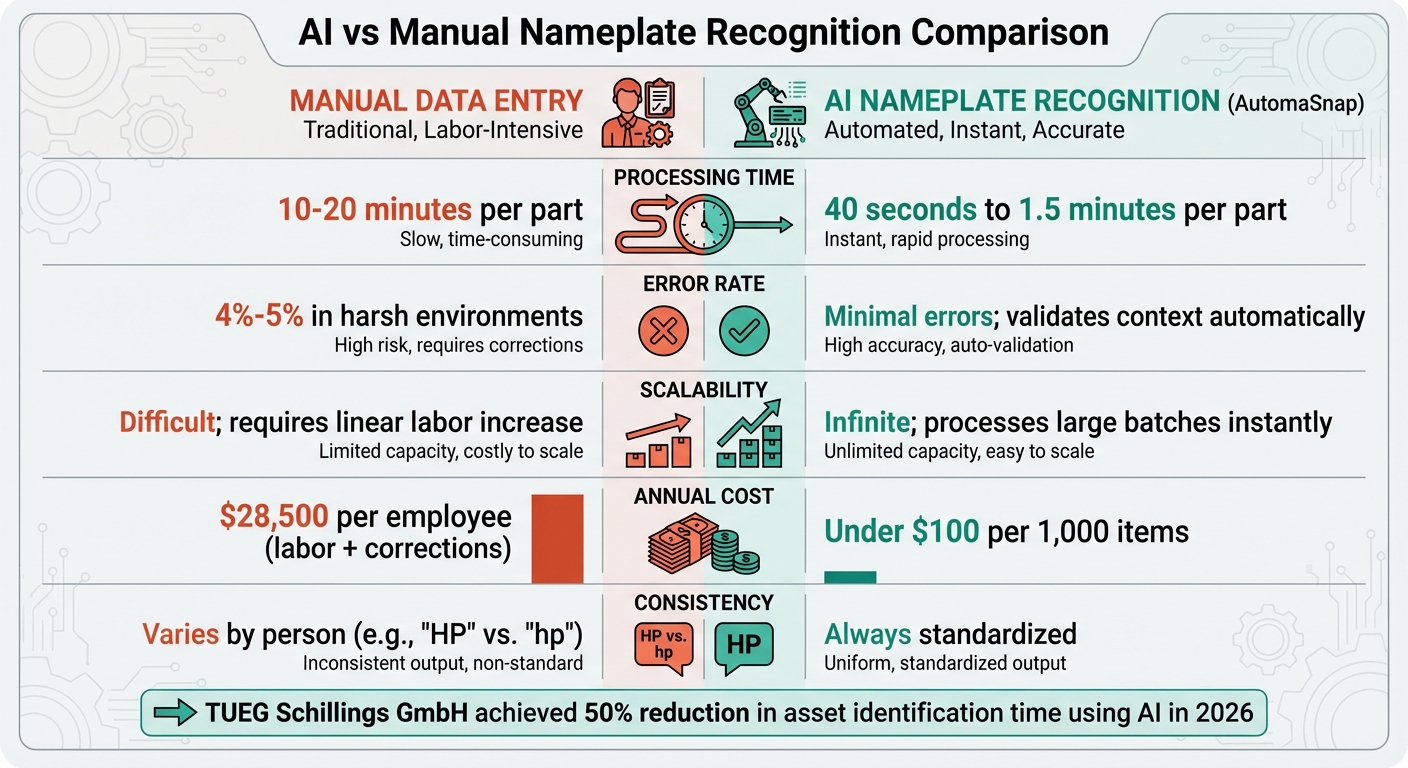
When spare parts distributors weigh their options, the contrast between AI nameplate recognition and manual data entry becomes striking. Here’s a quick breakdown of how these methods stack up across critical metrics like accuracy, speed, scalability, and cost:
| Factor | Manual Data Entry | AI Nameplate Recognition (e.g., AutomaSnap) |
|---|---|---|
| Processing Time | 10–20 minutes per part | 40 seconds to 1.5 minutes per part |
| Error Rate | 4%–5% in harsh environments | Minimal; AI validates context (e.g., “Model No.” vs. “Serial ID”) |
| Scalability | Difficult; requires linear labor increase | Infinite; processes large batches instantly |
| Annual Cost per Employee | $28,500 (labor + corrections) | Under $100 per 1,000 items |
| Consistency | Varies by person (e.g., “HP” vs. “hp”) | Always standardized |
Breaking It Down
AI systems like AutomaSnap transform the role of technicians from manual data entry to quality control. Instead of painstakingly typing out every detail from a worn or corroded nameplate, technicians can validate pre-extracted fields in just seconds. This shift not only saves time but also reduces mental fatigue.
A great example of AI’s impact comes from TUEG Schillings GmbH, which adopted AutomaSnap in 2026. Their results? A 50% reduction in the time needed for asset identification, even in tough, corrosive environments.
The financial benefits are just as compelling. Manual data entry costs U.S. companies an average of $28,500 per employee each year when you include labor and error correction. By comparison, AI systems can handle the same workload for under $100 per 1,000 items. That’s a massive cost cut, allowing businesses to reallocate resources to more strategic activities.
Pro Tip: Before scanning, take a moment to clean nameplates with a rag. This small step can significantly improve AI extraction accuracy, especially for labels that are dirty or scratched. It’s a simple way to get reliable results on the first try.
Conclusion
AI-driven nameplate recognition is reshaping how inventory intake is managed. Manual data entry is not only time-consuming but also expensive. On the other hand, AI systems like AutomaSnap significantly reduce costs while boosting both accuracy and processing speed.
One of the standout advantages of AI is its ability to bridge the “analog gap” that often leads to inefficiencies and errors in digital workflows. Modern Vision-Language Models can extract structured data in under two minutes - far quicker than the 15–30 minutes typically needed for manual transcription. These systems also excel at understanding context, such as distinguishing between power ratings and serial numbers.
However, AI doesn’t eliminate the need for human involvement. The best results come from a hybrid approach: AI handles 99% of the work, while a technician steps in as a visual auditor to verify results in just seconds. This combination ensures a seamless and reliable data verification process.
For distributors dealing with worn or damaged nameplates, AI-powered tools offer a scalable solution. Whether you’re processing 50 parts or 5,000, AutomaSnap delivers consistent accuracy without the need for additional staff. This efficiency not only reduces costs but also helps businesses stay competitive. Interested? Try AutomaSnap with a free trial and see the difference for yourself.
FAQs
What photo quality do I need for accurate nameplate scans?
For accurate nameplate scans, make sure to use high-quality photos that are clear, well-lit, and sharply focused. This helps the AI extract details like the brand, MPN, and serial number effectively, even when conditions aren’t perfect.
How does AutomaSnap handle damaged or corroded nameplates?
AutomaSnap excels at pulling data from damaged or corroded nameplates, even when the images are in rough shape. This makes it easier to identify parts accurately and minimizes mistakes, especially when working with outdated or worn components.
How does AutomaSnap fit into my ERP workflow (e.g., SAP or Odoo)?
AutomaSnap works seamlessly with ERP systems such as SAP and Odoo. It extracts essential data from nameplate photos and converts it into ERP-compatible rows. These rows can be imported directly, simplifying inventory updates while cutting down on manual data entry mistakes.