On this page
AI-Powered Inventory Planning for MRO Spares
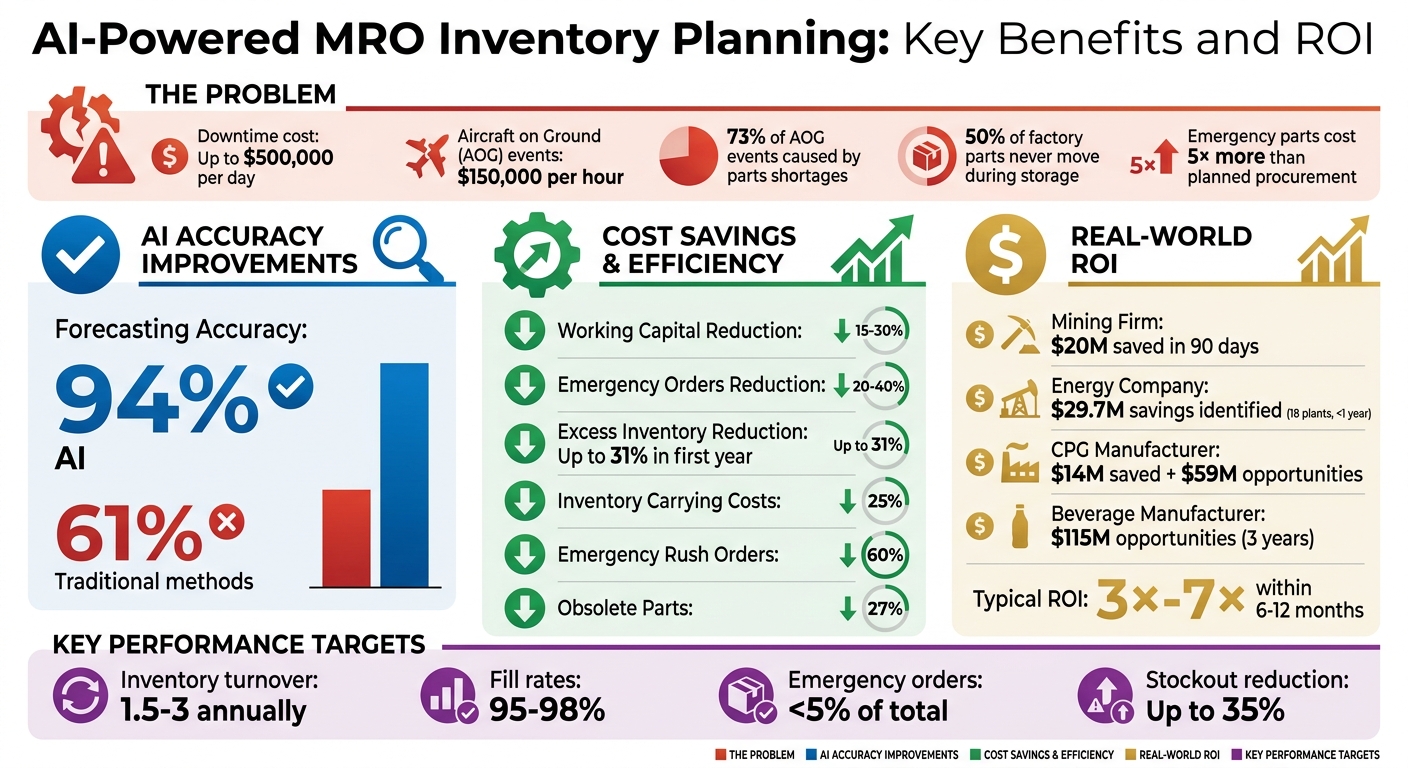
Here’s the problem: MRO (Maintenance, Repair, and Operations) spares have unpredictable demand. Parts may sit unused for years but become critical during sudden equipment failures. This unpredictability leads to costly downtime - up to $500,000 per day in some industries - and excessive inventory, tying up millions in capital.
How AI helps:
- Better forecasting: AI analyzes equipment usage, failure patterns, and lead times to predict demand with up to 94% accuracy, compared to traditional methods at 61%.
- Optimized stock levels: AI calculates safety stock dynamically, reducing excess inventory by 15-30% and cutting emergency orders by 20-40%.
- Preventive planning: By integrating with predictive maintenance systems, AI ensures parts are ordered before failures occur.
Real-world results:
- A mining firm saved $20 million in 90 days by using AI to unify inventory data.
- An energy company identified $29.7 million in savings across 18 plants in under a year.
To implement AI, start by cleaning and centralizing your data, then integrate AI tools with your existing ERP and CMMS systems. Training your team and monitoring KPIs like stockout rates and inventory turnover will ensure long-term success.
AI transforms MRO inventory planning from reactive to proactive, saving time, money, and resources.
MRO360 - AI Native Spare Parts Management
AI Techniques for Inventory Planning
AI has reshaped MRO inventory management by tackling three major challenges: demand forecasting, safety stock optimization, and integrating predictive maintenance. These techniques address the gaps in traditional planning methods, offering a smarter way to manage inventory.
AI-Based Demand Forecasting
Conventional forecasting often relies on simple moving averages applied broadly across all parts. AI, however, takes a more granular approach, forecasting demand at the individual part level. It factors in details like asset utilization rates, equipment age, and Mean Time Between Failures (MTBF). This precision leads to impressive results - machine learning models achieve a 94% forecast accuracy, compared to just 61% with traditional methods, and can reduce excess inventory by up to 31% within a year.
AI is particularly effective in managing intermittent demand patterns. As Jason Afara, Director at Fiix, explains:
“Most spare parts follow intermittent or lumpy demand patterns. A sensor might not be used for months and then suddenly three fail in a month”.
For such irregularities, specialized algorithms like Croston’s method and the Syntetos-Boylan Approximation (SBA) are used. These algorithms separate demand size from intervals, allowing AI to integrate factors like asset utilization, maintenance schedules, and lead-time variability. This ensures stock is pre-positioned well ahead of scheduled maintenance events.
This level of precision naturally feeds into more effective safety stock calculations, paving the way for dynamic inventory control.
Calculating Safety Stock and Reorder Points
AI replaces outdated, fixed ERP thresholds with dynamic models that simulate countless supply and demand scenarios. Using probabilistic techniques like bootstrapping and Poisson distributions, AI evaluates thousands of “what-if” situations - ranging from supplier delays to sudden production surges - to determine optimal safety stock and reorder points. These models also offer confidence levels for predictions, helping planners make informed decisions before committing capital.
By analyzing historical supplier performance instead of relying on static ERP lead times, AI predicts actual delivery times and adjusts reorder points to prevent stockouts. Additionally, semantic matching techniques can consolidate duplicate SKUs across multiple sites. The result? A 15-30% reduction in working capital and 20-40% fewer emergency purchases - critical when emergency parts sourcing costs nearly five times more than planned procurement.
When these optimized stock levels are combined with predictive maintenance data, inventory planning becomes even more efficient.
Predictive Maintenance and Spare Parts Planning
Predictive maintenance (PdM) systems use sensors to monitor equipment health, tracking factors like vibration, temperature, and pressure. When this data is integrated into inventory planning, the focus shifts from maintaining stock to predicting exactly when a part will be needed. AI links sensor data with production schedules and CMMS workflows, enabling it to trigger procurement well before maintenance is required.
This proactive approach significantly reduces downtime. For example, 73% of Aircraft on Ground (AOG) events are caused by parts shortages that could have been anticipated, with each AOG event costing up to $150,000 per hour. By flagging parts for procurement weeks in advance, AI-driven planning minimizes emergency orders and lowers inventory carrying costs. As Martin Weber, CEO of SPARETECH, puts it:
“Factories buy spare parts inventory because they think they need it, and then they never need it. It’s common that 50% of the parts at any factory never move”.
These techniques can result in a 60% reduction in emergency rush orders and a 25% drop in inventory carrying costs.
Data Accuracy and Quality for AI Systems
AI-driven inventory planning hinges on having clean, structured data to work with. Unfortunately, many MRO operations deal with messy and inconsistent data - think handwritten labels, unclear photos, or information buried in PDFs. Without standardized data, even the most advanced AI models can churn out unreliable forecasts. This challenge has spurred the development of tools for automated data extraction and seamless system integration.
Extracting Inventory Data from Physical Assets
One of the toughest challenges is gathering accurate information from physical parts. Manual data entry is prone to errors, especially when technicians are tasked with recording thousands of parts across multiple sites. As Martin Weber, CEO of SPARETECH, explains:
“The biggest issue is human error. The human needs to key in every part themselves without making mistakes. At that scale, it makes sense that there are errors”.
To tackle this, AI-powered extraction tools come into play. These tools automatically pull critical details - like Brand, Manufacturer Part Number (MPN), and Serial Number - straight from photos of nameplates. A great example is AutomaSnap, which uses AI to extract such data even when labels are dirty or scratched. The tool generates ERP-ready spreadsheets, cutting out manual transcription errors and ensuring the records are complete and accurate.
But data extraction alone isn’t enough. AI also needs semantic understanding to make sense of inconsistencies. For instance, it must recognize that “HP”, “hp”, and “horsepower” mean the same thing, or that “TI GRADE 5” and “Titanium” refer to identical materials. Without this capability, duplicate records can inflate inventory by up to 15%, throwing off demand forecasts and safety stock calculations. Once standardized, this clean data must integrate smoothly with existing systems.
Connecting AI Tools with ERP and CMMS Systems
After data is accurately extracted, the next step is integrating it with ERP and CMMS systems. AI platforms work best as a decision-making layer that operates above these systems, pulling in data from multiple sources without requiring a complete overhaul. This layered approach creates a unified data environment - a single source of truth that synchronizes inventory records across different sites.
The benefits are striking. For example, a Fortune 500 energy producer used AI to unify inventory across 18 plants, reviewing 45,000 materials in under a year and uncovering $29.7 million in verified savings opportunities. Similarly, a global CPG manufacturer connected fragmented ERP systems through an AI platform, saving $14 million and identifying $59 million in total optimization opportunities. These kinds of results are only possible when high-quality, consistent data flows seamlessly between systems. Without it, AI struggles to identify duplicate SKUs or optimize reorder points. This smooth data integration is what enables more accurate demand forecasts and better inventory management overall.
How to Implement AI-Powered Inventory Planning
Evaluating Your Current Inventory Processes
To tackle inefficiencies, start by auditing your current inventory management practices. This means reviewing your MRO (Maintenance, Repair, and Operations) data sources, which are often scattered across ERPs, maintenance logs, and spreadsheets. Look for outdated static min/max levels, inventory levels that keep climbing despite reduction goals, and frequent emergency purchases.
Next, assess the quality of your data. Check for outdated thresholds, duplicate entries, and reliance on informal, undocumented knowledge. Here’s a striking fact: around 50% of parts in a typical factory remain unused during their time in storage. While perfect data is ideal, you can start with what you have - AI platforms are designed to handle less-than-perfect inputs efficiently.
Once you’ve identified the gaps and inefficiencies, you’re ready to integrate AI tools that complement your current systems.
Selecting and Deploying AI Tools
Opt for AI tools that enhance your existing systems rather than replacing them. The best platforms integrate seamlessly with systems like SAP, Oracle, or Maximo, creating a unified model without requiring a complete system overhaul. For example, tools like AutomaSnap simplify inventory intake by extracting key details from nameplate photos and generating ERP-ready spreadsheets. This reduces data entry time for each part from 5-15 minutes to less than a second.
A phased 90-day deployment roadmap can streamline the process:
- Days 1-30: Connect your data sources and identify areas of overstock.
- Days 31-60: Implement changes, such as adjusting stock levels and redistributing surplus inventory.
- Days 61-90: Scale the program across your organization.
For instance, a global mining company that followed this approach reduced working capital by 10% to 20%, avoiding approximately $20 million in costs within the onboarding period.
Training Staff and Monitoring Performance
Deploying tools is just the beginning - success hinges on engaging teams across maintenance, procurement, and finance from the start. This collaboration ensures the AI-driven improvements are sustainable. Train your staff on essential data practices, like standardizing naming conventions and tagging assets based on type and priority, so the AI receives clean, accurate inputs.
Track key performance indicators such as forecast accuracy, stockout occurrences, and approval times (aim for around 4 minutes) to measure progress. For example, a Fortune 500 energy company reviewed 45,000 materials and uncovered $29.7 million in verified savings opportunities within a year by maintaining a disciplined, data-driven approach.
Measuring Success: KPIs and ROI
Building on the earlier use of AI-driven analytics, measurable KPIs now highlight the financial and operational benefits of these advancements.
Inventory Turnover and Stockout Rates
Two key metrics - inventory turnover and stockout rates - help assess how well AI is performing in managing MRO (Maintenance, Repair, and Operations) spares. Ideally, inventory turnover should range between 1.5 and 3 annually, while fill rates (the percentage of requests fulfilled from stock) should stay between 95% and 98%. For critical parts, the target is zero stockouts.
Take this example: a large manufacturing plant using AI for MRO optimization reduced stockouts by 35%, lowered working capital by $3.2 million, and improved maintenance response times by 22%. Similarly, an automotive facility cut obsolete parts by 27% and trimmed spare parts spending by 22%. Facilities leveraging real-time AI demand sensing have reported 20-40% fewer emergency purchases. The best-performing operations keep emergency orders below 5% of total orders, saving on costly rush shipping and avoiding 2-12 hours of production downtime with each averted emergency.
These metrics provide clear evidence of cost savings and operational improvements.
Cost Savings and Efficiency Gains
Organizations implementing AI-powered MRO optimization typically see a return on investment (ROI) of 3x-7x within 6-12 months. AI systems help reduce working capital by 15%-30% and lower inventory carrying costs, which usually account for 18%-25% of inventory value, leading to substantial savings.
For instance, a top-five beverage manufacturer identified over $115 million in optimization opportunities over three years by consolidating material data and eliminating duplicates across six global regions. Similarly, a Fortune 500 consumer packaged goods company saved $14 million and uncovered a $59 million working capital optimization opportunity by identifying 672 at-risk materials.
Efficiency gains are also tangible. Tools like AutomaSnap slash data entry time from 5-15 minutes to under a second, freeing up staff to focus on strategic tasks instead of manual data entry. High-performing facilities also monitor MRO inventory as a percentage of Replacement Asset Value (RAV), often aiming for less than 1.5%.
These results highlight how AI-driven systems can deliver measurable financial and operational benefits.
Conclusion
AI-powered inventory planning is transforming how companies manage MRO spares, shifting the focus from reactive problem-solving to proactive strategies. Businesses adopting these systems report tangible benefits, including 10-20% reductions in working capital, achieving significant ROI within the first year, and avoiding the costs of emergency procurement.
Modern AI platforms streamline the process by automatically cleaning and unifying fragmented data from multiple systems. This not only improves forecast accuracy but also eliminates the need for time-consuming manual data cleanup.
To start making these changes, focus on high-priority components where stockouts could have the greatest financial consequences. For example, an Aircraft on Ground (AOG) event can cost up to $150,000 per hour. Additionally, identifying opportunities for cross-site transfers can help reduce unnecessary purchases.
Tools like AutomaSnap simplify inventory planning by automating nameplate data extraction and producing ERP-ready spreadsheets complete with photo documentation.
FAQs
What data do I need to start AI forecasting for MRO spares?
To start using AI for forecasting MRO spares, you’ll need a few key inputs: historical usage data, equipment failure trends, maintenance records, supplier lead times, and operational schedules. These elements allow predictive models to analyze patterns and accurately estimate future demand.
How does AI set safety stock for lumpy spare-parts demand?
AI leverages predictive analytics, historical trends, and probabilistic forecasting to manage safety stock levels for spare parts with irregular demand. Unlike traditional static methods, AI continuously adapts inventory strategies by examining patterns, lead times, and potential failure risks. This dynamic approach helps strike a balance - it reduces the chances of running out of critical parts while avoiding overstock, keeping costs in check.
What sets AI apart is its ability to consider a wide range of variables. It evaluates supplier reliability, maintenance schedules, and even cross-site inventory availability to ensure essential parts are always on hand. This not only boosts reliability but also optimizes inventory management across the board.
How do I integrate AI inventory planning with my ERP and CMMS?
Integrating AI-driven inventory planning with your ERP and CMMS systems can streamline how you handle your MRO data. AI tools, such as AutomaSnap, simplify the process by cleaning, standardizing, and organizing your data. For example, these tools can extract structured details from nameplate photos, automate tasks like background removal, and generate ERP-ready spreadsheets effortlessly.
By leveraging these technologies, you can improve data accuracy, minimize manual errors, and ensure seamless synchronization across systems. This not only supports better decision-making but also enhances predictive maintenance and optimizes stocking policies, making your operations more efficient.