On this page
AI-Powered Inventory: Key to Sustainable Supply Chains
The future of inventory management is here - AI-powered tools are transforming supply chains by cutting waste, reducing costs, and improving efficiency. Here’s what you need to know:
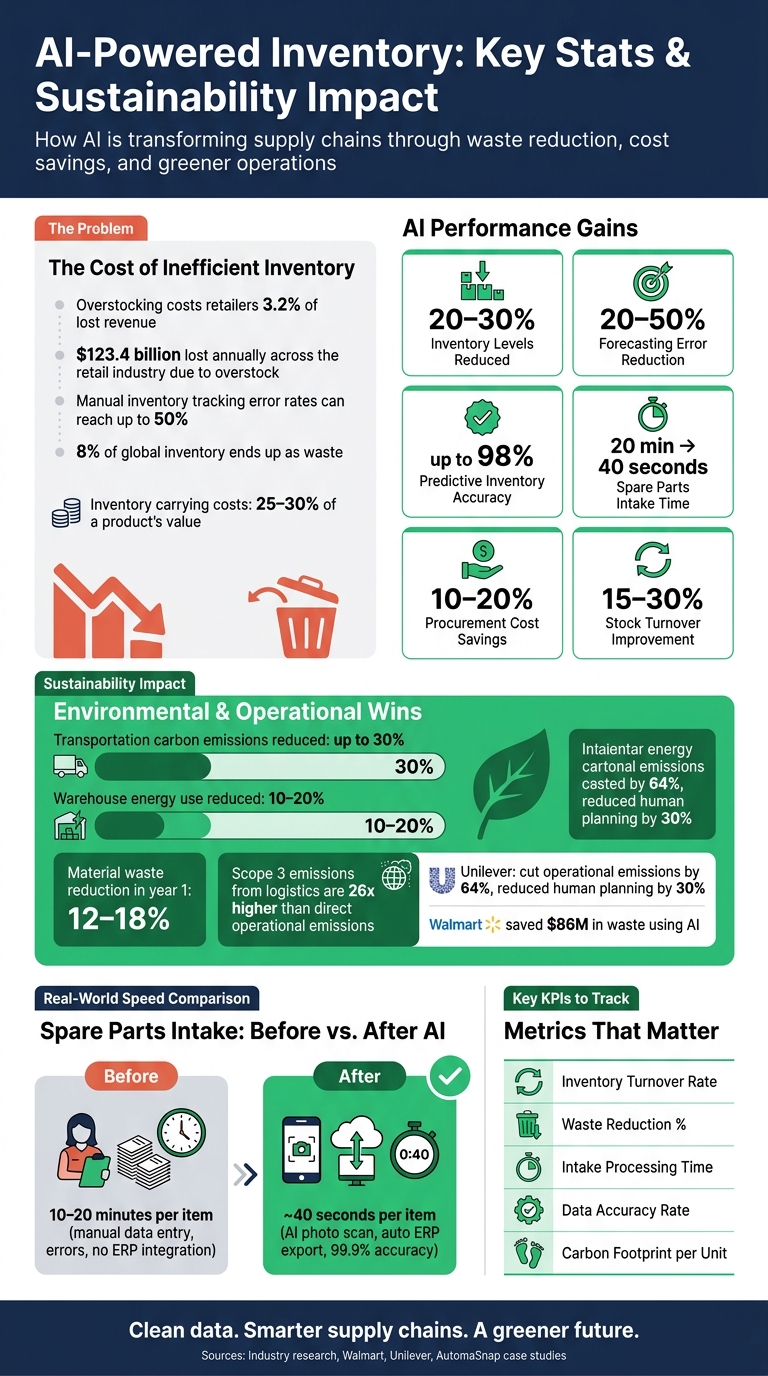
- AI reduces waste: Forecasting tools can lower inventory levels by 20–30% and logistics costs by 5–20%.
- Big savings: Walmart’s AI system saved $86M in waste, while Unilever cut operational emissions by 64%.
- Better accuracy: AI tools improve inventory precision, cutting errors and overstock costs by millions annually.
- Faster processes: Tasks like speeding up inventory intake for spare parts drop from 20 minutes to 40 seconds using AI tools like AutomaSnap.
- Lower carbon emissions: AI-driven route optimization reduces transportation emissions by up to 30%.
AI isn’t just about efficiency - it helps businesses tackle waste, emissions, and costs head-on. By adopting AI-powered inventory systems, companies can modernize operations, save money, and support greener supply chains.
What Is AI-Powered Inventory?
Defining AI-Powered Inventory
AI-powered inventory management uses technologies like machine learning (ML), computer vision (CV), and natural language processing (NLP) to automate and improve how inventory is tracked, processed, and managed. Instead of relying on manual stock counts or outdated spreadsheets, these systems continuously monitor stock levels and generate structured data in real time.
“Traditional inventory management is like driving while looking only in the rearview mirror: you react to problems after they’ve already cost you money.” - Krzysztof Choma, CEO, Nomtek
This approach shifts inventory management from being reactive to proactive. For instance, overstocking costs the average retailer about 3.2% of lost revenue, translating to a staggering $123.4 billion annually across the industry. By identifying potential issues early, AI reduces waste and prevents lost sales, offering a smarter way to manage inventory. These proactive capabilities lay the groundwork for the features discussed below.
Key Features of AI-Powered Inventory Tools
AI inventory tools stand out for their ability to simplify and improve operations. They automatically extract structured data - like brand names, part numbers, and serial numbers - from physical labels or nameplate photos. This eliminates the need for manual data entry and integrates seamlessly with ERP systems such as SAP, Odoo, or Microsoft Dynamics 365. By automating these tasks, businesses not only save time but also reduce waste, promoting more efficient supply chains.
In addition to data capture, these tools enable real-time demand sensing and pricing verification, helping teams make better purchasing decisions on the spot. For example, AutomaSnap can extract details like brand, MPN, and serial numbers from photos taken on a smartphone, then produce ERP-ready spreadsheets without requiring extra tools or changes to existing processes. This is particularly helpful in areas like spare parts management and asset recovery, where manual errors can be both frequent and expensive.
The impact is clear. AI-driven demand forecasting models can cut forecasting errors by 20% to 50%, and predictive inventory models have achieved accuracy rates as high as 98%. For businesses dealing with large numbers of SKUs or unpredictable stock levels, this level of precision is not just helpful - it is a game-changer.
How Accurate Inventory Management Supports Sustainability
Knowing exactly what you have - and where it is located - is one of the smartest ways to create a greener supply chain. Accurate inventory management is not just about keeping operations smooth; it directly impacts waste levels, transportation efficiency, and how effectively warehouse space is used. Tools like AutomaSnap, powered by AI, simplify inventory tracking, making precision an achievable goal for businesses.
Preventing Overstock and Dead Stock
Overordering does not just clutter shelves; it ties up funds, wastes space, and often leads to discarded products. With inventory carrying costs reaching 25%-30% of a product’s value, overstock becomes expensive long before it turns into waste.
AI changes the game by replacing outdated reorder formulas with smarter, dynamic systems that adjust based on real-time supplier performance and demand trends. Businesses using AI have reported inventory reductions of 20% to 30%, cutting down on unnecessary production and waste from the start.
This precision not only reduces waste but also minimizes emissions and optimizes how resources are used.
Cutting Carbon Emissions in Logistics
Poor inventory tracking often leads to unexpected stockouts, forcing businesses into quick fixes like emergency air freight - one of the most carbon-heavy logistics options. With Scope 3 emissions from suppliers and logistics being 26 times higher than direct operational emissions, better planning can have a huge environmental impact.
Accurate inventory data allows companies to plan ahead, consolidate shipments, and select transportation methods with lower emissions. By combining real-time forecasting with sales trends, businesses can optimize sourcing and shipping strategies. AI-driven route optimization alone can reduce transportation-related carbon emissions by up to 30%, thanks to shorter routes, fewer empty miles, and smarter load consolidation.
“AI-driven route optimization has been shown to reduce transportation-related carbon emissions by up to 30 percent through shorter routes, consolidated loads, fewer empty miles, and better mode selection.” - Phil Cornier
Making Better Use of Storage and Materials
Accurate inventory records also lead to smarter use of space and materials. When data is unreliable, companies often overstock “just in case,” lease extra warehouse space, or reorder items they already have. AI systems streamline this process, cutting warehouse energy use by 10% to 20% by optimizing item placement and reducing equipment travel distances.
Real-time visibility across locations takes it further. Businesses can shift stock between sites to avoid overordering, keeping existing resources in circulation. Boosting inventory accuracy from 65% to 93% has even been shown to increase sales by about 9% by preventing stockouts. In the end, better data does not just reduce waste - it also helps capture revenue that might otherwise slip away. These improvements highlight how AI-powered tools turn accurate inventory into real-world sustainability benefits.
How AI Improves the Spare Parts Intake Process
Handling spare parts manually can take anywhere from 10 to 20 minutes per item. But with AI, that time shrinks to just about 40 seconds. This shift turns what used to be a frustrating bottleneck into a smooth, routine task. The process relies on three main steps: automatic data extraction, preparing data for ERP systems, and quick market validation.
Extracting Inventory Data Automatically
AI tools like AutomaSnap use a combination of Optical Character Recognition (OCR) and computer vision, specifically trained to read industrial nameplates. These systems extract key details like Brand, MPN, Serial Number, and technical specifications, organizing them into a structured format.
Here is how it works: snap a photo of the nameplate with your smartphone browser, let the AI process the image to extract and enhance the data, and then export the results. No special hardware or software is required. Even if the labels are damaged - a common issue when entering data manually - the AI is designed to handle these real-world challenges.
Preparing Data for ERP Systems
Once the data is extracted, the next step is formatting it for ERP systems. AutomaSnap creates ERP-ready files (CSV or XLSX) with all fields neatly organized into columns. These files can be imported directly into platforms like SAP, Odoo, or Dynamics 365. Additionally, each record includes a photo proof link, providing a direct URL to the original nameplate image. This feature simplifies auditing and ensures quality control without requiring extra steps.
The setup process is simple: map your columns between AutomaSnap and your ERP system once, and every subsequent batch will follow that same structure seamlessly.
Verifying Pricing and Market Demand
Understanding a part’s market value is essential. Without quick access to pricing and demand data, teams often hesitate to list items, slowing down turnover and tying up working capital.
“Crucially, without fast, accurate visibility into a product’s market value, teams hesitated to invest time in photographing and listing items. Slow onboarding directly reduced turnover and tied up working capital.” - Gal-Industry Case Study
To solve this, AutomaSnap includes a Quick Market Check feature. With one click, it retrieves price ranges for different conditions (New, Refurbished, Used) by querying sources like eBay and Automa.Net using the extracted MPN. This instant feedback gives warehouse teams a clear go/no-go decision during intake, saving time and resources. By focusing on sold prices - not just asking prices - the tool ensures a realistic view of demand and helps set competitive pricing.
Business and Supply Chain Benefits of AI-Powered Inventory
AI-powered inventory systems take efficiency to another level by reducing errors, cutting unnecessary costs, and improving stock turnover. These advancements build on streamlined processes, offering businesses a chance to operate smarter and more effectively.
Fewer Manual Errors and Less Rework
Did you know that manual inventory tracking can have error rates as high as 50% in some cases? Automating processes like data entry drastically reduces the time and effort spent investigating these mistakes. Tools such as AutomaSnap are game-changers, extracting data from nameplate photos with up to 99.9% accuracy. This level of precision not only prevents reconciliation headaches but also slashes the need for rework.
With fewer errors, procurement teams can make better-informed decisions, ensuring that purchasing aligns with actual needs.
Avoiding Unnecessary Purchases
When inventory data is incomplete or inaccurate, procurement teams often order extra parts “just in case.” This leads to surplus stock, driving up costs and creating waste. AI-driven inventory systems fix this by providing real-time, reliable data. With a clear picture of stock levels, businesses can avoid over-ordering, leading to procurement cost savings of 10-20%.
This level of accuracy does not just save money - it also supports smoother operations and better inventory management.
Better Stock Turnover and Efficiency
Accurate inventory data does not just prevent waste; it also speeds up product movement. Businesses that use AI inventory systems report improvements in turnover rates of 15-30%. For spare parts distributors and asset recovery operations, this means less capital tied up in idle stock and a healthier cash flow.
Faster turnover strengthens cash flow and supports a leaner, more agile supply chain, helping businesses stay competitive while reducing inefficiencies.
What You Need to Implement AI-Powered Inventory
Setting up an AI-powered inventory system does not have to be complicated. With a few focused steps, you can ensure tools like AutomaSnap deliver the performance you need.
Taking Clear Nameplate Photos
The quality of your input directly impacts the accuracy of your system. AI tools designed to extract information from equipment nameplates - such as Brand, MPN, or Serial Number - depend on clear, well-lit images. Blurry or angled photos can disrupt the process and lead to errors in data extraction.
A standard smartphone camera works perfectly fine as long as the image is straight-on, well-lit, and close enough to capture the details. Systems like AutomaSnap are built to handle less-than-perfect conditions, such as scratched or dirty labels, but maintaining consistency in how photos are taken is critical. Train your team to follow a standardized process for capturing images to avoid unnecessary delays.
Checking ERP and System Compatibility
Before rolling out an AI inventory tool, verify its compatibility with your existing ERP systems. Automating data extraction is only useful if the data integrates seamlessly with your current platforms.
Choose a solution that can generate ERP-ready spreadsheets tailored to systems you already use. For instance, AutomaSnap supports formats for SAP, Odoo, Microsoft Dynamics 365, and BaseLinker. If your ERP is not on the list, check for support for custom export formats or CSV file imports to ensure smooth integration.
Training Staff and Aligning Workflows
Even the best technology is only as effective as the people using it. Before introducing AI tools, review your current inventory processes to identify areas where automation can make the biggest impact. This review also helps clarify which tasks should remain manual, which can be AI-assisted, and which can be fully automated.
Make sure your team’s goals prioritize accuracy and efficiency over sheer speed. A well-structured onboarding session can go a long way in helping staff adapt to new workflows and ensure the system is used correctly from day one.
Measuring the Impact of AI-Powered Inventory
After implementing your AI-driven inventory system, it is essential to track specific metrics. These metrics help confirm the system’s effectiveness and guide decisions based on data.
Key Metrics to Monitor
To evaluate the performance of AI-powered inventory management, focus on metrics that emphasize accuracy, efficiency, and waste reduction. Here’s a breakdown of key performance indicators (KPIs) to watch:
| KPI | What It Measures | Why It Matters |
|---|---|---|
| Inventory Turnover Rate | How quickly stock is sold and replaced | A higher turnover indicates lower carrying costs and reduced risk of obsolete inventory |
| Waste Reduction % | Decrease in scrap or unsellable stock | Directly lowers costs and minimizes landfill contributions |
| Intake Processing Time | Time spent logging items into the system | Faster processing boosts throughput without adding staff |
| Data Accuracy Rate | Percentage of error-free records | Reduces rework and ensures smoother downstream operations |
| Carbon Footprint per Unit | CO2e emissions per product unit across its lifecycle | Aligns with ESG goals and enhances brand accountability |
For businesses managing spare parts with tools like AutomaSnap, intake processing time and data accuracy rate are particularly relevant. These metrics provide immediate feedback on how well the system improves intake speed and reduces entry errors. Over time, they also set the stage for broader operational improvements.
Long-Term Gains from Consistent Use
While some benefits are immediate, the real value of AI inventory systems grows over time. Companies that adopt AI for inventory management often see a 12-18% reduction in material waste within the first year. Ongoing use reinforces these gains, driving further reductions in waste and increased efficiency.
Jackie Wu, CEO of Corvus Robotics, emphasizes the importance of clean and reliable data:
“If shipping times get worse, tariffs go higher, demand softens or whipsaws, and the margin for error shrinks fast. The one thing you can control is how clean, current and accurate your internal data is, starting with inventory.”
Conclusion: Building Better Supply Chains with AI-Powered Inventory
Clean, accurate data is the backbone of efficient supply chains. By eliminating manual errors, avoiding overstock, and feeding precise information into ERP systems, businesses can prevent waste from piling up at every stage of their operations.
Looking ahead to 2027, it is predicted that 80% of sustainability efforts will shift focus to operational discipline rather than back-office metrics. Accurate inventory data plays a key role in turning environmental goals into actionable steps. With AI-powered tools, businesses can translate data accuracy into practical outcomes - like reducing waste, cutting carbon emissions, rebalancing purchase orders, or flagging surplus stock before it becomes a burden.
Globally, about 8% of inventory ends up as waste. For industries like spare parts distribution and asset recovery, solutions like AutomaSnap offer automated data extraction that ensures accurate records and seamless ERP integration, paving the way for more sustainable operations.
Take Unilever as an example. By adopting AI-driven demand forecasting and supply chain optimization, the company reduced human planning efforts by 30% and cut operational emissions by 64%. Achievements like these do not happen overnight, but they all start with one thing: a commitment to clean, reliable inventory data.
The key is starting now. Clean your data, integrate it with your ERP, and let AI help you build a supply chain that’s ready for the future. The businesses that succeed tomorrow are those laying the groundwork today.
FAQs
How do I know if AI inventory is worth it for my business?
AI-powered inventory tools can be a game-changer if you are dealing with issues like manual data entry mistakes, overstocking, or operational inefficiencies. Tools such as AutomaSnap take over repetitive tasks, ensuring more accurate data, cutting down on waste, and simplifying processes. Businesses using these solutions often report a 97% reduction in operational costs and a 15–30% boost in inventory turnover, which helps free up cash flow and optimize supply chains.
What data is needed before implementing an AI inventory tool?
Before rolling out an AI inventory tool, it is crucial to determine the inventory fields you need to capture, such as Brand, MPN (Manufacturer Part Number), and Serial Number. These fields should align seamlessly with your ERP’s data model to avoid compatibility issues.
Next, confirm that your ERP supports RESTful or SOAP APIs. This is key for smooth integration. Also, make sure your network infrastructure can manage tasks like image uploads, which are often part of AI-driven inventory processes.
Gather operational inputs - like nameplate photos - to help the tool extract structured data effectively. This data should be exportable in formats your system can work with, such as CSV, Excel, or API payloads. Preparing these steps ensures your AI inventory tool fits into your existing workflow without a hitch.
How can I measure sustainability gains from AI inventory?
Tracking progress in reducing waste and improving inventory alignment can reveal substantial efficiency improvements. Focus on key metrics like inventory reduction, which often ranges between 15–30% in just a few months, along with decreases in excess or obsolete stock. Another area to monitor is the time saved on manual data entry - businesses can see up to an 80% reduction in time spent on these tasks.
Operational benefits are equally important. Look for lower costs, fewer write-offs, and a noticeable drop in stockouts or downtime. Tools like real-time ERP integration and predictive analytics play a crucial role here. They not only streamline processes but also help eliminate duplicate SKUs, ensuring smoother and more efficient operations.