On this page
AI in Price Tracking: Benefits for Spare Parts Sellers
AI price tracking is transforming how spare parts sellers manage prices. Here’s why it matters:
- Manual pricing is too slow: Checking prices manually takes 10–20 minutes per SKU, making it impossible to keep up with thousands of products.
- Market complexity: Sellers face fragmented platforms, unpredictable demand, and inconsistent product data, leading to errors and missed opportunities.
- AI solves these problems: By automating price monitoring, product matching, and recommendations, AI helps sellers respond instantly to market shifts, improving margins by 2–6 percentage points.
For sellers, this means faster decisions, fewer errors, and better profits. Clean product data and clear pricing rules are key to making AI work effectively. With tools like AutomaSnap, sellers can streamline operations and stay competitive in a fast-changing market.
Common Pricing Challenges for Spare Parts Sellers
Spare parts sellers face a variety of pricing challenges that can quickly eat into profits. Identifying the root causes of these issues is the first step toward addressing them effectively.
Fragmented Markets and Unpredictable Demand
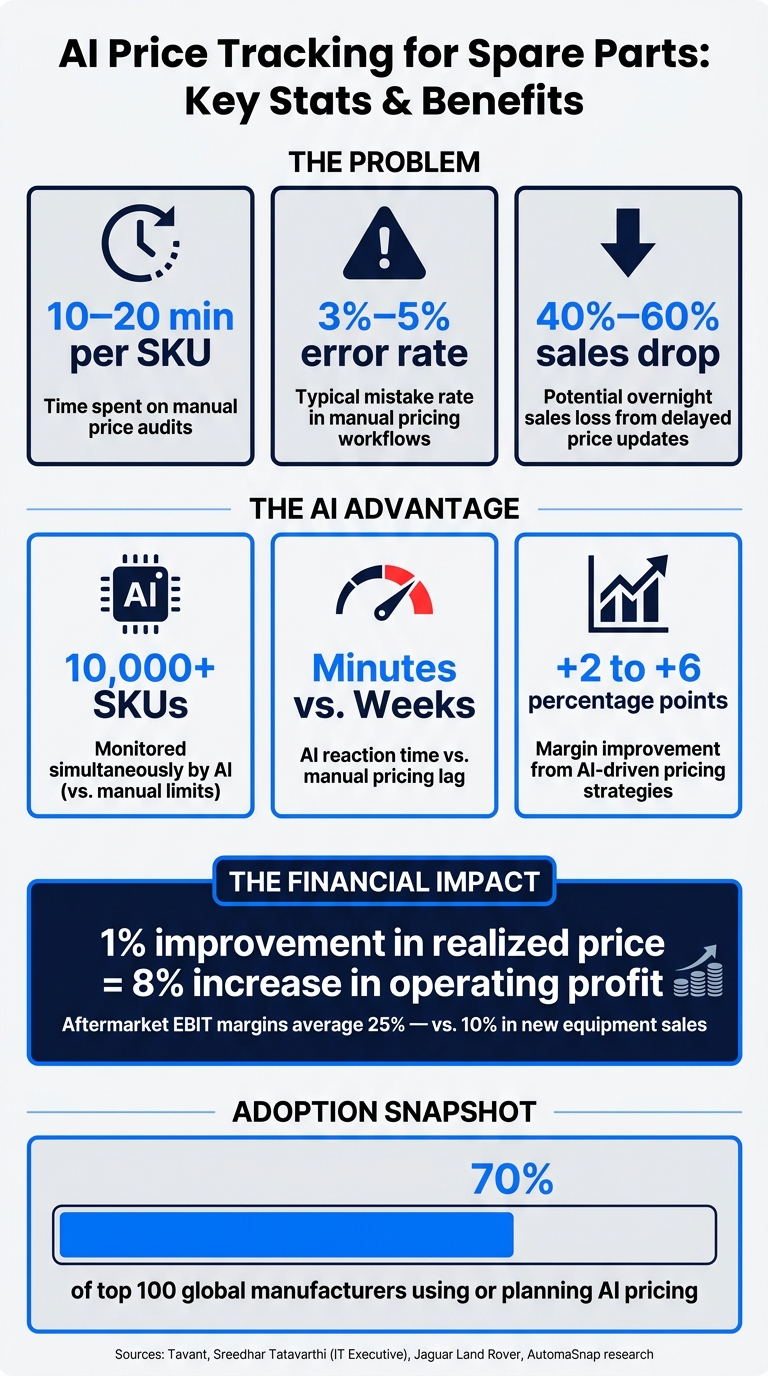
Spare parts are sold through a maze of platforms - Amazon, eBay, RockAuto, manufacturer websites, and dealer networks - each with its own pricing rules and behaviors. Keeping track of hundreds of competitors across such diverse platforms is a massive undertaking. Delays in updating prices can have serious consequences, with some sellers experiencing a 40% to 60% drop in sales for specific parts almost overnight.
Demand patterns add another layer of difficulty. A single vehicle application might involve dozens of interchangeable parts, all sold by a wide array of vendors. While the aging vehicle fleet in the U.S. has driven up the need for replacement parts, the demand is not uniform. Some parts see seasonal or regional surges, while others remain untouched for months. Without tools that offer real-time insights, managing prices across thousands of SKUs becomes a guessing game. This is where automated AI solutions can make a significant impact.
Manual Price Updates and the Errors They Cause
Relying on manual processes to update prices is inefficient and error-prone. Each manual price audit takes 10–20 minutes per SKU, which makes it nearly impossible to keep up with a catalog of 10,000 or more parts. Most teams end up reviewing only a fraction of their inventory, leaving the rest to chance.
One of the biggest issues with manual updates is the lag. By the time a price is identified and adjusted, the market may have already shifted.
“Large OEMs and distributors often make daily price decisions on hundreds of thousands of SKUs, with disparate ERPs and homegrown tools, creating leakage and latency.” - Samantha Horton, Business Architect, Manufacturing, Tavant
When prices do not sync immediately across websites, dealer networks, and marketplaces, sellers lose revenue to leakage - inconsistencies and outdated listings that quietly drain profits. Manual workflows also introduce errors, with typical mistake rates ranging from 3% to 5%. These inefficiencies make a strong case for AI-driven automation.
Poor Product Data Makes Price Matching Harder
Even when sellers attempt to monitor competitor prices, they often struggle to confirm they are comparing the right products. Accurate matching depends on precise identifiers like Manufacturer Part Numbers (MPN), UPCs, and brand details. Missing or inconsistent data in a seller’s own catalog makes this process unreliable.
Supersessions add another layer of complexity. When a newer part number replaces an older one, sellers need clean data to map these changes. Without it, large portions of the competitive landscape remain untracked. Competitors further complicate matters by bundling parts differently or using non-standard naming conventions, turning price comparisons into guesswork. This often results in sellers either overpricing (losing sales) or underpricing (losing profits), eroding the 25% EBIT margins that make the aftermarket so appealing. These challenges underscore the importance of AI tools that can automatically organize and map product data.
These obstacles highlight the need for advanced, automated solutions, which are explored in the next section.
How AI Price Tracking Addresses These Problems
The issues of fragmented markets, manual updates, and inconsistent product data are not just minor annoyances - they directly impact profitability. AI price tracking tools step in to resolve these challenges head-on.
Automated Data Extraction and Product Matching
AI simplifies the complex task of matching data from platforms like eBay, Amazon, and RockAuto to your internal SKUs, even when identifiers like UPCs are unavailable. By leveraging image recognition and attribute analysis, AI can identify equivalent parts across different brands and private labels. For instance, a generic part listed on one platform can be accurately linked to its OEM counterpart in your catalog.
Take AutomaSnap as an example. This tool extracts structured data - such as Brand, MPN, and Serial Number - directly from photos of nameplates, creating ERP-ready records. Without accurate product data as a foundation, even the best pricing tools cannot deliver reliable results. Clean and structured data ensures seamless and timely market tracking.
Continuous Marketplace Monitoring
Relying on manual processes to monitor competitors often means weeks of delay before price changes are identified. AI eliminates this lag by continuously scanning multiple platforms, monitoring over 10,000 SKUs at once - far beyond what any human team can manage.
But AI does not just track prices. It also monitors stock levels, bundles, and promotions. For example, if a competitor runs out of a high-demand item, AI detects this in real time. This insight allows sellers to adjust their pricing strategy - potentially holding or even raising prices rather than engaging in unnecessary price wars.
“AI tracking isn’t just about lowering prices. It is equally about raising them. When the AI detects that your three biggest competitors are out of stock… you can confidently raise your price.” - Sreedhar Tatavarthi, IT Executive
Real-Time Price Recommendations
With continuous monitoring feeding live data, AI pricing tools can deliver contextual recommendations. These recommendations consider competitor pricing, demand signals, margin targets, and more, enabling businesses to respond to market changes in minutes instead of weeks.
These tools do not just suggest price cuts. They analyze factors like price elasticity, inventory costs, and product lifecycle stages to provide well-rounded advice. Importantly, AI solutions offer clear explanations for each recommendation, so teams can make informed decisions before implementing changes.
The impact is clear. A mere 1% improvement in realized pricing can increase operating profit by 8%. In the aftermarket sector, AI-powered pricing strategies have historically boosted margins by 2 to 6 percentage points. By combining clean data extraction, ongoing monitoring, and actionable recommendations, AI creates a comprehensive pricing solution that helps businesses safeguard and grow their margins.
Benefits of AI Price Tracking for Spare Parts Sellers
Leveraging automated tracking and real-time recommendations, AI offers clear advantages that directly enhance profitability and streamline operations.
Better Margins and More Accurate Pricing
Did you know that a mere 1% improvement in realized price can increase operating profit by 8%? In the aftermarket industry, AI-driven pricing strategies have been shown to deliver margin gains of 2 to 6 percentage points. That is a big deal in a sector where aftermarket EBIT margins already average 25% - well above the 10% seen in new equipment sales.
AI replaces outdated cost-plus pricing with dynamic, value-based approaches. Instead of sticking to a fixed markup, it continuously analyzes real-time market demand and perceived value. For instance, it can detect competitor stockouts, adjust to demand fluctuations, and identify opportunities to tweak prices up or down. With real-time alerts, sellers can capitalize on demand spikes to secure higher margins. Over time, this value-based pricing strategy ensures sustained margin growth across the entire product catalog.
Faster Response to Market Changes
AI gives sellers a speed advantage that manual processes simply cannot match. Quick price adjustments help prevent significant sales losses. Without AI, a competitor’s price change might go unnoticed for weeks - by then, the damage is already done.
AI shrinks this reaction time to minutes. It monitors marketplaces 24/7, flagging important changes almost instantly. Sellers can even set specific triggers, like alerting the team only when a top-100 SKU drops by more than 5%. This ensures the team focuses on critical shifts without being overwhelmed by unnecessary alerts.
Less Manual Work and Fewer Errors
Managing prices for thousands of SKUs manually is a daunting - and error-prone - task. AI eliminates this burden by continuously scanning SKUs and integrating price recommendations directly into ERP systems. This automation removes the need for manual data entry, which often leads to costly errors and margin leaks over time.
But the benefits go beyond accuracy. By automating routine monitoring, product managers can shift their focus from tedious data collection to impactful decision-making.
“When your routine market intelligence is automated, your human team is reserved strictly for high-value strategic maneuvering.” - Sreedhar Tatavarthi, IT Executive
This shift allows teams to prioritize strategic pricing decisions, leading to more consistent and profitable management of SKUs across the board.
How to Add AI Price Tracking to Your Spare Parts Business
Start with Clean, Structured Product Data
For AI to accurately track prices, it needs dependable product data. If your catalog has inconsistent part numbers, unclear descriptions, or missing brand details, the AI will struggle to match your listings with the right market data. And every mismatch could mean a missed opportunity to optimize pricing.
The key is standardized data - every SKU should include the Brand, MPN (Manufacturer Part Number), and condition. Tools like AutomaSnap can help by extracting and exporting standardized product data into ERP-ready spreadsheets. These spreadsheets are compatible with platforms like SAP, Odoo, and Dynamics 365, making it easier to verify market data before adding products to your system. Starting with accurate inputs ensures your pricing engine performs correctly from day one.
Rather than tackling your entire catalog at once, focus on your top-performing SKUs first. Prioritize the top 10% of your inventory based on revenue and sales velocity. These high-volume parts are where pricing mistakes can hurt the most. For instance, if you are significantly undercut on a fast-moving part, sales for that SKU could plummet by 40% to 60% almost overnight.
Once your data is in order, you are ready to set up pricing rules that make the most of these inputs.
Set Your Pricing Rules and Targets
With your data cleaned up, the next step is to establish clear pricing rules. Before automating price adjustments, set specific parameters to guide the AI. For example, define a price floor for each SKU - such as the product’s cost plus a 15% margin. You can also set triggers to flag significant price changes, like any adjustment over 3%, for manual review.
Condition-based pricing is especially crucial for spare parts. A “new factory sealed” part and a “used” one are not interchangeable, so your AI tool must treat them differently. Beyond that, consider rules for stock-out scenarios. For example, if your AI detects that your top three competitors are out of stock on a specific part, it can recommend a price increase to help you capture additional margin.
Track Results and Refine Over Time
After configuring your pricing rules, monitor their performance to fine-tune your strategy. Start with a human-in-the-loop review process - have a team member check AI-generated recommendations before they go live, at least for the first week. This approach helps catch edge cases early and builds trust in the system.
Focus on metrics that show whether the AI is delivering results. Key indicators include gross margin improvement, Buy Box win rate on platforms like Amazon or eBay, and Speed to Insight - how quickly your team can respond to competitor price changes. To test effectiveness, try A/B testing: apply AI-driven recommendations to one sales channel first before rolling them out across all marketplaces. You should aim to see noticeable margin improvements within 3 to 6 months for your most important SKUs.
Another important metric is your recommendation acceptance rate - the percentage of AI suggestions your team approves versus overrides. A high override rate might signal that your pricing rules need adjustment, not that the AI is failing. By continuously refining your system, you will ensure it evolves to deliver better results over time.
“The most important metric is Speed to Insight. When your team isn’t acting as a human web scraper, they can react to market shifts in minutes rather than weeks.” - Sreedhar Tatavarthi, IT Executive
Conclusion: Where AI Is Taking Spare Parts Pricing
Shoppers today can compare prices across platforms like Amazon, eBay, and RockAuto in just seconds. For sellers, a single mispriced SKU can lead to a sharp drop in sales. This is where AI steps in, offering price tracking that eliminates the delays often responsible for lost revenue and reduced margins. Instead of reacting too late, teams can act swiftly and decisively. As Sadiq Pumuram, Global Head of Parts Pricing and Margin Management at Jaguar Land Rover, explains:
“Every time you take that action quicker, you’re protecting margin or you’re doing the right thing for the customer. But you’re doing it there and then rather than a month later. And by then, you could have lost a lot of money.”
The ability to respond quickly to market changes depends on having clean, structured product data. Tools like AutomaSnap make this possible by extracting key details - such as Brand, MPN, and Serial Number - directly from nameplate photos. With standardized and accurate data, AI can make fast and reliable pricing decisions.
AI-driven pricing strategies in the aftermarket have already shown impressive results, delivering margin improvements of 2 to 6 percentage points. Furthermore, 70% of the top 100 global manufacturers are either using AI for pricing or planning to implement it soon. Sellers who invest in strong data foundations and adopt AI pricing now will be better positioned to safeguard their margins and capture more sales as competition in the market intensifies.
FAQs
What data do I need before using AI price tracking?
Before diving into AI price tracking, make sure you’re prepared with the following:
- Competitor sources to monitor: This could include competitor websites, brand pages, or marketplace listings.
- A detailed list of parts to track: Ensure you have accurate product identifiers like SKUs, MPNs, or UPCs for precise tracking.
- Specific details to capture: Decide what data you need, such as current prices, shipping costs, or stock availability, and determine how to align it with your catalog.
With this setup, AI can effectively monitor changes and provide timely alerts.
How does AI match the same part across different listings?
AI simplifies the process of identifying identical parts across different listings by focusing on key details such as part numbers and attributes. It standardizes this information and cross-references it with internal SKUs and OEM data. Using methods like attribute analysis and description parsing, the system ensures that items, which might seem different in traditional setups, are accurately grouped together. This enables precise price monitoring and comparison.
How do I keep AI pricing from breaking my margin rules?
To keep AI-driven pricing strategies on track, it’s crucial to establish clear boundaries. These include price ladders, competitive floors, and specific segment targets to ensure decisions stay within acceptable limits. Use tools like anomaly detection to act only when competitor price changes surpass a certain threshold. For instance, you might set a rule to respond only when changes exceed a set percentage. Additionally, implementing human approvals for AI-generated recommendations adds another layer of oversight.
Accurate SKU matching and access to real-time data are essential to prevent costly errors. Lastly, ensure the AI delivers recommendations that are easy to understand. This way, you can confidently review and approve decisions without second-guessing the reasoning behind them.