On this page
AI Pricing for Spare Parts: Segment Strategies
AI-driven pricing is transforming how spare parts are priced, using machine learning to adjust prices based on real-time data like inventory, demand, and customer behavior. This approach replaces outdated methods like cost-plus pricing and manual updates, offering tailored pricing strategies for different customer segments and sales channels.
Key Takeaways:
- AI Pricing Basics: Automates price adjustments using data like sales history, competitor prices, and inventory levels.
- Customer Segmentation: Groups buyers by type (e.g., fleet operators, e-commerce shoppers), price sensitivity, and sales channels, enabling personalized pricing.
- Core AI Models: Includes demand forecasting, price elasticity estimation, and clustering for dynamic segmentation.
- Tools for Data Accuracy: Platforms like AutomaSnap clean and enrich data, ensuring AI models work effectively.
- Integration: AI pricing connects with ERP and inventory systems to reflect real-time updates and improve margins.
Foundations of AI Pricing and Segmentation
Key Data Inputs for AI Pricing
AI pricing is only as effective as the data it relies on. For spare parts distributors, this means pulling together both internal and external data into a cohesive and trustworthy dataset.
Internally, you will need transaction history, inventory levels, supply chain costs, and detailed product attributes like technical specifications, SKU, MPN (Manufacturer Part Number), and UPC. Externally, it is essential to gather competitor pricing, market demand trends, and customer behavior data. These combined inputs allow AI models to go beyond just calculating costs - they help determine what customers are actually willing to pay.
| Data Category | Specific Inputs | Role in AI Pricing |
|---|---|---|
| Transaction Data | Historical sales, price points, volume | Predicts demand and price elasticity |
| Product Data | Technical attributes, SKU, MPN, UPC | Enables precise part matching and value-based pricing |
| Market Data | Competitor prices, market trends | Supports dynamic pricing and competitive positioning |
| Operational Data | Inventory levels, supply chain costs | Optimizes margins and reduces holding costs |
| Customer Data | Buying behavior, price sensitivity | Fuels segmentation and personalized offers |
Automated price tracking is a game-changer compared to manual processes. Competitor prices can fluctuate several times a day, and manual updates simply cannot keep pace. Automated tools track these shifts in real time, ensuring your AI models work with up-to-date insights instead of outdated information.
Once you have built a solid data foundation, the next step is understanding how AI models use this data to deliver precise pricing strategies.
Core AI Models Used in Spare Parts Pricing
A mature AI pricing system relies on multiple model types working together. Demand forecasting models analyze historical sales data to predict future needs, helping to align pricing with inventory levels. Meanwhile, price elasticity estimation models assess how sensitive different customer groups or segments are to price changes, enabling you to find a sweet spot that maximizes revenue without sacrificing volume.
Clustering models are particularly valuable for segmentation. Instead of manually grouping customers, these algorithms identify natural clusters based on shared behaviors like purchase frequency, order size, or price sensitivity. The same approach applies to SKUs, where clustering parts based on demand volatility or margin profiles ensures each group gets the right pricing strategy. These models streamline both SKU pricing and customer segmentation, which are critical for effective spare parts pricing.
For parts with sparse pricing data, Random Forest regressors shine. These models predict prices based on technical attributes. In one case, a Random Forest model trained on aftermarket part data achieved a 76.14% accuracy rate in price predictions, addressing the challenge of pricing long-tail SKUs.
The results speak for themselves. A heavy machinery manufacturer saw a 10% boost in sales and reduced pricing errors by 15%. These are tangible outcomes from replacing guesswork with data-driven models.
Clean, enriched data is the backbone of these systems. The next section explores how tools like AutomaSnap ensure this crucial foundation is in place.
Using AutomaSnap for Data Enrichment
Even the most advanced AI models cannot operate effectively without clean data. This is a recurring issue in the spare parts industry, where incomplete records, mismatched identifiers, and missing catalog entries are common - particularly in asset recovery or secondary market inventories.
“ML algorithm accuracy depends on clean training data.” - Rishi Verma, Global Practice Director, AI, Birlasoft
Enter AutomaSnap, a tool designed to solve this problem. It extracts structured identifiers - Brand, MPN, and Serial Number - directly from nameplate photos taken on the shop floor. Even damaged or dirty labels, which are common in warehouses, do not pose an issue. The tool generates ERP-ready spreadsheets that integrate seamlessly with platforms like SAP, Odoo, and Dynamics 365. It also performs quick market checks to verify pricing and demand.
For distributors managing thousands of SKUs, AutomaSnap eliminates a major bottleneck. By delivering clean, structured data, it boosts the accuracy of AI pricing models and enhances customer segmentation. This leads to better catalog management and ensures your AI models are trained on high-quality data.
Segmentation Strategies for AI Pricing
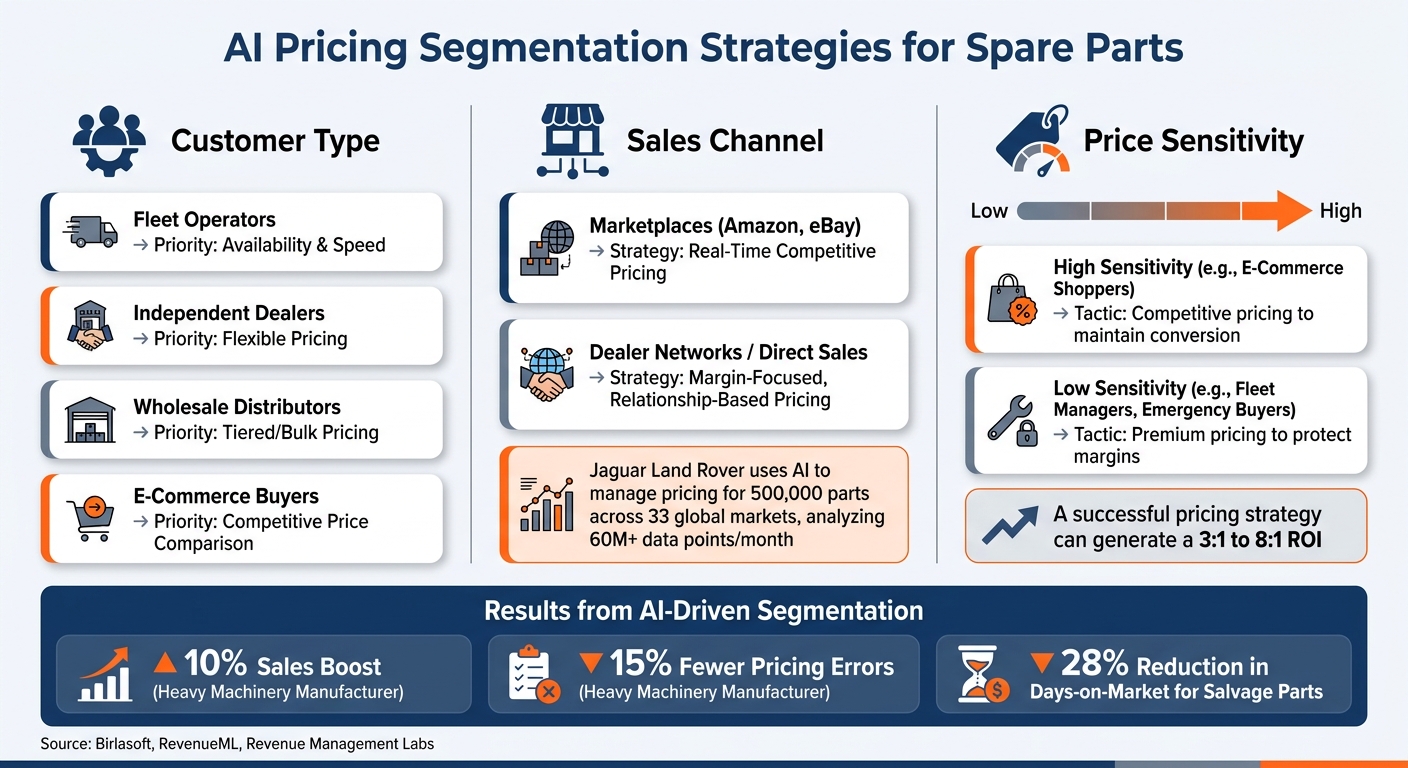
Getting segmentation right is key to ensuring your AI pricing strategy hits the mark. Customers are not all the same, and sticking to a generic pricing model can result in missed opportunities. By identifying the right segmentation dimensions, AI can help deliver the right price to the right customer at the right time.
Segmenting by Customer Type
Different customer groups have different priorities. For instance, fleet operators often need immediate replacements, while maintenance planners focus on routine scheduling. Efficiently managing these needs starts with speeding up inventory intake to ensure parts are ready for dispatch. These priorities influence what each group is willing to pay. AI can analyze buying patterns and behaviors to create pricing rules tailored to these distinct groups.
Some common customer types in spare parts distribution include:
- Fleet operators: They value availability and speed above all else.
- Independent dealers: Their needs vary but often include flexible pricing.
- Wholesale distributors: They typically buy in bulk and expect tiered pricing structures.
- E-commerce buyers: They tend to shop around and compare prices extensively before committing.
“AI systems can group clients based on their sensitivity to price changes, their past buying behavior, and their shopping habits. This segmentation allows businesses to set different prices for different customers.” - Rishi Verma, Global Practice Director, AI, Birlasoft
AI takes factors like order size, product mix, and discount preferences into account, translating customer behavior into actionable pricing strategies. This kind of segmentation provides a solid foundation for channel-specific pricing approaches.
Segmenting by Sales Channel
The sales channel plays a huge role in how pricing strategies are shaped. For example, marketplaces like Amazon or eBay are highly competitive, with prices frequently fluctuating as buyers compare options. On the other hand, direct sales or dealer networks often emphasize relationships and long-term contracts over price competition.
Take Jaguar Land Rover as an example. As of January 2026, they leverage AI to manage pricing for 500,000 parts across 33 global markets, analyzing over 60 million data points every month. Sadiq Pumuram, their Global Head of Parts Pricing, highlighted how AI transformed their pricing approach:
“AI will help us find those little nuggets. It helps us pinpoint areas to look at and it allows the team to become more responsive and proactive.” - Sadiq Pumuram, Global Head of Parts Pricing and Margin Management, Jaguar Land Rover
A one-size-fits-all approach does not work across channels. Dealer networks may benefit from a margin-focused pricing strategy, while e-commerce listings often require real-time, competitive pricing. By understanding the unique dynamics of each channel, businesses can refine their pricing strategies even further.
Segmenting by Price Sensitivity
Price sensitivity varies widely among customers. Some buyers are highly price-conscious and will walk away if prices are not competitive. Others are willing to pay a premium for trusted brands or urgent needs. AI can measure this elasticity at a segment level, enabling businesses to fine-tune their pricing.
For example, price-sensitive e-commerce shoppers are often offered competitive pricing to maintain conversion rates. Meanwhile, less price-sensitive segments, like loyal fleet managers or emergency buyers, can sustain higher margins without jeopardizing sales. AI uses data-driven scoring to categorize customers into these segments and automates pricing adjustments accordingly.
“Pricing is the fastest and most effective way for companies to increase profit… a successful pricing strategy can generate a 3:1 to 8:1 return on investment.” - Jenya Kubashevskiy, Director, RevenueML
Building AI-Powered Segmentation Models
Data Preparation and Enrichment
For segmentation to work effectively, clean and consistent data is non-negotiable. This involves merging internal data sources - like sales history, inventory levels, and supply chain costs - with external inputs such as competitor pricing, market trends, and salvage auction feeds. Without this solid groundwork, even the most advanced AI models will produce unreliable results.
One crucial step is standardizing part identifiers. Every SKU should have a matching MPN, UPC, and internal SKU code to avoid errors and enable accurate cross-referencing. Tools like AutomaSnap can simplify this process by extracting identifiers and generating ERP-compatible spreadsheets, ensuring your catalog data is ready for modeling.
Before diving into modeling, it is smart to audit all your data feeds - auction records, repair histories, local listings - and document any gaps. This helps identify missing pieces that could hinder the accuracy of your segmentation efforts.
Once your data is clean and enriched, you are ready to group customers and SKUs into actionable clusters.
Clustering Customers and SKUs
With clean data in hand, the next step is to create meaningful clusters for both customers and parts. Instead of using outdated demographic categories, AI can group customers based on behaviors like order frequency, discount sensitivity, product preferences, and reactions to price changes. These behavior-driven clusters are more accurate than traditional labels like “small business” or “enterprise.”
On the SKU side, parts are clustered by demand patterns, lifecycle status (e.g., active or obsolete), and seasonality. For instance, a frequently purchased hydraulic seal will require a different pricing strategy than a rarely ordered legacy component for discontinued equipment. Treating all SKUs the same could lead to missed opportunities for maximizing margins.
“AI-driven aftermarket parts pricing strategy analyses a lot of data, such as market trends, customer behaviour, and competitor pricing, to predict demand and adjust prices in real-time.” - Rishi Verma, Global Practice Director, AI, Birlasoft
These clusters are not static. As new transactions, clicks, and sessions flow in, the system updates segment definitions automatically. This ensures that a customer shifting from routine purchases to urgent, high-frequency orders is repriced appropriately without manual adjustments.
Connecting Segments to AI Pricing Engines
Once dynamic clusters are defined, the next step is integrating them into your AI pricing engine. Each segment is assigned specific pricing rules, such as target margin thresholds, discount limits, and optimization goals. For example, high-intent customers with low price sensitivity can be protected with rules to maintain margins, while price-sensitive or high-churn-risk segments can trigger competitive pricing strategies automatically.
As your system scales, explainability becomes critical. Sales teams are more likely to trust AI-generated pricing when they understand the logic behind it. Tools like SHAP (SHapley Additive exPlanations) can highlight the specific attributes - geography, relationship duration, urgency - that influenced a pricing decision. This helps transform AI from a black box into a transparent tool. For instance, a mid-market dealer group that integrated live supplier feeds and edge valuations shifted from weekly to sub-hourly repricing. This change reduced days-on-market for salvage-derived parts by 28% and boosted margins on high-turn SKUs by 6 percentage points within six months.
“Segmentation-based models are a valuable steppingstone for improving pricing discipline in organizations.” - Conga Team
Segmentation-based models not only improve pricing discipline but also deliver measurable results. They provide a solid starting point for businesses before moving on to more advanced approaches, like neural network-based prescriptive pricing. Pricing, after all, is an ongoing and evolving process.
Putting AI Segment Strategies into Practice
Pricing Policies and Governance by Segment
Once you have built a strong foundation in customer segmentation, the next step is to weave these insights into your pricing strategies. By tying segments directly to your pricing engine, you can ensure that pricing decisions across the organization remain consistent and well-justified. Without clear guidelines, sales teams might resort to random discounts, which can quickly eat away at your margins.
“Margin is rarely lost at list price. It is lost in execution. Discounting behavior explains more variance in financial performance than headline pricing levels.” - Revenue Management Labs
One way to tackle this is by using formalized discount corridors. These define strict discount limits for each segment. For instance, a high-volume OEM account might have a higher discount threshold with automatic approvals, while smaller or lower-priority segments require managerial sign-off. This structured method replaces the chaos of ad-hoc exceptions that often harm profitability.
It is also essential to integrate ethical safeguards into AI models. These safeguards can flag pricing decisions that risk being discriminatory or noncompliant. With 70% of the top 100 global manufacturers either using or planning to use AI for pricing, ensuring compliance has never been more critical.
Integration with Sales and Inventory Systems
Governance is only part of the equation. To unlock the full potential of AI pricing, it must seamlessly connect with your sales and inventory systems. This involves integrating the pricing engine into your ERP system - whether that is SAP, Oracle, or Infor - so that price updates are instantly reflected across all channels, from sales quotes to online stores.
Inventory alignment is just as important. AI pricing models need access to real-time stock levels and supply chain costs. This allows for automatic price adjustments when inventory dips or supplier costs rise. For example, one major automaker saw a 15% increase in sales and a 20% reduction in inventory holding costs after implementing AI-driven pricing that tied directly to their inventory systems.
Even smaller distributors can achieve this level of integration using cloud-based pricing tools, avoiding the need for a complete overhaul of older systems. Start by linking AI to core ERP functions, then gradually expand to include sales quoting tools and service workflows. Clean data and dynamic segmentation add even more value to these integrations, ensuring that pricing strategies stay sharp and responsive.
Tracking Performance and Refining Models
The true measure of success in AI pricing is not the list price - it is the price you actually realize after discounts. Monitoring price realization by segment helps uncover margin leaks and tighten discount controls.
Regular recalibration is key to preventing discount policies from drifting over time. AI can analyze historical sales data to predict future price trends, allowing you to adjust segment rules proactively rather than scrambling to react to market changes. One heavy machinery manufacturer saw a 10% sales boost and cut pricing errors by 15% by continuously refining their machine learning-based pricing and demand forecasting models.
Automated competitor price monitoring, conducted multiple times a day, provides timely market insights to keep your strategies sharp. These ongoing adjustments and refinements complete the cycle - from capturing data to implementing actionable pricing strategies - ensuring your AI-driven segmentation efforts continue to deliver results.
Conclusion
Key Takeaways
AI-powered pricing combined with smart customer segmentation is no longer just for big players - it is quickly becoming a necessity for businesses of all sizes. With the aftermarket parts market projected to hit $619.25 billion by 2029, and 65% of aftermarket executives already preparing for tighter margins, one thing is clear: treating every customer the same is a missed opportunity. By segmenting customers based on type, sales channel, and price sensitivity - and linking those segments to an AI-driven pricing engine - you can safeguard your margins while meeting the unique needs of your buyers.
The Role of Clean, Enriched Product Data
None of these strategies work without clean and enriched data. As Rishi Verma, Global Practice Director, AI at Birlasoft, emphasizes:
“ML algorithms accuracy will depend on the clean underlying data used for training purposes.”
In fact, research suggests that up to 30% of generative AI projects could be abandoned by 2025 due to weak data foundations. This risk underscores why clean, structured data is crucial for AI pricing success. Tools like AutomaSnap simplify data extraction - capturing details like Brand, MPN, and Serial Number - and generate ERP-ready spreadsheets that ensure your data is ready for precise pricing.
Once your data is in order, the next step is refining your model over time.
Pricing as a Continuous Process
AI pricing is not a one-and-done task. Markets shift, customer behavior evolves, and competitor pricing can change in an instant. Sadiq Pumuram, Global Head of Parts Pricing and Margin Management at Jaguar Land Rover, shared his experience after implementing AI across 500,000 parts in 33 markets:
“Every time you take that action quicker, you’re protecting margin or you’re doing the right thing for the customer. But you’re doing it there and then rather than a month later. And by then, you could have lost a lot of money.”
Think of your AI pricing model as a dynamic system. Feed it updated data regularly, keep a close eye on how different segments perform, and fine-tune your rules as your business evolves. The goal is not to launch the most advanced model - it is to continuously adapt and improve so you stay ahead of market changes.
FAQs
What data do I need to start AI pricing for spare parts?
To set up AI-driven pricing for spare parts, you will need a variety of data points, including market trends, customer behavior, competitor pricing, historical sales data, inventory levels, and supply chain costs. Tools like AutomaSnap can simplify this process. For instance, AutomaSnap can extract structured product details - such as brand names, MPNs (Manufacturer Part Numbers), and serial numbers - directly from nameplates. This enables precise inventory tracking and allows for dynamic pricing adjustments based on real-time demand and shifting market conditions.
How do I choose the right customer segments for pricing?
To select the best customer segments for pricing, leverage AI-powered tools to categorize customers based on their behavior, price sensitivity, and buying habits. Dive into data such as purchasing trends and reactions to price changes to form clear, actionable segments. Make sure to keep these groups updated with real-time data, so your pricing strategies remain effective. This approach allows you to offer tailored pricing that boosts revenue while keeping your customers happy.
How do I integrate AI pricing with my ERP and inventory systems?
To connect AI-driven pricing with your ERP and inventory systems, opt for AI tools designed to integrate smoothly. Look for solutions that align with your ERP configuration and support efficient data sharing, demand forecasting, and real-time price updates. This setup enables automated pricing changes based on market trends, demand shifts, and inventory levels, ensuring your pricing strategies stay dynamic and well-managed.