
On this page
AI in Spare Parts: Demand Trends and Pricing Insights
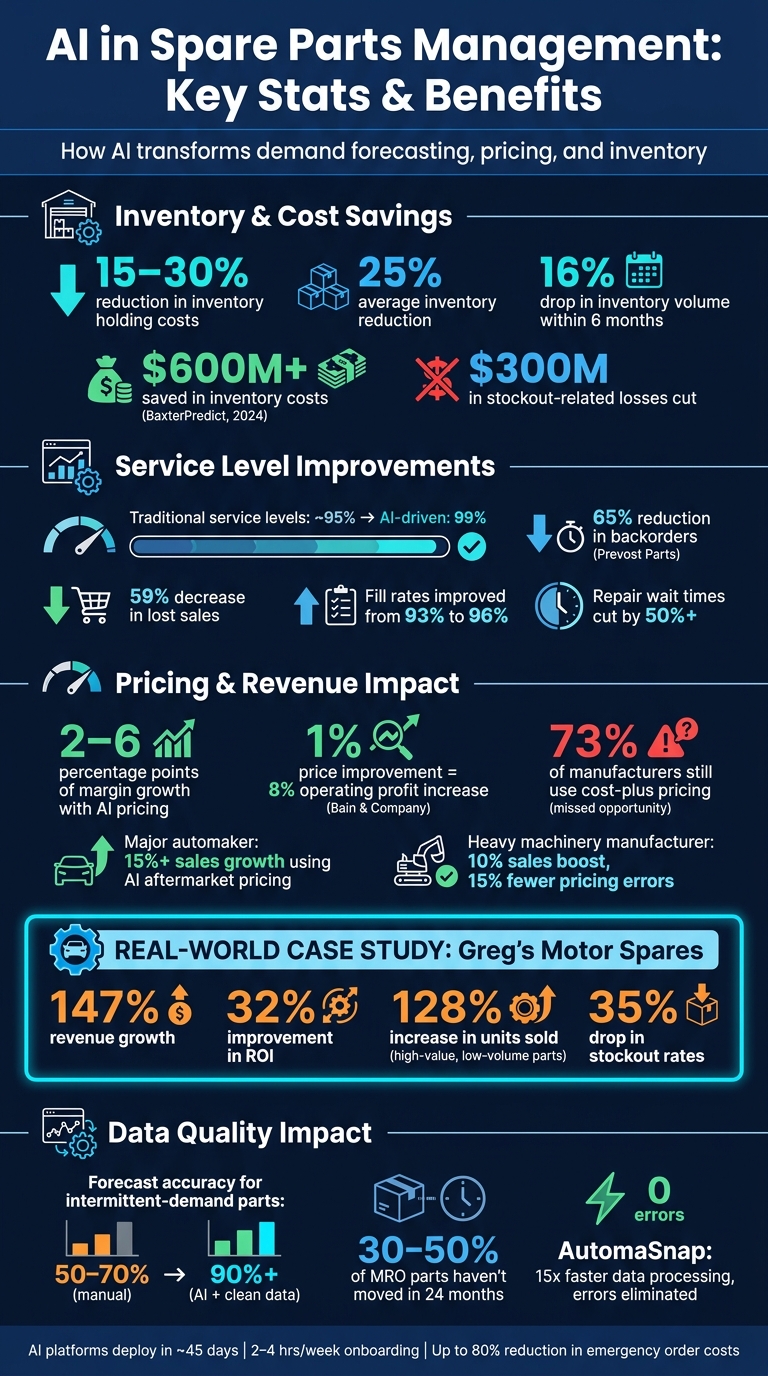
AI is transforming spare parts management by solving inventory and pricing challenges with precision. Businesses lose billions annually to excess inventory and unplanned downtime. Traditional methods fall short, but AI offers solutions by analyzing diverse data sources to predict demand and adjust prices in real time.
Key Takeaways:
- Demand Forecasting: AI handles unpredictable demand using advanced models, integrating data like IoT sensors, supplier lead times, and maintenance logs. This improves accuracy and reduces stockouts.
- Pricing: Dynamic pricing adjusts to market changes instantly. AI uses price elasticity to balance profitability and competitiveness, boosting margins by 2-6 percentage points.
- Inventory Costs: AI reduces holding costs by 15-30% and excess inventory by 25%. It aligns stock with demand, avoiding overstock or shortages.
- Service Levels: AI-driven planning achieves 99% service levels, cutting backorders and downtime significantly.
AI tools like AutomaSnap streamline data accuracy, enabling businesses to achieve results faster. The bottom line? AI saves costs, improves service, and drives revenue growth in spare parts management.
How AI Improves Demand Forecasting for Spare Parts
Predicting demand for spare parts is notoriously tricky. Unlike finished goods, spare parts often sit idle for long periods, only to experience sudden spikes in demand. This erratic pattern, known as “lumpy” or intermittent demand, doesn’t align well with traditional forecasting tools, which are designed for steady, predictable trends.
Data Sources That Feed AI Demand Models
AI-driven models rely on a much broader range of data than traditional methods. These systems pull from both internal and external sources, creating a more complete picture of demand. Internally, data comes from ERP systems, work order logs, BOM records, and preventive maintenance schedules. Externally, AI taps into real-time IoT sensor data - such as temperature and vibration readings - along with factors like supplier lead times, fleet attrition rates, and even weather conditions.
| Source Category | Specific Data Points |
|---|---|
| Internal (ERP/Logs) | Historical consumption, maintenance records, part-to-machine mapping |
| Warranty/Claims | Defect types, product age at failure, repair vs. replace resolution |
| Operational/IoT | Sensor data (temperature, vibration), usage intensity |
| External/Market | Weather patterns, seasonal trends, geopolitical events |
| Lifecycle Data | Fleet size, attrition rates, end-of-life schedules |
The more interconnected these data streams are, the more accurate the forecasts become. For example, combining six key inputs - including work order history, asset condition scores, preventive maintenance (PM) schedules, production intensity, failure mode patterns, and supplier lead times - allows AI models to generate clearer and more reliable predictions. This level of integration is essential for addressing the challenges of irregular demand.
AI Methods for Handling Irregular Demand
With access to such diverse data, AI employs advanced techniques to tackle intermittent demand. Approaches like the Croston method and Syntetos-Boylan Approximation (SBA) are specifically designed for scenarios where demand is sporadic. These methods separate the size of demand from its frequency, making them particularly effective for spare parts forecasting.
For more complex patterns, machine learning models such as Random Forest, XGBoost, and LightGBM excel at identifying non-linear relationships across multiple variables, like equipment age and failure patterns. Additionally, stacking ensemble learning combines the strengths of multiple machine learning and deep learning models, uncovering insights that individual models might miss.
For end-of-life parts, specialized frameworks like Decay-Function-Blended ML (DFB-ML) incorporate physical lifecycle decay curves directly into the forecasting process. In a 2025 study covering 1,709 automotive part numbers over an eight-year horizon, this method achieved a Safe Mean Absolute Percentage Error (Safe MAPE) of just 4.36%.
“In the aftermarket, availability matters more than forecast accuracy. A highly accurate forecast that still results in a backorder is a failure.” - Andrey Meshalkin, Syncron
How AI Is Applied Across Key Industries
The impact of AI-driven forecasting is evident across industries. In aviation, Boeing uses a Directed Acyclic Graph (DAG) of interconnected machine learning models to analyze operational and environmental variables, such as weather and terrain, for entire aircraft fleets. This system generates automated plans for acquiring replacement parts, directly linking forecasts to procurement actions. This efficiency can be further enhanced by speeding up inventory intake to ensure parts are ready for use as soon as they arrive. Considering that maintenance accounts for about 20% of airline operating costs, even small gains in parts availability can have a meaningful financial impact.
In the automotive sector, AI helps manage the long-tail challenge of maintaining parts for 10-15 years after a model is discontinued. Techniques like survival analysis and decay functions track how serviceable fleets shrink over time, adjusting demand projections to reflect these changes. Meanwhile, in industrial and B2B environments, AI integrates service-level agreements (SLAs) into its models, ensuring that critical components maintain 95%+ availability even when demand is unpredictable.
Across these industries, the shift is clear: instead of reacting to failures after they occur, AI enables businesses to anticipate and prepare for them in advance. This proactive approach not only improves operational efficiency but also minimizes downtime and costs.
How AI Shapes Pricing Decisions in Spare Parts
Figuring out demand is one hurdle. Pricing those parts correctly is the next. AI handles both by not only predicting demand with precision but also adjusting prices in real time. This combination creates a seamless approach to managing spare parts.
Dynamic Pricing Using Real-Time Market Data
The spare parts industry has embraced digitization. With global marketplaces making price comparisons instant, outdated methods like spreadsheets just don’t cut it anymore. AI steps in with automated competitor pricing scouts that gather and compare competitor prices from dealer portals, online marketplaces, and e-commerce platforms. It even flags anomalies using OEM part numbers in real time.
The real game-changer? Speed. AI enables “always-on” pricing, updating prices across websites, dealer networks, and marketplaces the moment market conditions change. No delays, no manual bottlenecks, and no inconsistencies across channels.
“Dynamic pricing - where prices can be updated in real time to match market conditions - is the best way to ensure your customers see prices that are relevant to market and channel conditions at any given point in time.” - Barrett Thompson, General Manager of Commercial Excellence, Zilliant
Using Price Elasticity to Optimize Revenue
Not all spare parts react the same way to price changes. For example, a common HVAC replacement filter is highly price-sensitive, while a unique part for a discontinued industrial machine is not. AI uses price elasticity analysis to figure out which parts can support higher margins and which need competitive pricing to keep customers.
This analysis can transform profitability. Bain & Company reports that a 1% improvement in realized price can increase operating profit by 8% - a bigger impact than boosting volume or cutting costs. Despite this, 73% of industrial manufacturers still use cost-plus pricing, which ignores elasticity altogether. Companies using AI for pricing in the aftermarket have seen 2 to 6 percentage points of margin growth, all while staying competitive.
One way to apply this insight is by categorizing parts into pricing tiers based on their elasticity and availability:
| Part Category | Target Margin | Pricing Strategy |
|---|---|---|
| Competitive | 25-35% | Match market prices to retain customers |
| Standard | 40-55% | Balance competitiveness and profitability |
| Captive | 55-75% | Use value-based pricing for OEM-exclusive parts |
| Emergency | Premium | Charge for speed when downtime is critical |
These strategies can also guide inventory decisions, tying market intelligence directly to stock management.
Balancing Inventory Costs, Availability, and Profit
Pricing isn’t just about numbers - it’s closely linked to inventory. With real-time insights, AI ensures pricing and stock levels work together. For instance, AI adjusts prices to clear out overstock or protect limited supply for key customers. This avoids two costly mistakes: holding onto slow-moving items too long or underpricing high-demand parts.
Inventory holding costs typically run 20% to 30% of inventory value annually. Overpriced, slow-moving items sitting in storage can drain profits. AI can cut these holding costs by 15% to 30% by connecting pricing decisions directly to replenishment systems.
“Quick actions protect margin and customer service, avoiding costly delays.” - Sadiq Pumuram, Global Head of Parts Pricing and Margin Management, Jaguar Land Rover
The big shift? Moving from reactive pricing to a system that senses, decides, and acts. This approach aligns pricing, inventory, and service levels into a unified strategy, rather than treating them as separate challenges.
AI Tools, Data Accuracy, and Market Intelligence
Accurate and well-organized data is the backbone of AI’s ability to improve spare parts demand forecasting and pricing strategies. For AI to deliver reliable results, the quality of input data is critical. If the data is messy or inconsistent, even the most advanced algorithms will produce unreliable outcomes.
Why Clean, Structured Data Matters
The effectiveness of AI models hinges on the quality of the data they process. Inconsistent part identification introduces noise that can degrade a model’s performance over time. In many cases, the limits of forecast accuracy stem from poor data rather than the model itself. Duplicate SKUs (Stock Keeping Units) are a major culprit, as they can trick AI systems into seeing “phantom” inventory. This leads to incorrect reorder points and skewed pricing suggestions. Research indicates that 30% to 50% of MRO (Maintenance, Repair, and Operations) parts in typical organizations have not moved in 24 months.
Clean, structured data - capturing fields like Brand, MPN (Manufacturer Part Number), and Serial Number - provides a stable foundation for AI models. This can push forecast accuracy for intermittent-demand parts from a range of 50-70% to over 90%. Addressing these data challenges often requires automation tools designed to ensure data integrity.
How AutomaSnap Supports Inventory Data Accuracy

Manual data entry is prone to errors, which can undermine the effectiveness of forecasting and pricing models. Enter AutomaSnap, an AI-powered tool that tackles this issue head-on. Using OCR (Optical Character Recognition) technology, AutomaSnap extracts critical information - like Brand, MPN, and Serial Number - from nameplate photos in just seconds, completely eliminating manual errors. The extracted data is then formatted into ERP-ready spreadsheets compatible with systems like SAP, Odoo, and Dynamics 365, ensuring a seamless transition from data intake to forecasting.
A practical example comes from Gal-Industry, a company specializing in industrial automation. Before adopting AutomaSnap, their staff spent over 10 minutes manually transcribing data for each item. With AutomaSnap, Operations Manager Bartek reported that the process became 15 times faster, and data entry errors were entirely eliminated.
“AutomaSnap modernized how we work. Nameplate data flows into our system instantly and accurately, listings are created with professional photos and rich SEO descriptions, and the time we used to spend on manual tasks is now invested in growing the business.” - Bartek, Operations Manager, Gal-Industry
AutomaSnap doesn’t stop at data extraction. Its Quick Market Check feature provides instant market price ranges based on part condition, offering one-click verification. This connects accurate intake data directly to the market intelligence needed for pricing strategies.
| Feature | Traditional Manual Process | AutomaSnap AI Process |
|---|---|---|
| Data Entry | Manual transcription (error-prone) | AI OCR extraction (errors eliminated) |
| Processing Time | ~10 minutes per item | Seconds |
| Market Intelligence | Manual search across multiple sites | One-click market snapshot |
| Pricing Guidance | Inconsistent/gut-feel | Data-driven price ranges by condition |
| Listing Velocity | Slow/bottlenecked | 15x faster |
Measured Benefits of AI in Spare Parts Management
The earlier sections highlighted how AI can enhance data quality and market insights. But what does this mean in practice? The results speak for themselves. These measurable outcomes illustrate how AI helps businesses align inventory with market needs.
Reducing Excess Inventory and Carrying Costs
AI enables companies to calculate optimal safety stock levels by analyzing real-time demand variability, rather than relying on broad, static buffers. This approach has led to a 15-30% reduction in holding costs and an average inventory reduction of 25%. Remarkably, many businesses report a 16% drop in inventory volume within just six months of implementation.
“Inventory optimization isn’t about having less stock - it’s about having the right stock, where and when you need it.” - Chad Hawkinson, Chief Innovation Officer, Baxter Planning
In 2024, companies using the BaxterPredict platform collectively saved over $600 million in inventory costs and cut stockout-related losses by nearly $300 million. This was achieved by transitioning from reactive replenishment to proactive, AI-driven planning.
Improving Service Levels and Fill Rates
Beyond cost savings, AI-driven forecasting also boosts customer service. While traditional methods typically achieve service levels around 95%, AI forecasting can push that figure to 99%. That seemingly small 4% improvement can translate to fewer lost sales and happier customers, particularly in high-demand spare parts operations.
For example, within just three months of adopting AI-driven inventory planning for over 25,000 active parts, Prevost Parts achieved the following results:
- 65% reduction in backorders
- 59% decrease in lost sales
- Fill rates improved from 93% to 96%
Additionally, AI helps cut repair wait times by over 50%, thanks to its ability to pre-position parts based on failure probabilities rather than waiting for stockouts to occur.
Growing Revenue and Profit Margins
AI doesn’t just save money - it helps businesses make more of it. A major automaker using AI for pricing strategies in its aftermarket parts division saw sales grow by over 15% while also reducing carrying costs. Similarly, a heavy machinery manufacturer employing machine learning for pricing reported a 10% sales boost and a 15% drop in pricing errors.
The success story of Greg’s Motor Spares, a regional automotive parts distributor managing 33,000 SKUs across 31 locations, is particularly noteworthy. Between April 2024 and April 2026, the company leveraged AI-driven demand forecasting and SKU-level allocation tools to achieve:
- 147% revenue growth
- 32% improvement in ROI
- 128% increase in units sold for high-value, low-volume products
- 35% average drop in stockout rates across all part categories
“The platform has helped us respond more effectively to demand, optimize purchasing and transfers, and manage inventory complexity in a way that supports both customer service and profitable growth.” - Mel Bock, COO, Greg’s Motor Spares
These examples show that when AI is combined with clean, structured data and clear business objectives, its financial and operational benefits are undeniable.
Conclusion: Putting AI to Work in Spare Parts Management
AI is changing the way spare parts management operates. Whether it’s predicting irregular, “lumpy” demand patterns through advanced forecasting or adjusting prices in real time with dynamic pricing, AI takes the guesswork out of the equation and replaces it with accuracy.
But here’s the catch: the effectiveness of AI hinges on the quality of the data it uses. Clean, structured, and detailed part-level data - like Brand, MPN, and Serial Number - is what allows AI models to perform beyond just the basics.
This is where tools like AutomaSnap shine. By extracting structured data from something as simple as nameplate photos and creating ERP-ready spreadsheets, AutomaSnap removes one of the biggest challenges in spare parts management: accurately capturing part data. With features like built-in market checks for pricing and demand verification, it provides spare parts distributors with the reliable data they need to make AI-driven decisions. This streamlined process not only simplifies data intake but also accelerates implementation, delivering clear operational improvements.
Modern AI platforms are surprisingly quick to deploy - up and running within 45 days - with minimal time commitment from teams (just 2-4 hours per week during onboarding). For companies managing thousands of SKUs, this small investment can lead to big results: inventory reductions of up to 25%, service levels as high as 99%, and emergency order costs slashed by as much as 80%. These numbers make it clear why moving forward with AI is more than just a good idea - it’s essential.
To stay ahead, spare parts professionals need to focus on three things: ensuring clean, reliable data; integrating AI-powered forecasting with ERP systems; and applying criticality-based strategies to their SKU portfolios. When combined, these steps create a powerful strategy for mastering spare parts management, delivering real-world benefits like lower inventory levels, improved service rates, and significant cost savings on emergency orders. The time to act is now.
FAQs
What data is needed to start AI forecasting for spare parts?
To kick off AI forecasting for spare parts, start by collecting data from a variety of sources. Key inputs include work order history, asset age and condition scores, preventive maintenance schedules, production intensity, failure mode patterns, and supplier lead times. Additionally, when applicable, include warranty and claims data, product lifecycle information, and sales and distribution records. These data points allow for accurate demand modeling, usage predictions, and consideration of factors like wear and tear, shifts in utilization, and scheduled maintenance activities.
How does AI handle intermittent (lumpy) spare parts demand?
AI tackles the challenge of intermittent spare parts demand by leveraging machine learning to refine forecasts as fresh data becomes available. Unlike traditional methods that often oversimplify the problem, AI evaluates critical factors such as maintenance logs, environmental conditions, and service usage. By generating probabilistic, SKU-specific demand predictions, it effectively handles scenarios with long stretches of no demand interrupted by sudden surges. This smarter forecasting helps optimize reorder timing, reducing the risk of stockouts while avoiding excess inventory.
How can AI pricing avoid hurting service levels or margins?
AI-driven pricing safeguards both service levels and profit margins by leveraging real-time, SKU-level data to precisely predict demand and spot irregularities early. This approach helps ensure timely restocking to avoid running out of stock and reduces the risk of over-purchasing. For essential parts, AI enhances forecasting accuracy while factoring in supplier lead times. On the pricing front, it detects unusual patterns and makes proactive adjustments to protect margins. Additionally, inventory-aware pricing dynamically adjusts prices when stock levels are either excessively high or critically low, optimizing both sales and inventory management.