On this page
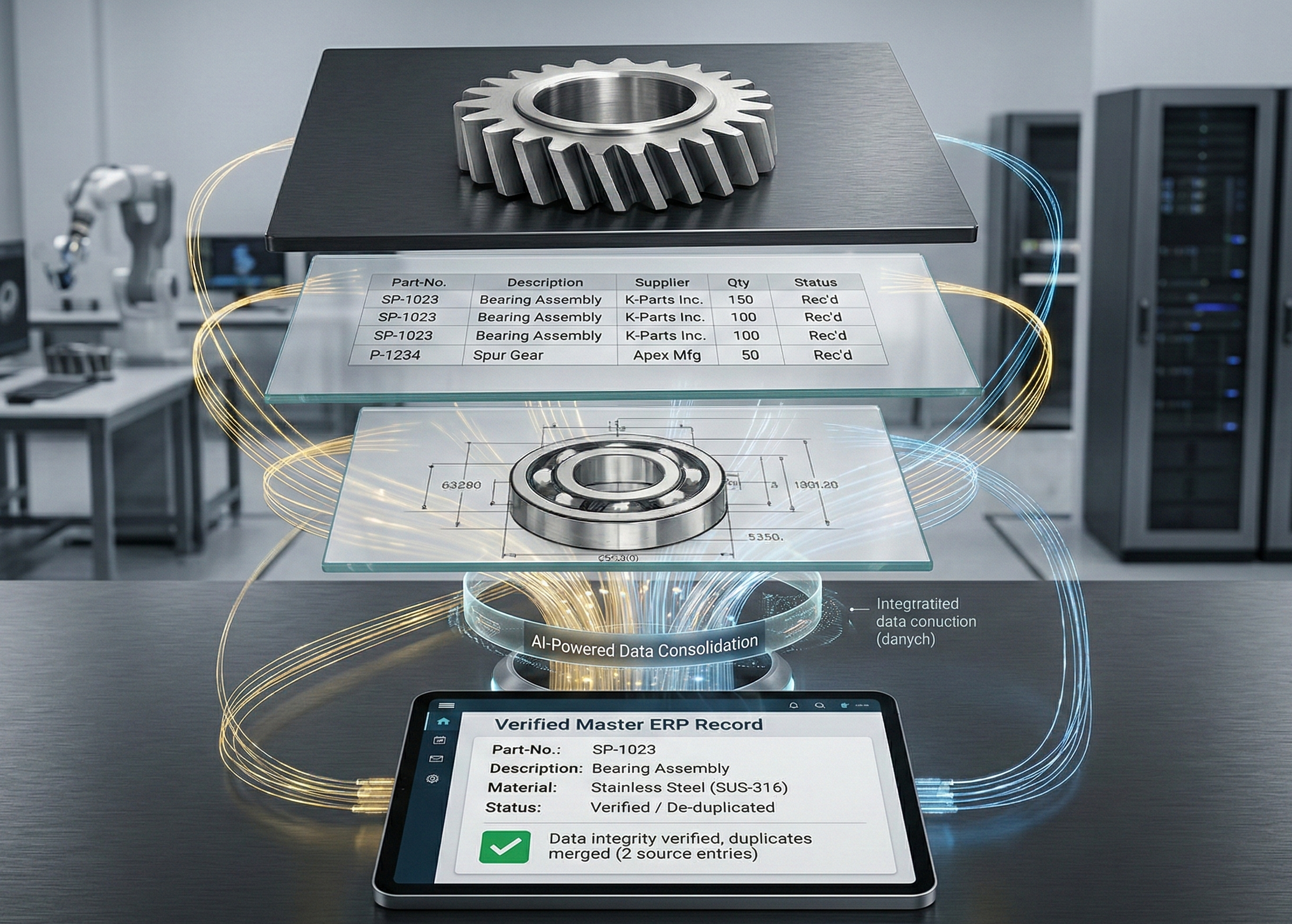
Extracting spare parts data manually is time-consuming and error-prone. AI tools now simplify this process, improving accuracy and saving time. Here are seven standout tools that can handle tasks like extracting data from nameplates, PDFs, and technical drawings, while integrating seamlessly with inventory systems:
- AutomaSnap: Extracts data from nameplate photos, even in poor conditions. Works via smartphone, integrates with ERP systems, and offers pricing tools.
- Partium: Identifies parts using photos or drawings, enriched by a database of 350M OEM parts. Reduces duplicates by 17% and integrates with platforms like SAP and Maximo.
- 3YOURMIND Part Identification: Processes 2D drawings for legacy equipment, evaluates manufacturing options, and creates centralized catalogs. Ideal for aerospace and defense.
- Verdantis AI: Extracts data from PDFs, 3D CAD files, and more. Enriches missing details and supports ERP integration. Reduces duplicate parts and overstock significantly.
- ThroughPut AI: Automates MRO workflows, preventing errors and optimizing inventory. Cuts inventory costs by 15–25% and boosts productivity by 30%.
- V7 Go: Processes damaged documents and schematics with up to 99.9% accuracy. Integrates with tools like SharePoint and Salesforce, reducing manual data entry by 90%.
- Skyvia: Focused on structured data extraction from SaaS apps and databases. Best for consolidating inventory data across platforms, starting at $15/month.
These tools streamline spare parts management, reduce costs, and enhance efficiency. Below is a quick comparison to help you choose the right tool. If you want to see how AutomaSnap turns extracted fields into better listings, compare the Data Enrichment and Quick Market Check workflows.
Quick Comparison Table
| Tool | Key Strengths | Integration Options | Starting Price |
|---|---|---|---|
| AutomaSnap | Nameplate extraction, pricing tools | Baselinker, Odoo, ebay | Free Trial |
| Partium | Visual search, deduplication | SAP, Maximo, Coupa | Varies |
| 3YOURMIND | Legacy 2D drawings, manufacturing | Centralized catalog, ITAR compliance | Free trial |
| Verdantis AI | PDF, CAD extraction, enrichment | SAP, Oracle, Maximo, Windchill | Varies |
| ThroughPut AI | MRO workflows, inventory optimization | SAP, Oracle, IBM Maximo | Varies |
| V7 Go | Damaged docs, schematics processing | SharePoint, Salesforce, Snowflake | Varies |
| Skyvia | Structured data extraction | Shopify, Dynamics 365, SQL databases | $15/month |
Choose the tool that aligns best with your needs, whether it’s reducing duplicates, automating data extraction, or integrating with your ERP system.
1. AutomaSnap
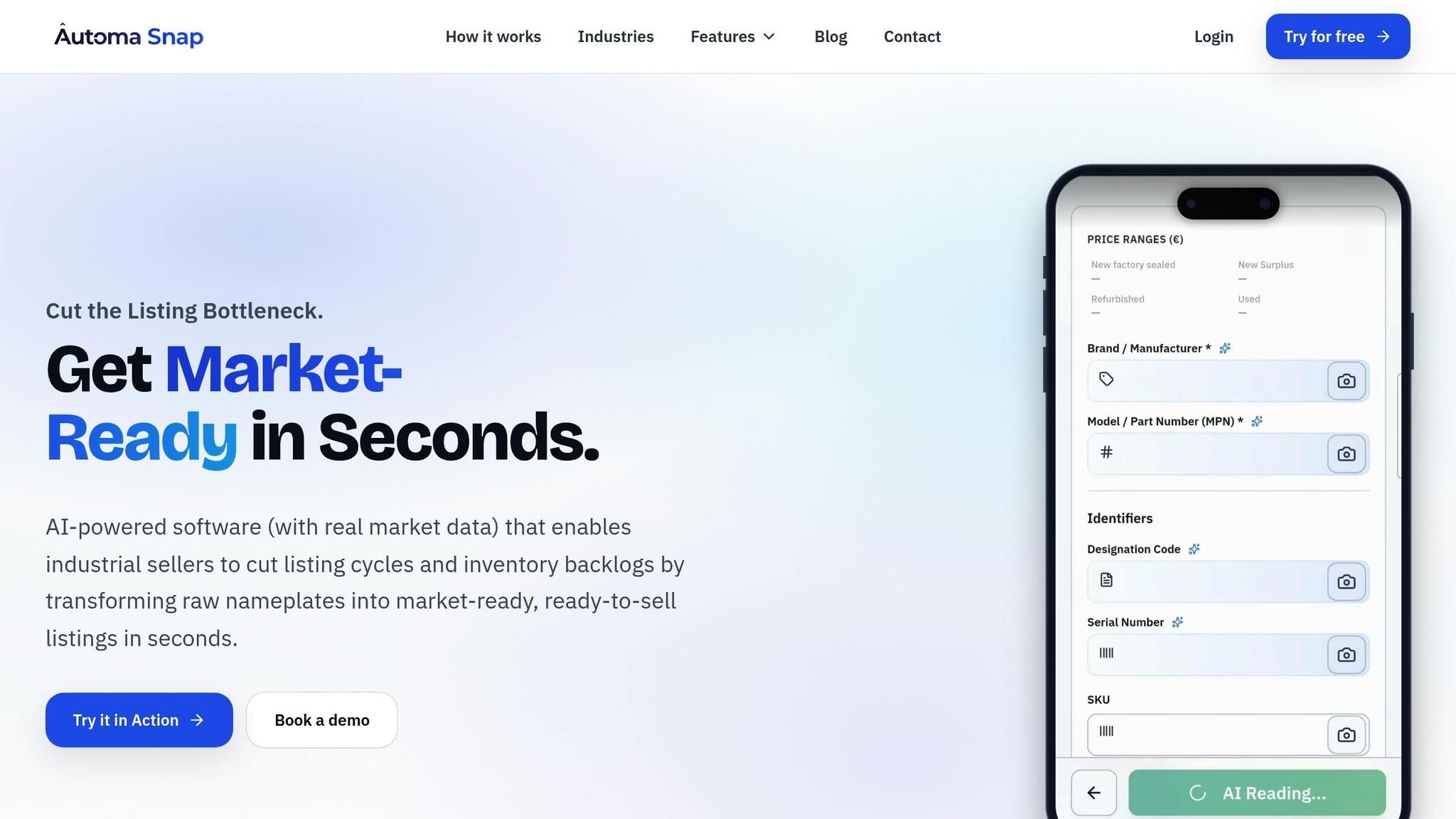
AutomaSnap is a tool designed to extract crucial information - like Brand, MPN, and Serial Numbers - from nameplate photos, even when dealing with tough conditions such as dirty labels, scratches, or poor lighting. This eliminates the errors often caused by manual rekeying. As Joseph Jacob from Sav puts it:
AI-driven image extraction can pull the same fields faster and with greater consistency than manual entry, accelerating data capture and reducing reliance on manual entry.
Beyond just accuracy, AutomaSnap offers a host of practical features. It can automatically remove backgrounds, creating clean, professional images for catalogs or online listings. It also exports the extracted data into ERP-ready spreadsheets that integrate seamlessly with platforms like prestashop, Odoo, ebay, and BaseLinker. Plus, it includes a built-in photo audit trail for added transparency.
Another standout feature is its market pricing integration. By connecting directly to eBay and Automanet, AutomaSnap saves hours of manual work by streamlining asset pricing and surplus inventory analysis.
The tool is accessible through any web browser using a smartphone camera, so there’s no need for extra hardware or software.
For asset recovery teams and manufacturers, AutomaSnap delivers real advantages: it reduces search time by 15–20% and helps prevent duplicate entries in 5–15% of spare parts records.
2. Partium
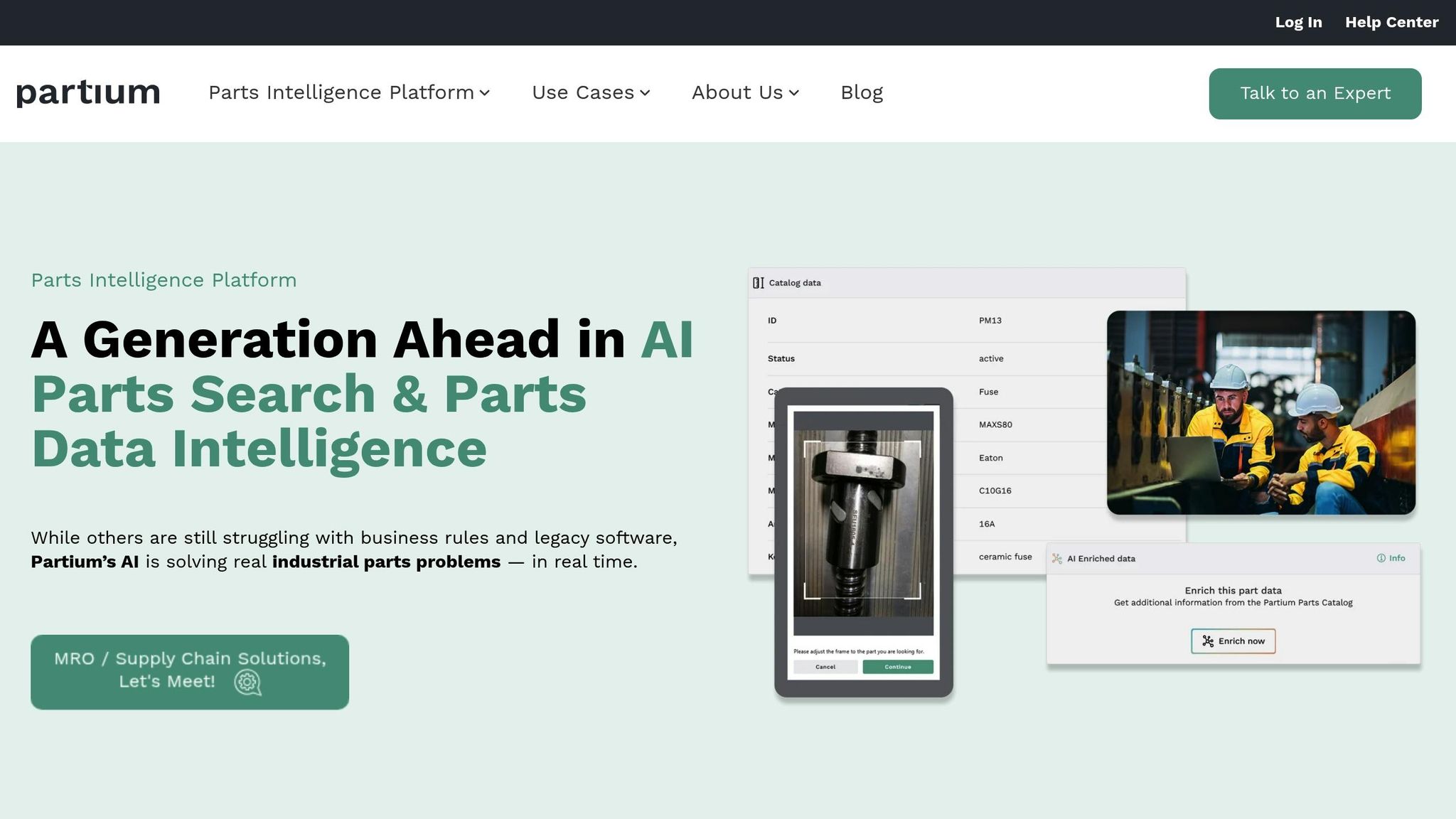
Partium uses visual search, OCR, and semantic text recognition to identify parts from photos, technical drawings, and even handwritten notes. With a database pre-trained on 350 million OEM-verified spare parts, the platform matches and enriches records almost instantly, making it a powerful tool for data extraction.
Data Extraction Capabilities
This tool works with multiple input formats. You can snap a photo of an unlabeled part, upload a technical drawing, or scan a Bill of Materials (BOM). Its Fusion AI search bridges these formats effortlessly, recognizing industry-specific synonyms and naming variations. For instance, it understands that “Hydraulic Seal” and “Seal, Hydraulic” refer to the same component, even if your catalogs use inconsistent naming conventions.
Integration with Inventory Management Systems
Partium integrates seamlessly with systems like SAP, Maximo, Coupa, and Ariba, and it doesn’t require a complete system overhaul. It can function as a standalone mobile app, a web interface, or be embedded into your existing ecosystem via SDK. The platform accepts native data formats, which eliminates the need for time-consuming manual data preparation.
For example, Wien Energie, a major European energy provider, adopted Partium to improve parts search and procurement processes. This implementation reduced downtime and streamlined their inventory management.
Beyond its integration capabilities, Partium includes advanced features that simplify and enhance spare parts digitization.
Key Features for Spare Parts Digitization
One standout feature is automated deduplication, which identifies duplicate entries in 17% of parts data. Using AI and fuzzy logic, it catches inconsistencies that traditional exact-match searches might miss. Additionally, the platform offers data enrichment, automatically filling in missing details like attributes, technical specs, product images, and CAD files from its verified database.
Another time-saving feature is its AI-based BOM checks, which can cut 60% of the time spent on manual line-by-line reviews.
Target Industries or Use Cases
Partium is tailored for industries like manufacturing, transportation, energy, utilities, and heavy equipment. Field technicians can save 15–30 minutes per search, while companies benefit from a 20% reduction in inventory stock by avoiding overstocking.
The platform’s OEM conversion feature is another cost-saving tool, identifying original parts manufacturers to help businesses bypass expensive OEM markups. This can result in 37% lower procurement costs. Pricing for Partium is based on a monthly fee, which varies depending on the size of your parts catalog. Initial AI training and onboarding typically take about four weeks.
3. 3YOURMIND Part Identification
3YOURMIND Part Identification uses cutting-edge AI to extract data from 2D technical drawings, offering a solution for organizations dealing with legacy equipment. Often, these drawings are the only documentation available. The software pulls critical details from title blocks, annotations, and notes - like materials, dimensions, and part numbers - and evaluates the feasibility of production methods such as CNC machining or 3D printing.
Data Extraction Capabilities
This platform is a game-changer in terms of speed. It processes technical drawings up to 200× faster than manual methods, analyzing thousands of files in just minutes instead of days. Beyond extraction, it evaluates the suitability of parts for various manufacturing methods.
“Our goal is to unlock the full potential of this existing data, enabling organizations to make faster, more informed manufacturing decisions.” - Stephan Galozy, Chief Product Officer, 3YOURMIND
Once the data is extracted, it can be seamlessly integrated into inventory systems, enabling immediate action.
Integration with Inventory Management Systems
The extracted data is organized into a centralized Part Identification Catalog, creating a digital inventory of spare parts ready for production. The system also provides cost and lead time estimates, helping companies weigh the benefits of re-engineering for advanced manufacturing versus sticking with traditional procurement.
Additionally, the platform supports distributed manufacturing by securely sharing part files and data with internal teams or external suppliers. With ITAR compliance and secure cloud hosting, it meets the stringent security requirements of defense and government sectors.
Target Industries and Use Cases
3YOURMIND is tailored for industries like defense, aerospace, and energy, where maintaining older equipment is essential. These sectors often rely on aging machinery with limited documentation, making rapid digitization a crucial need. Companies can even take advantage of a free trial to test the software on their legacy part catalogs. Looking ahead, the platform aims to introduce “text-to-3D” functionality, which would automatically generate 3D models from extracted text data.
4. Verdantis AI Data Extraction
Verdantis offers a powerful suite of AI tools designed to extract and manage spare parts data effectively. Among these tools, the Document Extraction Agent stands out for its ability to pull structured information from engineering drawings, technical PDFs, and both 2D and 3D CAD files. Meanwhile, Auto-Spec AI, trained on more than 1 billion data points, identifies key attributes, units of measure, and product categories from unstructured spare parts descriptions. If key data is missing, Auto-Enrich AI steps in, sourcing technical specifications from both public and proprietary databases. Together, these tools streamline the handling of diverse data sources with impressive speed.
Data Extraction Capabilities
Verdantis supports a wide range of formats, from legacy 2D PDFs to intricate 3D CAD models. By leveraging NLP (Natural Language Processing) and NER (Named Entity Recognition), the platform deciphers even the most complex part descriptions. AutoDoc AI transforms technical diagrams into structured, searchable master data records, while SpareSeek AI focuses on obsolescence management, suggesting alternative or interchangeable parts when originals are no longer available. The system achieves up to 90% accuracy in automated BOM-to-equipment mapping and reduces manual data cleansing efforts by as much as 50%.
Integration with Inventory Management Systems
Verdantis doesn’t just stop at data extraction - it ensures seamless integration with enterprise systems. The platform connects with major systems through APIs, SFTP, built-in connectors, or manual file uploads. It supports bi-directional integration with platforms like SAP (S/4HANA), Oracle EBS, IBM Maximo, Infor EAM, Microsoft Dynamics 365, and PLM systems such as Siemens Teamcenter and PTC Windchill. Cleansed data feeds directly into the material master, with the AI checking for duplicate materials and generating new material IDs only when necessary, maintaining data integrity at all times.
“Auto-Enrich AI and Auto-Spec AI are game-changers for enterprises looking to overhaul their data strategy. As our first AI Agents, they mark a major step towards our vision of becoming an AI Super-Agent for Master Data Management.” - Kumar Gaurav Gupta, CEO, Verdantis
Target Industries and Use Cases
In March 2025, a global energy company leveraged Verdantis to process over 100,000 legacy 2D drawings, achieving a 65% reduction in overstock and duplicates, along with 90% accuracy in BOM-to-equipment mapping. Around the same time, a manufacturing company used the platform to speed up its SAP S/4HANA migration by automating BOM extraction from more than 5,000 engineering drawings. This cut BOM processing time by 80% while ensuring compliance with ERP standards. Verdantis is particularly suited for asset-heavy industries like Oil & Gas, Metals & Mining, Chemicals, Food & Beverage, and Energy, where poor data quality can lead to costs averaging $12.9 million annually.
5. ThroughPut AI MRO Data Management
ThroughPut AI takes manual processes and turns them into automated, intelligent workflows. By leveraging decision intelligence, it extracts vital data about spare parts. The platform uses advanced document analysis to pull information from unstructured sources like drawings, manuals, and PDFs. Its BOM Intelligence feature simplifies data extraction from Bills of Materials, while its attribute enrichment tool fills in missing details - such as manufacturer information or dimensions - by analyzing existing data and established industry taxonomies. Additionally, it identifies duplicate parts hidden across fragmented systems.
Data Extraction Capabilities
The platform excels at processing complex documents, including drawings, manuals, and PDFs, turning them into structured, usable records. It even provides real-time error prevention during data entry. This is a game-changer for the industry, where challenges like unused spare parts are rampant - about 90% of MRO spares go unused after their purchase year, and up to 50% of spare parts in factories remain idle.
These advanced extraction capabilities work hand-in-hand with inventory workflows, ensuring smooth integration with existing systems.
Integration with Inventory Management Systems
ThroughPut AI amplifies its functionality by integrating seamlessly with major enterprise systems like SAP, Oracle, and IBM Maximo. It pulls MRO master data from current inventory systems and continuously validates it using AI models. Acting as an intelligence layer, it automates tasks like replenishment and procurement based on real-time usage patterns and lead times. The results speak for themselves: decision-making processes are up to 600 times faster, with a return on investment exceeding 50×.
Target Industries and Use Cases
ThroughPut AI caters to sectors such as manufacturing, oil & gas, utilities, chemicals, mining, aviation, and government & defense. Its primary focus is optimizing spare parts inventory - a crucial factor in avoiding expensive downtime. Companies use the platform for tasks like inventory optimization, aligning maintenance with supplier lead times, and redistributing surplus inventory across multiple sites. By adopting AI-driven spare parts management, businesses can achieve maintenance turnaround times that are 20%–30% faster and cut inventory costs by 15%–25%. The platform has also shown it can enhance labor productivity by over 30% while reducing lead times by more than 30%.
“In 2026, spare parts inventory is no longer a back-office activity - it is a strategic lever for uptime, resilience, and profitability.” – ThroughPut.ai
6. V7 Go Automated Document Processing
V7 Go offers a robust solution for document processing, tailored to handle complex spare parts data with precision and efficiency. This platform can process everything from high-resolution PDFs to water-damaged faxes, low-quality scans, and other outdated or damaged documents [44,51]. By combining advanced text and image analysis, V7 Go extracts information from scanned documents, photos, and technical drawings [9,48]. Its Visual Data Recognition Agent takes it a step further by interpreting engineering schematics and blueprints, identifying components, connections, and measurements with ease.
Data Extraction Capabilities
V7 Go delivers highly accurate results, achieving between 95% and 99.9% accuracy for document processing tasks - far exceeding the performance of standard OCR tools and traditional language models [45,46]. It can process 1,000 pages in just 2–3 hours, compared to the 40–60 hours typically required for manual work. The platform even handles handwritten notes and signatures on technical documents, which is essential for maintaining older records [44,48]. Each piece of extracted data links back to its original source, ensuring full traceability [44,45]. With support for over 50 languages and compatibility with formats like PDFs, TIFFs, JPEGs, PNGs, Word documents, and Excel spreadsheets, the platform adapts to a wide range of needs [45,47].
Integration with Inventory Management Systems
V7 Go doesn’t just extract data - it integrates seamlessly into existing workflows. Using API connections, the platform feeds processed spare parts data directly into business systems, ensuring smooth integration into production environments [47,49]. It supports popular tools like Microsoft SharePoint Online, Google Drive, Dropbox, Salesforce, and Snowflake data warehouses [44,47,49]. Users can customize schemas and field mappings to match their inventory systems, with outputs available in JSON, CSV, Excel, or SQL formats [47,49]. To maintain data accuracy, the system flags low-confidence extractions for human review, reducing the risk of errors in inventory records [44,45].
Target Industries and Use Cases
This platform is ideal for businesses looking to digitize old spare parts catalogs, turn engineering schematics into searchable databases, or pull component lists from technical drawings. By automating these tasks, users can reduce manual data entry by 90% and save up to 95% of the time typically spent on processing [44,47,49].
7. Skyvia Data Extraction Tools
Skyvia specializes in extracting structured and semi-structured data from over 200 sources, including SaaS applications, databases, and cloud storage. It handles formats like SQL, CSV, JSON, and Excel, making it ideal for predictable data structures. However, it’s not designed for unstructured data, such as nameplate photos or scanned documents, which require OCR engines or NLP models. This focus on structured data extraction aligns with broader efforts in AI-driven digitization.
Integration with Inventory Management Systems
Skyvia integrates seamlessly with systems relevant to inventory management, including Shopify, Microsoft Dynamics 365, Salesforce, and various SQL databases like SQL Server, MySQL, and PostgreSQL. It supports ETL, ELT, and reverse ETL processes, enabling businesses to consolidate spare parts data from operational systems into data warehouses like Google BigQuery, Snowflake, or Amazon Redshift. This eliminates data silos and ensures that maintenance and procurement teams have access to up-to-date information.
Key Features for Spare Parts Digitization
Skyvia automates critical tasks like data synchronization and cleaning, ensuring spare parts records stay accurate and consistent across platforms. Features include automated incremental loads using Change Data Capture and tools to handle complex API requirements like pagination and rate limits, ensuring stable data flows. Additionally, its SQL-based tools allow users to clean, deduplicate, and enrich spare parts data before integrating it into their systems.
Target Industries and Use Cases
Skyvia has proven effective for businesses migrating spare parts data from outdated databases to modern ERPs or consolidating inventory data scattered across multiple platforms. For instance, Redmond Inc. improved its inventory management with Skyvia. Senior Data/BI Engineer John Mcphillips shared:
“I definitely think that Skyvia has very good flexibility. It can do simple data exports or do things that are more complicated, which I’ve seen only in enterprise level tools.”
The platform offers a free plan for trial purposes, with its Basic plan starting at $15 per month. It’s also highly rated, with a 4.8/5 score on G2 Crowd, based on 242 reviews.
Conclusion
AI-driven spare parts data extraction has become a game-changer for operational efficiency. Take Deutsche Bahn, for instance: in 2024, they implemented an AI search tool for over 10,000 technicians, slashing search times from nearly 20 minutes to just seconds. The result? A staggering 16,800 person-days saved every year. With the right tool tailored to your needs, similar results are well within reach.
These time savings directly enhance resilience and cut costs. Pinpoint your biggest bottleneck - whether it’s duplicate entries or inconsistent naming conventions - and choose tools that can reduce duplicates by 5–15%. If speed is critical, look for solutions with image recognition capabilities that can identify parts in seconds, far outperforming the traditional 15–20-minute process. These aren’t just claims; real-world examples prove the impact.
Integration is key to scaling these benefits across your operations. Tools with prebuilt connectors for platforms like SAP, Oracle, or IBM Maximo ensure smooth data flow, which can shrink ROI timelines to just 3–6 months compared to the 18+ months often seen with older ERP systems.
The financial upside is undeniable. Companies report a 30–60% reduction in inventory value, up to a 60% cut in working capital spend, and a 10–15% production boost that drives a 4–5% increase in EBITA. These aren’t hypothetical gains - they’re measurable outcomes achieved by aligning the right tools with operational goals.
Start small. Focus on clean, high-quality data from the outset and equip your field teams with mobile tools for part identification. By integrating solutions like AutomaSnap into your workflow, spare parts management can evolve into a streamlined, high-return asset.
FAQs
Which tool fits my spare parts data sources?
The right tool for the job depends on the type of data you’re working with and your specific needs. For handling images or photos of spare parts, AutomaSnap is a great choice. It can pull structured data - like brand names, MPNs, and serial numbers - making tasks like inventory management and market analysis much easier. If you’re dealing with engineering documents or CAD files, tools like Verdantis are ideal for managing Bills of Materials (BOM). When it comes to cleaning and standardizing data, SPARROW.Clean uses advanced AI algorithms to harmonize master data across multiple locations efficiently.
How do I integrate extraction into my ERP?
To bring data extraction into your ERP system, leverage AI tools designed to work smoothly with ERP platforms. Focus on tools offering features such as export/import templates, live data synchronization, and API support for either real-time or scheduled syncing. These functionalities help automate data transfers, making inventory and spare parts management more accurate and efficient.
What data should I capture first for best ROI?
To get the most out of your ROI, prioritize collecting essential identification details such as Brand, MPN (Manufacturer Part Number), and Serial Number. By automating the process of extracting these unique identifiers, you can simplify inventory management and speed up market verification. This not only saves time but also boosts overall efficiency.
Best next step
See how AutomaSnap turns raw fields into sellable data
The Data Enrichment workflow adds structured copy, cleaner attributes and export-ready output for industrial listings and ERP updates.