On this page
Digital Twin Dashboards for Spare Parts Management
Managing spare parts efficiently is a constant challenge. Too many parts increase costs, while shortages can disrupt operations. Digital twin dashboards offer a solution by creating real-time virtual models of inventory systems. These tools provide up-to-date data, predictive insights, and actionable alerts, all in one interface.
Key Benefits:
- Real-Time Tracking: Connects to IoT devices for live updates on inventory levels.
- Predictive Analytics: Forecasts demand and simulates scenarios to balance stock.
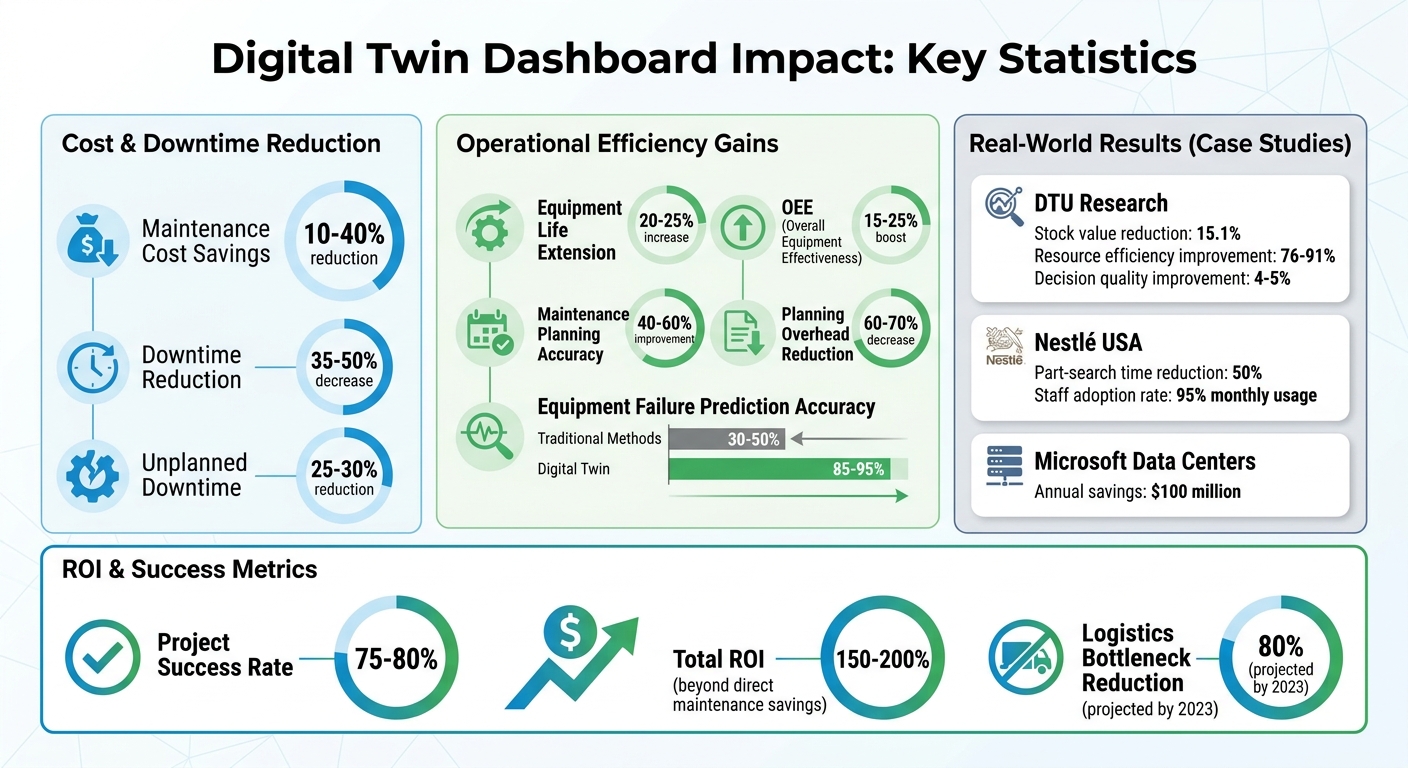
- Cost Savings: Reduces maintenance expenses by 10-40% and downtime by 35-50%.
- Custom Visualizations: Simplifies complex data with clear, adjustable dashboards.
Highlights from Case Studies:
- ASML: Used digital twins to refine inventory strategies and cut costs.
- Nestle USA: Achieved a 50% reduction in part-search time and centralized critical spares.
- DTU Research: Reduced stock value by 15.1% and improved decision-making efficiency.
Digital twin dashboards not only streamline inventory management but also enhance decision-making with clean data and predictive tools. As AI and IoT evolve, these systems are becoming indispensable for modern supply chains.
How can the Inventory Digital Twin by Goldratt Research Labs help you reduce shortages and surpluses

Main Features of Digital Twin Dashboards
Digital twin dashboards combine advanced tools to transform how spare parts are tracked and managed. By replacing outdated manual methods with intelligent, automated systems, they provide a real-time reflection of inventory conditions.
Real-Time Data Integration
Traditional inventory systems often rely on periodic manual counts, which are prone to delays and inaccuracies. Digital twin dashboards eliminate these inefficiencies by directly connecting to IoT sensors and devices, ensuring continuous, live updates. For example, RFID readers track the movement of parts across warehouse zones, while smart shelves equipped with weight sensors calculate quantities by dividing the total shelf weight by the known weight of individual items.
These systems also introduce automated alerts. When stock levels drop below predefined thresholds, the dashboard sends immediate notifications, helping prevent stockouts of critical components. With bidirectional data flow, changes in the digital model can trigger real-world actions, such as reordering supplies or adjusting workflows. Stream analytics further enhance reliability by detecting anomalies like sudden inventory changes, which could signal theft, sensor issues, or system errors. This level of real-time insight supports proactive and informed decision-making.
Predictive Analytics for Inventory Optimization
Building on real-time data, predictive analytics take inventory management a step further by forecasting demand and simulating various scenarios. By combining historical trends with live data, these models accurately predict spare parts demand, helping businesses strike the right balance between overstocking and running out of stock. Beyond simple forecasting, predictive tools allow for “what-if” simulations, enabling companies to test responses to potential events like supply chain disruptions or unexpected demand spikes.
A great example of this is ASML, which used a digital twin to refine its inventory strategies by learning from past outcomes and adjusting base stock levels accordingly. Predictive models also factor in holding costs, stock-out risks, and potential sales losses to minimize overall supply chain expenses. When paired with predictive maintenance systems, these dashboards can even anticipate equipment failures and ensure the necessary spare parts are available in advance.
Customizable Visualization Tools
To complement data integration and predictive capabilities, digital twin dashboards offer customizable visualization tools that make complex data easy to understand. These dashboards often feature hierarchical layouts - such as Warehouse > Zone > Shelf > Product - along with SKU-level summaries that highlight critical details like “below reorder” alerts for quick action.
Visualization tools also help identify inventory discrepancies by comparing planned performance with actual results. Advanced options include 3D modeling and simulations, which allow managers to experiment with warehouse layouts and optimize space usage or SKU velocity without making physical changes.
Real-time status indicators provide continuous updates, replacing outdated snapshots with live telemetry. As Thomas Kaiser aptly put it:
Digital twins are becoming a business imperative, covering the entire lifecycle of an asset or process, and forming the foundation for connected products and services. Companies that fail to respond will be left behind.
These visualization features give inventory managers the clarity and precision needed to meet the demands of today’s fast-paced supply chains.
Research and Case Studies on Dashboard Impact
Recent studies and real-world applications confirm how digital twin dashboards can significantly transform spare parts management. Below are some compelling examples that highlight the tangible benefits of real-time data and predictive analytics.
Improving Inventory Accuracy and Turnover
In early 2026, researchers at the Technical University of Denmark (DTU), led by Simon Klarskov Didriksen, developed and implemented a spare parts management data model across 10,843 spare parts. By integrating maintenance, logistics, and inventory data into one unified system, they dismantled organizational silos. The results were impressive: a 15.1% reduction in stock value, a 76-91% improvement in resource efficiency (measured in full-time equivalent hours), and a 4-5% improvement in decision quality.
Didriksen highlighted the impact of the model:
Model implementation led to a 15.1% stock value reduction, a 76-91% full-time equivalent resource improvement, a 4-5% decision quality improvement, and an enhancement of decision-maker engagement.
These improvements in inventory accuracy paved the way for notable cost reductions, as explored in the next section.
Cost Reduction Through Better Stock Management
Digital twin dashboards excel at cutting costs by eliminating redundant inventory. For instance, in March 2026, Nestle USA integrated an AI-powered dashboard into their SAP system across their factory network. Spearheaded by Senior Engineering Maintenance Manager Steven Gould and Senior Expert Maintenance Engineer Andy Goldinger, the initiative focused on standardizing data entry and implementing duplicate detection. The results were striking: a 50% reduction in part-search time and a 95% monthly usage rate among staff. By providing visibility across all sites, Nestle centralized high-cost critical spares instead of stocking them at every location, significantly reducing working capital.
Similarly, a 2023 study by G. Sirri and R. Accorsi at an Italian automatic packaging machine company demonstrated how digital twins can reduce overall supply chain costs. Their model balanced cost and reliability, effectively controlling service levels while lowering holding costs, minimizing stock-out risks, and reducing the likelihood of lost sales. Research from Northumbria University by Alireza Shokri further showed that integrating predictive maintenance with inventory management through digital solutions can address spare part shortages while cutting supply chain and inventory costs.
Efficiency Gains in Operations
The benefits of digital twin dashboards extend beyond cost savings - they also streamline operations and improve teamwork. These systems have been shown to reduce unplanned downtime by 25-30% and extend equipment life by 20-25% compared to traditional methods. Maintenance planning accuracy improves by 40-60% with digital twin insights, and prediction accuracy for equipment failures reaches 85-95%, far exceeding the 30-50% accuracy typical of conventional condition monitoring.
Digital twins also enhance resource allocation. They enable autonomous maintenance scheduling, cutting planning overhead by 60-70%, while real-time performance optimization boosts Overall Equipment Effectiveness (OEE) by 15-25%. Properly implemented projects achieve success rates of 75-80%, and total ROI often surpasses direct maintenance savings by 150-200% when factoring in production and quality improvements. These operational advancements naturally lead to discussions about how AI-driven tools can further enhance dashboard performance.
Integrating AI Tools for Better Dashboard Performance
Accurate, real-time data is the backbone of digital twin dashboards, enabling them to deliver powerful insights, as outlined previously. However, many systems still rely on manual data entry for spare parts information - technicians typing in details like nameplate data by hand. This manual process often introduces errors that can ripple through inventory records, affecting decision-making. AI-powered tools are changing the game by automating data extraction from physical assets, eliminating manual errors, and continuously improving dashboard performance.
AI-Driven Data Extraction for Clean Inputs
Tools like AutomaSnap leverage computer vision and OCR technology to extract structured data - such as Brand, MPN, and Serial Number - directly from nameplate photos taken on a smartphone. This process eliminates the need for manual data entry, significantly reducing errors. Even with worn or damaged labels, these tools can convert a simple photo into clean, structured records in seconds.
A great example of this in action comes from ASML, a semiconductor equipment manufacturer. By implementing AI-driven data extraction, they developed a digital twin that created a feedback loop between spare parts planning and actual performance. Feeding clean, accurate data into their system allowed them to pinpoint the root causes of performance issues and adjust stock levels as needed. Without clean inputs, even the most advanced dashboards can generate unreliable recommendations, making these AI tools essential.
ERP-Ready Exports for Simplified Processes
AI extraction tools don’t just clean up data - they make it easy to use. They generate export-ready files in formats like CSV, JSON, and XML, which are compatible with ERP systems such as SAP, Odoo, and Dynamics 365. This eliminates the need for additional middleware or manual reformatting, addressing a key challenge in digital twin implementations: ensuring seamless data compatibility.
Take Microsoft’s 2024 initiative as an example. By insourcing spare parts management for its global data centers and using a digital twin-powered SAP platform, Microsoft saved nearly $100 million in just one year while also reducing emissions. The success of this initiative relied heavily on standardized, compatible data - precisely the kind of output that AI-driven tools provide. These standardized exports not only simplify integration but also enable smoother automation across systems.
Improving Spare Parts Visibility with Automation
Automated data capture doesn’t just clean up inputs - it keeps physical and digital systems in sync. By unifying ERP and CMMS views, AI tools ensure that inventory records update in real time, flagging only exceptions for manual review. This synchronization ensures that dashboards remain up-to-date, enabling predictive features like automated purchase orders and maintenance alerts.
For example, when parts move through a facility, these tools update inventory records automatically. This real-time synchronization allows dashboards to predict stockouts and trigger actions before they happen, significantly improving operational efficiency. The result? A streamlined approach to spare parts management that boosts both productivity and reliability.
Challenges and Future Trends in Digital Twin Dashboards
Data Standardization and Integration Challenges
One of the biggest hurdles in implementing digital twins is bringing together data from different systems. Information is often stored in various formats across maintenance, logistics, inventory, and equipment IT systems, making it difficult to achieve smooth communication between them. For older infrastructures, connecting with modern digital systems often requires costly middleware solutions.
Another critical issue is data quality. As Johann Diaz from Service Revolution Academy puts it:
Digital twins are only as smart as the data feeding them.
If the sensor data is incomplete or noisy, it can lead to inaccurate predictions and poor decisions, especially in areas like stock management.
However, progress is being made. Frameworks like the Asset Administration Shell (AAS) offer modular solutions for achieving semantic interoperability across different systems. Additionally, OPC UA information models are helping create unified address spaces that can organize and process data from multiple sources. For companies struggling with sensor noise, edge-based deep learning techniques are proving useful by filtering out anomalies and refining data before it even reaches the dashboard. These advancements are critical for addressing the challenges of scaling digital twin solutions.
Scalability and IoT-Digital Twin Integration
Scaling digital twins from small pilot projects to full-scale enterprise solutions brings its own set of challenges. As data volumes grow, cloud-based architectures become crucial for managing the massive computational demands. By 2023, experts projected that 30% of manufacturers would enhance their shop floor digital twins with real-time signal transponder data, cutting logistic bottlenecks by 80%.
Examples from the field highlight this potential. At Danone’s Wexford facility in Ireland, a 3D digital twin ecosystem reduced the need for on-site visits by 50% and sped up project timelines by weeks, according to Digital Innovation Manager Stuart Grace. Similarly, Siemens digitized their 43,000 ft² factory in Lisbon, integrating IoT sensor data into a digital twin that has been accessed over 20,000 times by stakeholders for better operational insights.
The key to scaling lies in focusing on high-value assets first, where ROI can be demonstrated quickly, and then expanding from there. Modular designs make it easier to add new assets without overhauling the entire system, while robust data governance frameworks ensure quality and compatibility as the network grows. These strategies are crucial as businesses prepare for the next generation of AI-enabled digital twins.
Future Research on AI and Digital Twin Synergy
Once integration and scalability challenges are addressed, the focus shifts to leveraging AI for smarter, more adaptive digital twins. Emerging innovations include generative AI and large natural language processing models, which are being used to automate complex design tasks and replicate human expertise when operators are unavailable. Another exciting development is physics-ML hybrid modeling, which combines IoT telemetry with physical principles and machine learning to improve predictions, such as Remaining Useful Life (RUL) estimations.
High-quality data remains the foundation for these AI advancements. Self-calibrating adaptive models are a major step forward, using online learning to adjust for wear and changing conditions in physical assets. Research from 2025 highlights how these adaptive frameworks improve early-fault detection and reduce false alarms compared to static models.
The rise of Industry 5.0 emphasizes the collaboration between humans and AI rather than focusing solely on automation. As Johann Diaz advises:
Test it, prove the value, then go bigger.
To make the most of AI-driven digital twins, organizations need to prioritize data validation to avoid the pitfalls of “garbage in, garbage out” scenarios. Combining AI with human expertise can further strengthen these systems, ensuring they are both accurate and robust.
Conclusion: The Potential of Digital Twin Dashboards
Digital twin dashboards are reshaping spare parts management by using real-time data to predict what parts are needed, when, and where. Johann Diaz highlights this shift perfectly:
It’s not just about stocking the right parts - it’s about getting the entire operation in sync.
Take semiconductor manufacturers as an example - they’ve successfully used digital twins to fine-tune inventory base stock levels and lower supply chain costs.
Looking ahead, the potential of digital twin dashboards continues to grow. As AI and IoT technologies advance, these dashboards are evolving beyond basic monitoring into systems that manage overall operational health. The move toward Industry 5.0 emphasizes collaboration between humans and AI, blending predictive analytics with professional expertise to improve reliability and minimize waste. This transition underscores the importance of digital twins in optimizing spare parts management. Companies that start with small-scale implementations and demonstrate clear value can quickly scale up and reap the benefits.
To stay competitive, spare parts professionals need to take proactive steps. Prioritizing high-quality data, training teams to interpret dashboard insights, and testing digital twin technology on a smaller scale are all critical first steps to achieving a fast return on investment. Tools like AutomaSnap can further boost dashboard performance by ensuring inventory data is accurate and complete. The technology is ready - now it’s up to organizations to take action.
FAQs
What data is needed to build a digital twin for spare parts?
To build a digital twin for spare parts, you’ll need a mix of detailed and real-time data. Start with information on inventory levels, service performance, costs, supply chain reliability, maintenance schedules, logistics, and the equipment itself. Incorporating real-time operational data can further enhance its accuracy. Together, these inputs allow for better inventory management and streamlined workflows.
How do digital twin dashboards predict stockouts and downtime?
Digital twin dashboards combine real-time monitoring, predictive analytics, and simulation models to keep tabs on equipment and inventory conditions. This approach allows businesses to address maintenance needs and make inventory adjustments before problems arise, reducing the risk of failures and shortages. By spotting potential issues early, these tools help streamline workflows and cut down on disruptions.
How do I start a small pilot and prove ROI fast?
To show ROI quickly in spare parts management, begin by using AI-powered tools to streamline inventory intake and boost data accuracy. Start small - perhaps with a pilot program targeting a specific warehouse or product line. Track metrics like inventory accuracy, downtime reduction, and cost savings. This focused strategy not only highlights measurable benefits but also helps refine workflows in a relatively short period.