On this page
Disorganized ERP data for spare parts can lead to inventory mismatches, delays, and frustrated customers. Manual validation, while familiar, is prone to errors, slow, and costly - especially for large inventories. AI-powered tools, like AutomaSnap, offer faster, more accurate alternatives by automating data extraction and validation.
Key Takeaways:
- Manual Validation: Relies on human input, with a 4% error rate and high costs (~$28,500/employee annually). Struggles with scalability and efficiency.
- AI Validation: Processes parts in seconds, reduces errors, and integrates with ERP systems for real-time updates. Costs start at $0.35–$0.50 per part.
Quick Comparison:
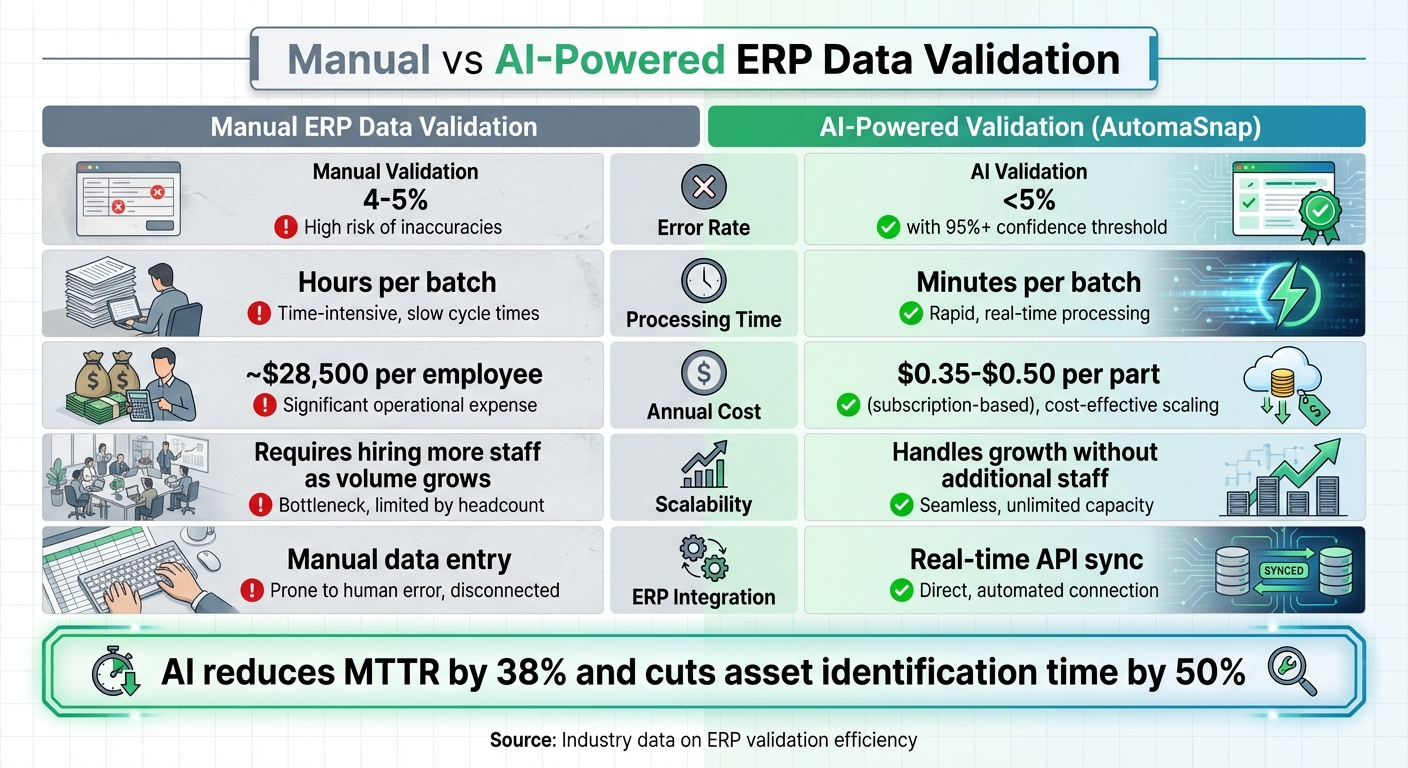
| Factor | Manual Validation | AI Validation (AutomaSnap) |
|---|---|---|
| Error Rate | 4–5% | Less than 5% (confidence-based) |
| Processing Time | Hours per batch | Minutes per batch |
| Annual Cost | ~$28,500 per employee | Subscription-based ($0.35–$0.50/part) |
| Scalability | Requires more staff | Handles growth without extra staff |
| ERP Integration | Manual data entry | Real-time sync via APIs |
AI tools save time, reduce costs, and improve accuracy, making them ideal for businesses managing large inventories or upgrading ERP systems. With features like image-based data extraction and confidence thresholds, they ensure reliable data and smoother operations.
The Importance of AI Data Validation: Building Reliable Models with Accurate Data Labeling
1. Manual ERP Data Validation
Manual ERP data validation for spare parts relies heavily on human effort, involving tasks like inspecting parts, reading nameplates, and cross-referencing catalogs. The collected information is then entered into spreadsheets or ERP systems. While this method has been a long-standing practice, it comes with several drawbacks that can impact overall operations. Let’s break down these challenges in terms of accuracy, efficiency, scalability, and cost.
Data Accuracy
Mistakes are inevitable when humans are tasked with managing ERP data. Workers might misread nameplates or incorrectly input manufacturer part numbers. Even a minor typo can lead to incorrect orders, shipping delays, and dissatisfied customers. Damaged or worn nameplates only add to the uncertainty, leading to incomplete or inaccurate records.
Time Efficiency
The process of identifying and verifying spare parts is far from quick. Workers must confirm specifications and ensure compatibility, which can be especially taxing for distributors managing large inventories. These inefficiencies trickle down, as technicians often waste valuable time searching for parts due to inconsistencies in ERP data. Over time, this creates a frustrating cycle of lost productivity.
Scalability
When inventory levels grow, manual validation quickly becomes a bottleneck. Meeting increased demand often requires hiring more staff, which drives up costs without significantly improving speed or accuracy. Seasonal spikes in demand or large-scale equipment liquidations can overwhelm manual teams, leading to delays and backlogs. This inability to scale efficiently underscores the need for solutions that can handle higher volumes without requiring proportional increases in resources.
Cost Effectiveness
At first glance, manual validation might seem like a cost-effective option, relying mainly on basic tools and labor. However, hidden expenses can pile up. Wages, overtime during peak periods, and the cost of fixing errors all add to the financial burden. Mistakes in data entry can result in ordering incorrect parts, delaying shipments, and losing potential sales. Moreover, skilled technicians often spend time on routine validation tasks when they could be focusing on more critical, higher-value responsibilities.
2. AI-Powered ERP Data Validation (e.g., AutomaSnap)
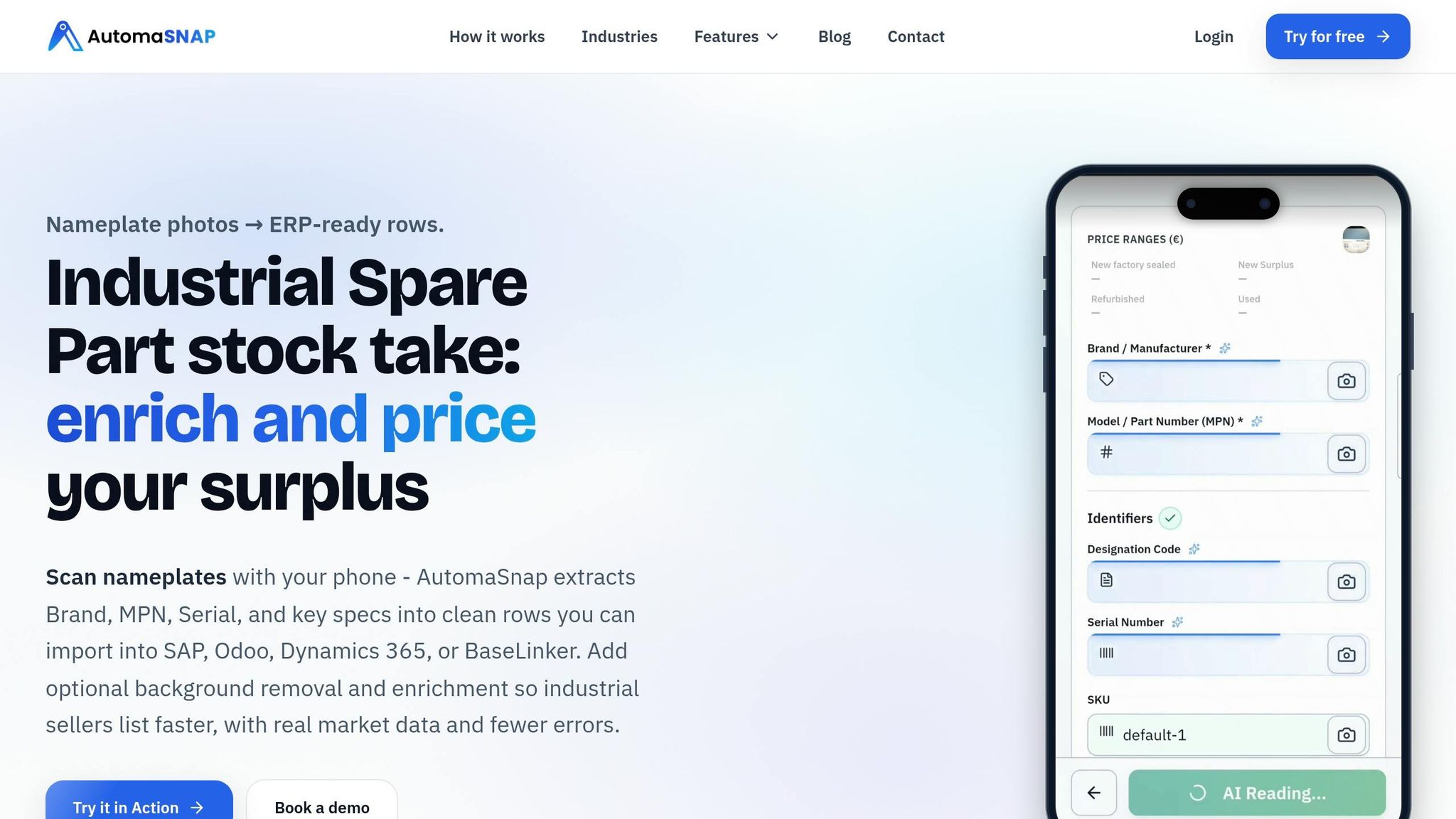
AI tools are reshaping how spare parts distributors and manufacturers handle ERP data validation. Take AutomaSnap, for example. This platform uses cutting-edge Vision-Language Models (VLM) to pull structured data straight from nameplate images. It can interpret technical details, tell apart similar identifiers, and even assign confidence scores. If the confidence level dips below 95%, the system flags the data for human review.
Data Accuracy
By cross-checking extracted data against ERP master tables via API connections, AI validation minimizes errors. Before any data is posted to systems like SAP or Dynamics 365, the AI ensures that vendor codes and SKUs are valid and active. This prevents costly errors, which can lead to a “domino effect” - a common issue that costs organizations around $15 million annually due to poor data quality. A strong case for this is TUEG Schillings GmbH, which developed an AI system to handle corroded nameplates in the chemical industry. The result? A 50% cut in asset identification time by combining image analysis with natural language understanding. Better accuracy means smoother, faster operations.
Time Efficiency
AI validation doesn’t just improve accuracy - it also saves time. These systems can significantly reduce processing times, boosting overall efficiency. For instance, AI solutions can lower Mean Time to Repair (MTTR) by about 38%, freeing up technicians to tackle more complex tasks instead of mundane data entry.
Scalability
One of the standout benefits of AI validation is its ability to scale. Whether it’s 50 parts or 5,000, the process maintains its speed and accuracy. Integration with ERP platforms ensures real-time syncing of data across operations, eliminating bottlenecks during busy periods like seasonal demand spikes or large-scale equipment liquidations. For distributors with expanding inventories, this means managing growth without adding staff or compromising data quality. The result? Streamlined operations and lower costs.
Cost Effectiveness
Manual data entry isn’t cheap - it costs an average of $28,500 per employee each year. By comparison, AutomaSnap offers a cost-effective alternative, with pricing starting at $0.50 per part for smaller volumes and dropping to $0.35 per part for larger batches of 500 or more. Beyond these savings, AI systems also cut costs tied to order errors, shipping delays, and overtime during peak times.
Pros and Cons
When comparing different validation methods, the performance gaps become evident when you look at measurable results. Manual validation offers the benefit of direct human oversight, which can be helpful for unique or uncommon spare parts. However, manual processes tend to struggle in tough environments, showing consistent error rates that can lead to major inaccuracies, especially when processing thousands of parts at scale.
To tackle these challenges, AI-powered validation tools like AutomaSnap step in as a game-changer. By using Vision-Language Models, these systems can differentiate between a Model Number and a Serial ID - a task where traditional OCR tools often fail. Additionally, the system flags any extraction with less than 95% confidence for human review, drastically cutting down on mistakes.
The cost difference is another critical factor. Manual data entry can cost around $28,500 per employee annually, factoring in both the time spent and the cost of correcting errors. On the other hand, AI-powered solutions operate on a subscription model, offering significant savings for businesses.
Here’s a side-by-side breakdown of the differences:
| Factor | Manual Validation | AI-Powered Validation (AutomaSnap) |
|---|---|---|
| Error Rate | 4–5% in harsh environments | Less than 5% with confidence thresholds (≥95%) |
| Processing Speed | Hours per batch | Minutes per batch |
| Annual Cost | ~$28,500 per employee | Lower cost with subscription pricing |
| Scalability | Needs more staff as volume grows | Scales easily without extra staff |
| ERP Integration | Manual data transfer | Real-time API sync with top ERP systems |
While AI systems do require initial setup and fine-tuning - such as setting confidence thresholds (e.g., 97%+ for financial data and 95%+ for crucial identifiers like Vendor or PO numbers) - once optimized, they handle high volumes effortlessly. This makes them particularly valuable during busy periods, delivering both cost efficiency and speed.
Conclusion
AI-powered ERP data validation offers a clear advantage in speed, accuracy, and long-term cost savings. While manual validation might work for smaller operations, it quickly becomes inefficient as volumes grow. With each employee costing an average of $28,500 annually, the financial impact of sticking with manual processes can be substantial.
Tools like AutomaSnap tackle these inefficiencies head-on by drastically reducing processing times and automating repetitive tasks. Today’s technology has moved beyond simple OCR capabilities - Vision-Language Models now handle nuanced tasks, like differentiating between a Model Number and a Serial ID, which previously required human input. These systems maintain data integrity by flagging low-confidence cases for human review, ensuring accuracy at scale.
For businesses handling large volumes, the benefits are even more pronounced. These systems integrate effortlessly with ERP platforms like SAP, Odoo, and Dynamics 365 via real-time APIs. Companies such as TUEG Schillings GmbH have already seen impressive results, cutting asset identification time by 50%, even in demanding industrial environments.
This approach also aligns with modern regulatory requirements, which increasingly demand precise asset tracking. AI-driven validation ensures compliance without adding unnecessary administrative burdens.
FAQs
What spare-parts data fields should we validate first in our ERP?
When it comes to validating spare-parts data in your ERP system, start with the essentials: serial numbers, MPNs (Manufacturer Part Numbers), and brands. These identifiers play a crucial role in maintaining accurate inventory records and reducing potential errors. Tools like AutomaSnap can simplify this process by using AI to extract and verify these details directly from nameplates and images, making spare parts management more efficient.
How do confidence thresholds work, and who reviews low-confidence parts?
Confidence thresholds represent the level of certainty an AI system needs to automatically validate data. When parts of the data fall below this threshold, they are marked as low-confidence. These flagged sections are usually handed over to human experts for manual review to ensure everything is accurate before being uploaded to the ERP system.
What is needed to integrate AI validation with SAP or Dynamics 365?
To connect AI validation with SAP or Dynamics 365, you’ll need to focus on a few key steps:
- Set up API data synchronization: This allows both systems to communicate effectively, ensuring data flows seamlessly between them.
- Map fields between systems: Align corresponding fields in the AI tool and SAP or Dynamics 365 to prevent errors and maintain consistency.
- Enable workflow automation: Automating workflows helps ensure real-time data transfer and validation, streamlining operations without manual intervention.
By handling these steps, you can achieve smooth integration and maintain accurate, up-to-date information across platforms.