On this page
Generative AI is transforming spare parts pricing by replacing outdated methods with real-time, data-driven strategies. Businesses using AI-driven pricing report increased revenue, reduced costs, and improved customer retention. Here’s how it works:
- Dynamic Pricing Simulations: AI evaluates “what-if” scenarios to adjust prices based on demand, inventory, and competitor behavior. Companies see profit margins improve by 10–25%.
- Demand Forecasting: AI analyzes multiple data streams to predict part needs, reducing inventory errors by up to 50% and cutting carrying costs by 25–35%.
- Alternative Parts Recommendations: AI identifies substitutes for unavailable parts, ensuring operational continuity and competitive pricing.
- Personalized Pricing: AI tailors prices to individual customers, boosting earnings by 10% while maintaining margins.
- Predictive Pricing: AI anticipates maintenance needs and adjusts prices accordingly, reducing downtime and emergency costs.
Generative AI simplifies complex pricing tasks, enabling businesses to act faster and smarter while meeting market demands. Tools like edge-enabled AI and natural language interfaces make these solutions accessible to companies of all sizes.
Dynamic Pricing Simulations
How Generative AI Simulates Pricing Scenarios
Generative AI transforms pricing from a static, spreadsheet-driven chore into a dynamic, interactive process. By running “what-if” scenarios, it evaluates factors like demand shifts, inventory levels, and market conditions. This approach replaces outdated, reactive pricing methods with strategies that respond to real-time data. It achieves this by integrating multiple data sources, offering insights into potential pricing disruptions.
Edge AI models and reinforcement learning agents play a key role here. These tools use compact machine learning algorithms that operate locally, enabling quick pricing adjustments. For example, they can estimate part values in seconds by analyzing live telemetry, regional demand, and competitor inventory. Retrieval-augmented generation (RAG) further strengthens these models by anchoring them in trusted enterprise data, ensuring the outputs are based on accurate technical specifications and historical trends rather than generic forecasts.
Additionally, competitive response modeling helps predict how competitors might react to pricing changes. This prevents damaging price wars while maintaining market share. AI-driven quoting engines add another layer of efficiency by extracting details from customer requests and applying complex discount rules automatically. What once took days can now be done in minutes.
These simulations align seamlessly with inventory optimization strategies, which are explored in the next section.
Benefits of Dynamic Pricing for Spare Parts Distributors
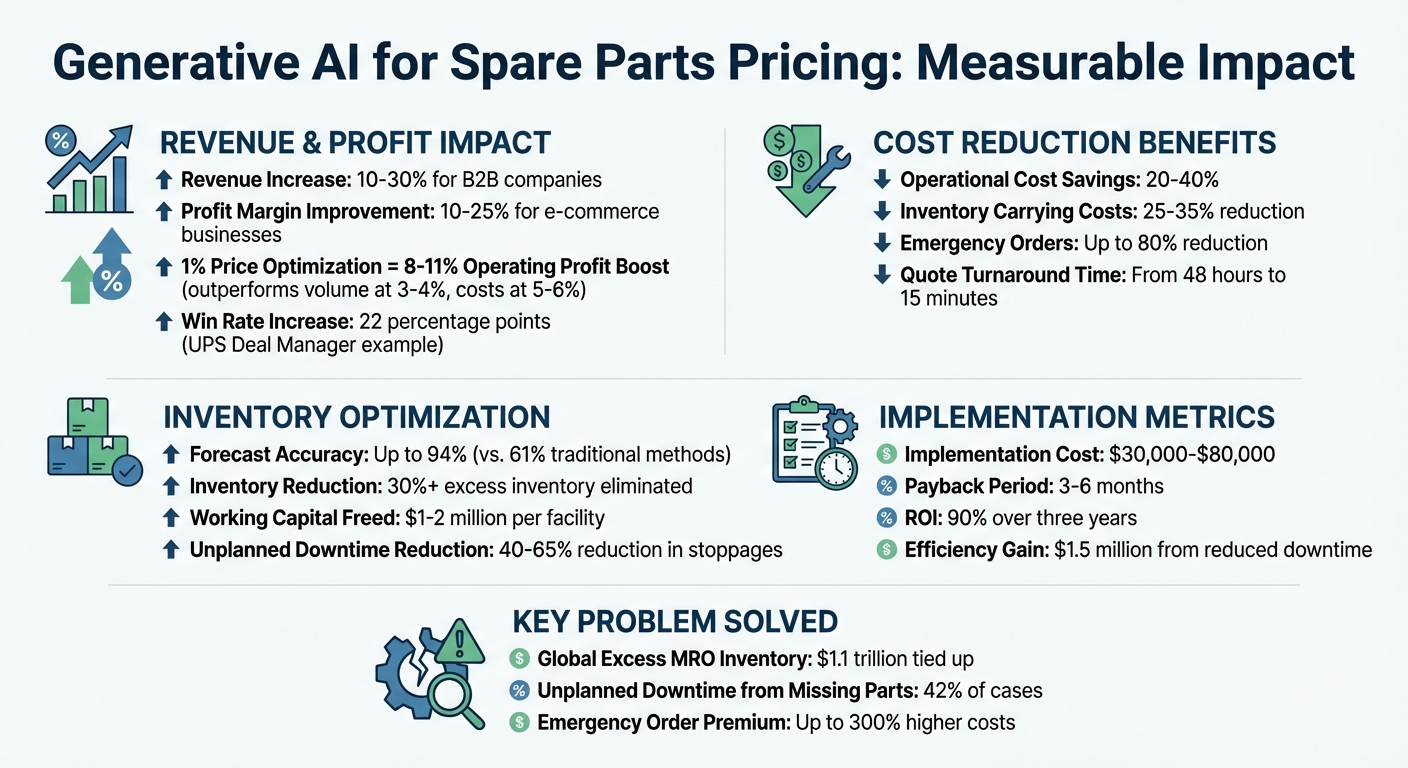
The financial upside of dynamic pricing is hard to ignore. A 1% improvement in price optimization can boost operating profit by 8% to 11%, outperforming gains from volume increases (3% to 4%) or cost reductions (5% to 6%). AI-driven pricing simulations typically lead to revenue increases of 5% to 15% and profit margin improvements of 10% to 25% for e-commerce businesses. For B2B companies, generative AI pricing solutions have delivered revenue growth of 10% to 30%, while cutting operational costs by up to 40%.
Take UPS as an example. In 2024, they launched an AI-enabled “Deal Manager” platform for B2B contract negotiations. This system analyzed historical transactions and customer segments to recommend optimal pricing strategies. The result? A 22 percentage point increase in win rates in the U.S., all while protecting profit margins from excessive discounting.
For successful implementation, distributors should establish clear boundaries, such as minimum profit margins and daily price change limits (e.g., no more than ±10%). This avoids alienating customers with erratic pricing and safeguards brand reputation. In highly volatile markets like electronics, competitor prices should be monitored every 4 to 6 hours. For more stable categories, a 24 to 48-hour review is sufficient. Most critically, AI systems should optimize for (price - cost) × quantity rather than focusing solely on revenue, ensuring margins remain intact. Implementation costs typically range from $30,000 to $80,000, with payback periods of just 3 to 6 months.
With pricing optimization in place, the next section dives into how generative AI enhances demand forecasting and inventory management.
Demand Forecasting and Inventory Optimization
Generative AI isn’t just a tool for dynamic pricing - it also plays a crucial role in improving demand forecasting and fine-tuning inventory management.
Accurate Demand Predictions for Spare and Obsolete Parts
Generative AI leverages dynamic, multi-variable predictions to update reorder points, analyzing six critical data streams: maintenance work orders, asset condition scores, preventive schedules, production intensity (OEE), failure patterns, and supplier lead times. This method is particularly effective for parts that are rarely needed, where traditional historical averages often miss the mark - like a component required only once every 14 months.
The financial stakes here are massive. Globally, $1.1 trillion is tied up in excess MRO inventory, while essential parts frequently go unstocked. Unplanned downtime due to unavailable spare parts accounts for 42% of cases, and emergency orders for these parts can cost up to 300% more than planned purchases. By using AI-driven demand forecasting, companies achieve up to 94% forecast accuracy, far surpassing the 61% accuracy of traditional moving-average methods.
“Factories buy spare parts inventory because they think they need it, and then they never need it. It’s common that 50% of the parts at any factory never move. So, what happens when they buy a new machine? They don’t need the part anymore, so they scrap it.” - Martin Weber, CEO, SPARETECH
For distributors, failure probability modeling is the game-changer, replacing outdated reliance on historical averages. AI models analyze supplier lead times and historical usage data to predict when a part might fail and ensure timely delivery. Companies adopting AI-based forecasting report inventory carrying cost reductions of 25% to 35%, while unlocking $1 million to $2 million in working capital per facility.
These precise demand forecasts pave the way for real-time inventory adjustments, avoiding both overstock and stockouts.
Real-Time Integration with Inventory Systems
Real-time inventory integration builds on the foundation of dynamic pricing simulations, ensuring that pricing strategies stay aligned with actual asset conditions and production demands. By connecting AI with CMMS and ERP systems, reorder points are continuously recalculated based on asset health and production intensity. This seamless integration eliminates the delays that often lead to excess inventory.
AI systems automatically adjust prices to reflect inventory levels - raising prices during low-stock periods to capture higher margins and lowering them when stock exceeds targets to cut storage costs. Companies that bridge pricing and supply chain data report margin improvements of 5% to 15% on average. AI also enables “what-if” scenario planning, helping businesses decide whether to centralize inventory or distribute it across facilities. This approach can reduce emergency orders by up to 80%.
“With the help of AI, inventories can be tracked and connected so that MRO procurement teams buy only what’s truly needed based on real-world demand.” - Felix Dosch, Senior Account Executive, SPARETECH
This level of visibility allows companies to transfer surplus stock between facilities, avoiding costly emergency purchases while maintaining optimal inventory levels.
Alternative Parts Pricing and Recommendations
When original parts are no longer available - whether due to obsolescence, supplier challenges, or extended lead times - generative AI steps in to identify suitable substitutes. It also determines competitive pricing, ensuring equipment stays operational while creating fresh revenue opportunities.
AI-Driven Suggestions for Alternative Parts
Generative AI leverages technical data, including CAD files and engineering change orders, to pinpoint alternative components when the originals are out of stock. By evaluating material properties, dimensional tolerances, and functional requirements, the system ensures replacements meet the required form, fit, and function, helping distributors source alternatives faster and avoid emergency orders.
Beyond technical analysis, AI also transforms informal technician notes into actionable parts references. These notes, often rich with practical insights about aftermarket or cross-compatible parts, are typically scattered and hard to standardize. AI consolidates this “tribal knowledge” into reliable substitution guides, saving months of manual effort.
“GenAI can compile and synthesize technicians’ notes into consistent troubleshooting guides, service procedures, and parts references, making these proven fixes easier to share.” – Infor
An example of this innovation came in March 2026, when Master of Code Global introduced an AI-driven parts sourcing chatbot for the airline industry. This tool automates the process of checking part availability and sourcing essential components. Similar systems can benefit spare parts distributors by monitoring supplier inventories in real time and even suggesting alternatives before customers request them.
These capabilities have a direct impact on pricing strategies, as detailed below.
Impact on Pricing Strategy and Custom Solutions
Alternative parts represent a chance to expand beyond traditional catalog sales. AI evaluates a mix of factors - like raw material costs, competitor pricing scraped from the web, and supplier reliability - to set competitive prices for substitute parts. Building on earlier dynamic pricing models, this approach ensures that pricing adapts to market conditions while protecting profit margins. Businesses using AI pricing solutions have reported revenue increases of 10% to 30% and operational cost savings of 20% to 40%.
AI also enables the creation of custom-engineered replacements tailored to improve durability, efficiency, and cost. This is especially useful when manufacturers discontinue parts or when customers need modifications for specific applications. By 2026, over half of the world’s largest manufacturers are expected to rely on AI to redesign service supply chains and guarantee spare parts availability.
The financial upside is clear. For instance, one global equipment manufacturer used AI to cut excess inventory by over 30%, avoid $568,000 in unnecessary ordering costs, and reallocate parts dynamically across more than 140 locations to speed up fulfillment. On a smaller scale, eBay sellers and independent distributors can use AI-driven recommendations to stand out by offering alternatives that minimize downtime for customers dealing with obsolete parts.
Platforms like AutomaSnap further empower distributors by simplifying inventory data extraction and performing quick market checks to verify pricing and demand. These tools help maintain competitive pricing for alternative parts while reducing equipment downtime.
Personalized Pricing for Customers
Personalized pricing takes dynamic pricing a step further by tailoring offers specifically to individual customer profiles. With this approach, businesses can move beyond one-size-fits-all models to better optimize margins on spare parts. Generative AI plays a key role here, analyzing factors like purchase volume, payment history, contract duration, and location to recommend the best discount ranges for each deal. This strategy not only safeguards profit margins but also ensures customers receive pricing that aligns with their overall value to the business.
Customer-Specific Pricing Models
AI excels at processing complex data to identify how much customers are willing to pay. It dives into CRM records to detect patterns in win/loss rates based on deal size and cross-references this with customer interview transcripts and support notes. This level of analysis reveals budget constraints and value perceptions that traditional spreadsheet methods often overlook.
For example, in 2025, a B2B services company used AI to tackle discount variance by developing separate models for new deals and renewals. Their sales teams utilized a deal-scoring app that suggested discount ranges based on hundreds of variables. The result? A 10% boost in earnings without increasing base prices. Similarly, a B2B e-commerce company cut quote turnaround time from 48 hours to just 15 minutes by automating order detail extraction and discount logic. This freed up sales teams to focus on building relationships rather than wrestling with manual data entry.
“B2B pricing involves balancing discounts, volume tiers, market demand swings, and competitive pressure simultaneously… Generative AI Solutions change this dynamic completely.” – Sara Ali, Reveation Labs
AI also drafts personalized pricing emails and provides clear margin explanations, making it easier for pricing professionals to communicate complex logic quickly. Additionally, real-time tracking of competitor pricing and market trends allows distributors to adjust quotes instantly, keeping pace with supply chain fluctuations. This adaptability is especially valuable in fast-moving marketplace environments where quick adjustments are critical.
Applications for eBay Sellers and Distributors

For eBay sellers and independent distributors, personalized pricing offers a way to boost conversions while maintaining profitability. AI systems continuously monitor market signals, adjusting recommendations based on demand, competition, and actual buying behavior. This creates a dynamic pricing system that responds faster than manual updates ever could.
Tools like AutomaSnap make this even easier by extracting structured data from nameplate photos and conducting rapid market checks to verify pricing and demand. When paired with AI-powered pricing models, these checks ensure that personalized offers reflect current market conditions, whether for repeat customers or new buyers. Businesses leveraging AI-driven pricing report revenue increases of 10% to 30% and operational cost reductions of 20% to 40%. By integrating personalized pricing into a broader AI framework, companies can stay agile and competitive in a shifting marketplace.
Predictive Pricing for Maintenance and Failures
Predictive pricing leverages equipment health data to set rates in advance by analyzing six key data streams: work order history, asset age and condition scores, preventive maintenance schedules, production intensity (OEE data), failure mode patterns, and supplier lead times. By combining these insights, businesses can anticipate the rising demand for parts as equipment deteriorates. This allows for dynamic pricing adjustments based on the urgency of predicted failures.
The financial stakes are high. Did you know that 42% of unplanned downtime in manufacturing stems from spare parts being unavailable at the moment of failure? By moving from a reactive to a predictive approach, distributors can pre-stage inventory 4–12 weeks ahead of maintenance schedules. This proactive strategy enables pricing adjustments that reflect anticipated supply constraints, rather than scrambling to react during stockouts. It’s an extension of earlier pricing simulations, now applied to maintenance forecasting.
Linking Predictive Maintenance to Pricing Adjustments
AI takes predictive pricing a step further by using a matrix to evaluate two key factors: part criticality and failure speed. This matrix helps classify parts based on their potential impact on downtime. For instance, mission-critical components can be priced at a premium during high-demand periods, while routine parts follow standard pricing logic. Aligning this strategy with preventive maintenance calendars ensures that pricing and maintenance schedules work hand-in-hand to protect margins.
Advanced tools like RAG (which synthesizes technician notes and service logs into structured parts data) and multi-site visibility enhance this process. By pooling inventory across facilities, companies can avoid costly emergency orders and fine-tune regional pricing strategies.
“AI-powered spare parts demand forecasting… analyzes equipment age, maintenance history, failure rates, seasonal production cycles, and supplier lead times to predict exactly which parts you will need… before the stockout happens.” – Kiren Concus, Oxmaint
Distributors using tools such as AutomaSnap can further refine predictive pricing. These tools extract structured data from equipment nameplate photos and conduct rapid market checks, ensuring pricing aligns with real-time market conditions - whether for anticipated failures or routine maintenance cycles.
Quantifiable Benefits of Predictive Pricing
The results of predictive pricing are impressive. For example, AI-driven spare parts forecasting can lead to a 35% average reduction in inventory carrying costs. Companies using AI for supply chain management report a 90% ROI over three years. Plants implementing predictive AI have seen a 40–65% reduction in stoppages caused by parts shortages within six months, while emergency orders can drop by up to 80% with better timing.
Financially, these improvements are game-changers. Reducing unplanned machine downtime can boost operational efficiency by approximately $1.5 million. Predictive pricing also frees up between $1 million and $2 million in working capital per facility by eliminating slow-moving overstock and ensuring parts availability precisely when needed.
Conclusion
Generative AI has transformed the way spare parts are priced, moving away from static price lists to dynamic, real-time strategies that react in seconds rather than days. This shift not only speeds up response times but also helps protect profit margins while meeting customer expectations.
By automating routine tasks, AI allows pricing teams to focus on more impactful strategies. For example, in early 2026, a regional dealer group adopted edge valuations and live feeds, which led to a 28% reduction in days-on-market for salvage-derived parts and a 6 percentage point increase in realized margins on high-turn SKUs within just six months. These numbers highlight the financial benefits of AI-driven pricing.
Generative AI also plays a key role in building customer trust by offering transparency. When buyers understand the logic behind a price - whether it’s demand-driven or based on compatibility factors - they are more likely to convert. This reinforces the importance of actionable and real-time pricing strategies.
Distributors looking to stay competitive must adopt live valuation feeds, monitor AI performance, and use natural language tools to clearly communicate pricing strategies. Tools like AutomaSnap further enhance these efforts by pulling structured data from nameplate photos and running quick market checks, ensuring your prices align with current conditions. Leveraging predictive insights, simulations, and automated workflows helps maximize profitability while meeting customer demands for speed and accuracy.
As Zilliant aptly puts it:
“Gen AI isn’t just a novelty – it can simplify workflows and automate manual processes. As a pricing professional, you need every edge to stay ahead in today’s volatile market.”
FAQs
What data do I need to start AI pricing for spare parts?
To get started with AI-driven pricing for spare parts, you’ll need to gather data from nameplate photos. This includes details like the Brand, MPN (Manufacturer Part Number), Serial Number, and other important identifiers. Tools such as AutomaSnap can streamline the process by extracting and organizing this information, helping you create more effective pricing strategies.
How can AI avoid erratic price changes that upset customers?
AI helps stabilize pricing by using data-driven strategies such as daily competitive tracking and elasticity-based pricing. These approaches maintain consistent prices, safeguard profit margins, and reduce unnecessary fluctuations that might annoy customers.
How does AI price alternative or obsolete parts safely?
AI plays a key role in ensuring accurate pricing for alternative or outdated parts by leveraging advanced identification tools and data analysis. It can swiftly recognize parts from photos or CAD drawings, cutting down on errors and boosting inventory precision. By examining factors like market trends, demand, and stock levels, AI suggests the best pricing strategies, helping to avoid both undervaluation and overpricing. This method reduces risks such as mispricing and builds trust in pricing decisions by checking for errors or duplicates.