On this page
AI Tools for Nameplate Data Extraction
AI tools have transformed how businesses extract information from industrial nameplates, making the process faster, more accurate, and cost-effective. These tools leverage advanced technologies like OCR (Optical Character Recognition) and Vision-Language Models to scan and interpret data from nameplates, even in challenging conditions. Here’s what you need to know:
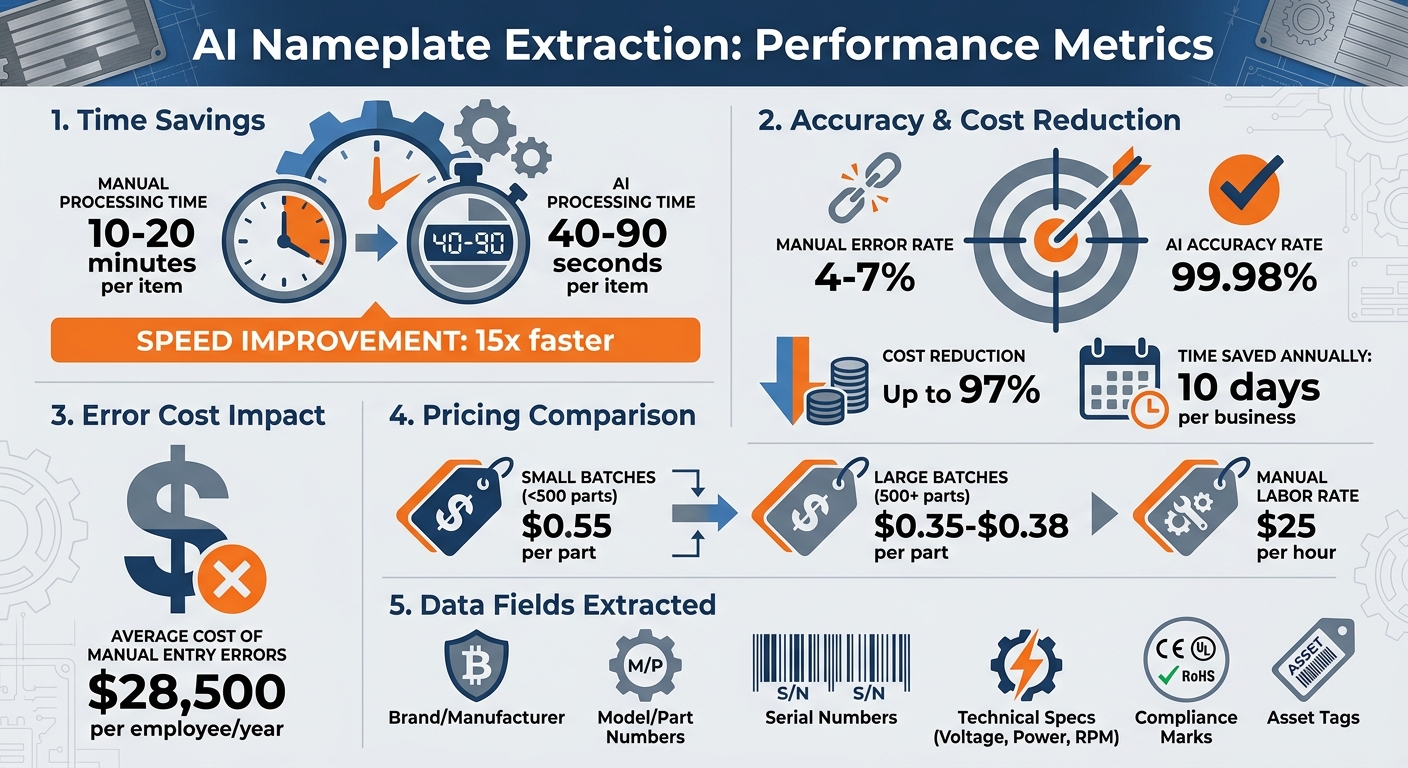
- Key Benefits: AI reduces manual data entry time by over 60%, cuts costs by up to 97%, and achieves accuracy rates as high as 99.98%.
- Common Applications: Managing inventory, creating product listings, streamlining maintenance, and complying with regulations like NIS2 and CSRD.
- Data Extracted: Brand, model numbers, serial numbers, technical specs (e.g., voltage, power, RPM), compliance marks, and more.
- Efficiency Gains: Tasks that took 10-20 minutes per item now take just 40-90 seconds, significantly improving daily operations.
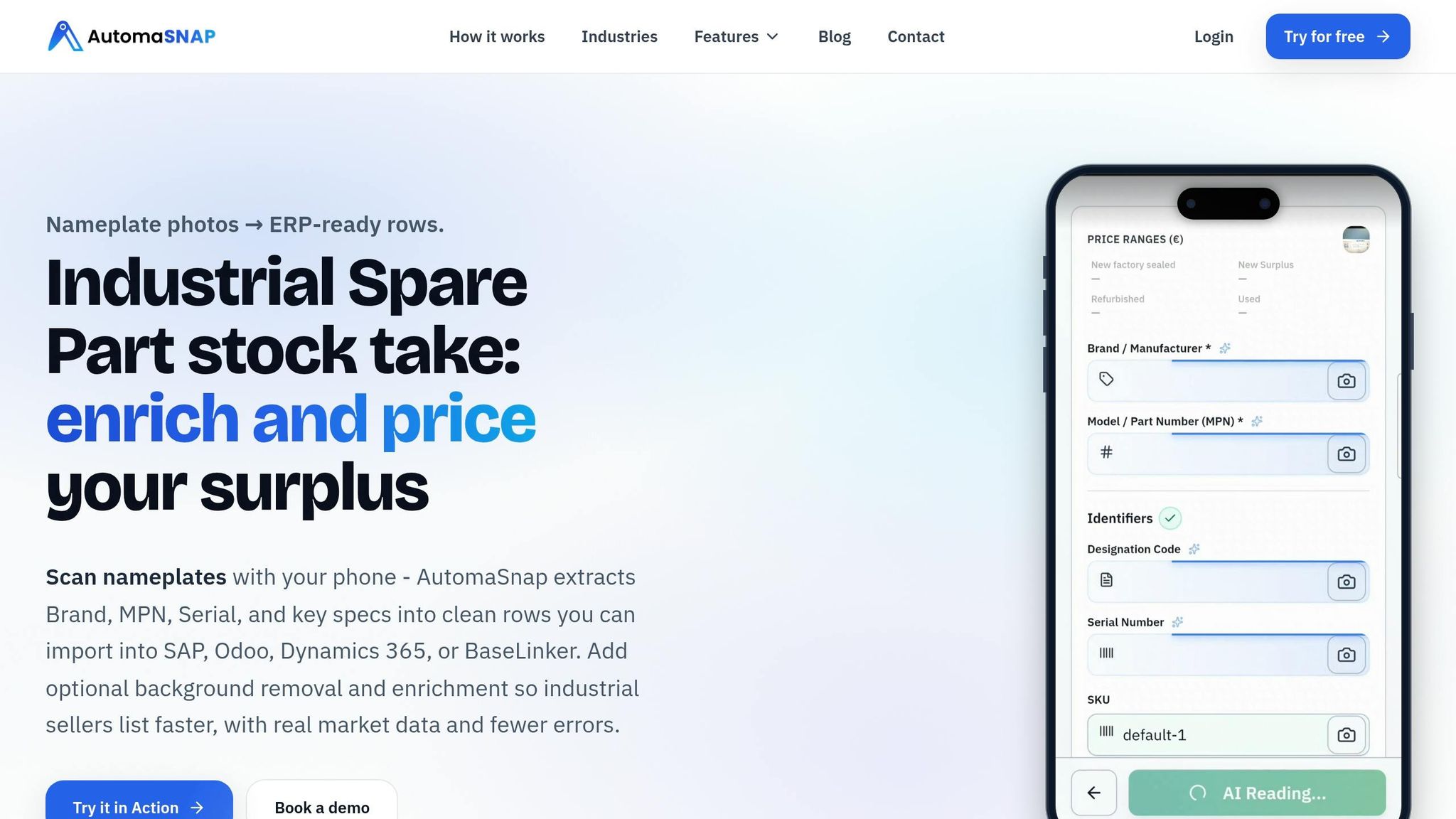
For example, tools like AutomaSnap simplify the process by converting nameplate photos into structured data compatible with ERP systems like SAP and Odoo. They also offer features like automatic background removal and pricing insights, making them highly practical for industries like manufacturing, e-commerce, and asset recovery.
How AI Extracts Data from Nameplates
OCR and Machine Learning Technology
AI has transformed how data is extracted from nameplates, using advanced imaging techniques that go far beyond traditional character recognition. Early OCR systems often struggled with errors, especially under poor lighting conditions. Today’s AI-powered systems, equipped with Vision-Language Models (VLM), not only read characters but also interpret the context and structure of technical documents.
This contextual ability allows these systems to differentiate between similar-looking alphanumeric strings, such as distinguishing model numbers from serial numbers, even when they appear nearly identical. By training on industrial nameplates, these models consistently identify key patterns. Additionally, photometric AI compensation enhances image clarity, ensuring accuracy even in low-light or glare-heavy environments.
A great example of this technology in action is TUEG Schillings GmbH, a German SME. In 2026, they showcased how AI could operate effectively in harsh industrial conditions. Their AI-enhanced image processing combined OCR with natural language processing to read nameplates that had been damaged by corrosive vapors. This resulted in a 50% reduction in the time required for asset identification.
These advancements in AI aren’t just about better technology - they bring real operational improvements.
Benefits of Automated Data Extraction
Switching from manual transcription to AI-powered automation delivers major benefits in terms of speed, accuracy, and cost savings. Manual data entry is prone to errors, but AI drastically reduces these mistakes. Automation cuts the time required for data extraction by over 60% and reduces costs by as much as 97%, saving businesses an estimated 10 days each year.
What’s more, modern AI systems don’t rely on templates. They can intuitively understand document layouts and adapt to different formats without needing manual setup. This means technicians can scan nameplates from any manufacturer without requiring IT assistance or system reconfiguration, streamlining the process even further.
Data Fields AI Tools Can Extract
Standard Extracted Information
AI-driven nameplate extraction tools are designed to capture key details essential for managing assets effectively. These tools typically extract Brand/Manufacturer, Manufacturer Part Number (MPN) or Model Number, and Serial Number. They also identify technical specifications like voltage, power ratings (kW or HP), RPM, amperage, frequency, and physical dimensions. Additional fields include Asset Tags, Service Tags, and Asset Class (e.g., “Electric Motor” or “Desktop Computer”). They even capture GTIN/UPC codes and compliance marks such as CE, UL, and RoHS. This robust data collection supports a wide range of operational tasks across industries.
What sets Vision-Language Models apart is their ability to interpret the context and layout of technical labels. For example, they can distinguish that text following “Model No.” is a part name, not a serial number, even if the nameplate is damaged or worn. By leveraging this advanced context recognition, these tools achieve accuracy rates as high as 98.99%, significantly minimizing errors and associated costs.
How Extracted Data Gets Used
The structured data from nameplates plays a critical role in streamlining enterprise workflows and integrating with ERP and CMMS systems like SAP, Odoo, Dynamics 365, and IBM Maximo. This ensures a clean and organized material master. For spare parts distributors and industrial resellers, these tools can automatically create SEO-friendly titles and descriptions, making it easy to list surplus inventory on platforms like eBay and Shopify. What once took hours can now be done in seconds, turning raw data into revenue opportunities.
In maintenance and repair operations (MRO), the extracted technical specs help teams quickly identify outdated parts and reduce downtime by ensuring accurate replacement orders. Warehouse and logistics teams benefit by eliminating manual data entry during intake, while testing and inspection services improve the accuracy of field reports through automated equipment spec recording. With the rise of mobile-first workflows, technicians can now use standard smartphones to scan nameplates directly on-site, syncing the data in real-time without needing specialized tools.
In Europe, businesses are increasingly adopting AI nameplate scanning to comply with the NIS2 Directive for operational technology inventory and CSRD regulations for ESG reporting. These regulations require precise asset tracking, including detailed energy consumption data for each unit. This regulatory push is driving adoption in sectors like chemical plants, energy facilities, and manufacturing, where maintaining accurate asset inventories is no longer optional but legally required.
AutomaSnap: AI-Powered Nameplate Data Extraction
AutomaSnap Features
AutomaSnap takes the hassle out of processing nameplate photos by converting them into structured inventory data. Designed for spare parts distributors, manufacturers, and e-commerce professionals, the platform uses contextual computer vision to extract crucial details like Brand, Manufacturer Part Number (MPN), and Serial Number from industrial nameplates. Unlike basic OCR tools that just read text, AutomaSnap understands the context of technical data. For instance, it knows that a value next to “kW” refers to power, not a serial number.
It also simplifies product presentation with automatic background removal, producing clean, professional images tailored to marketplace standards. The tool generates ERP-compatible spreadsheets that work with systems like SAP, Odoo, Dynamics 365, and BaseLinker. Each spreadsheet row includes photo proof, ensuring transparency for audits.
Pricing is straightforward and competitive: starting at around $0.55 per part for smaller batches (under 500) and dropping to about $0.38 per part for larger volumes (500 or more). A free trial is available for those who want to test its capabilities.
Another standout feature is the Quick Market Check, which provides instant links to platforms like eBay and Automa.Net. This allows users to quickly assess market prices and demand before listing items. Plus, AutomaSnap works directly in a browser - no installation required - and integrates seamlessly with your smartphone camera, even when photographing damaged labels. These features streamline inventory processes, speeding up data collection and improving overall efficiency.
How Businesses Use AutomaSnap
With its robust capabilities, AutomaSnap has helped businesses achieve major efficiency improvements. Asset recovery companies, for example, use the tool to tackle warehouse backlogs, turning idle inventory into active listings and freeing up cash flow for bulk buyers. Manufacturing teams can digitize entire production lines in a single day, eliminating the need to process each machine individually.
E-commerce sellers also see big benefits. AutomaSnap automates listing creation, complete with SEO-friendly titles and descriptions, while offering pricing insights across various conditions - new, surplus, refurbished, or used. Bartek, Operations Manager at Gal-Industry, shared his experience:
“AutomaSnap modernized how we work. Nameplate data flows into our system instantly and accurately, listings are created with professional photos and rich SEO descriptions.”
This example highlights how AutomaSnap’s features, like automated background removal and ERP-ready outputs, directly support faster inventory management and quicker time-to-market for businesses.
Practical Applications of AI Nameplate Extraction
Better Inventory Management
AutomaSnap makes large-scale inventory tasks far more efficient by replacing the slow, manual transcription of brand, part, and serial numbers with AI-driven digitization. Instead of spending 10-20 minutes per item, workers can now process nameplates in about 40 seconds using just a smartphone photo. This time savings is a game changer when managing hundreds or thousands of items.
Take one company’s experience: they achieved a 15x speed boost in creating listings while ensuring consistent naming conventions across their ERP systems. The AI handles variations like “HP”, “hp”, and “horsepower”, treating them as the same, which guarantees uniformity in records across platforms like SAP, Odoo, and Dynamics 365. Even in tough factory conditions - where nameplates might be greasy, corroded, or reflective - the system delivers reliable results.
This streamlined cataloging process not only improves daily inventory management but also sets the stage for smoother asset recovery efforts.
Faster Asset Recovery
AI-powered extraction doesn’t just save time - it helps turn idle assets into revenue faster. Many asset recovery operations face delays caused by warehouse backlogs, tying up capital that could otherwise be used. AutomaSnap speeds up digitization, allowing companies to convert dormant inventory into cash flow quickly.
For example, a testing and inspection team saw a dramatic reduction in errors, cutting them down to almost zero, and unlocked substantial savings annually. Manual data entry errors can be costly - averaging $28,500 per employee each year - and error rates often hover around 4-5%. By minimizing these mistakes, AI tools enable teams to process more items while using fewer resources, transforming backlogs into active revenue streams.
Super.AI Customer Stories: Automating Nameplate Extraction with Bureau Veritas
Conclusion
AI-powered nameplate extraction slashes manual processing time from 10-20 minutes per item down to just 40-90 seconds. This allows companies like Gal-Industry to work up to 15 times faster, while also eliminating transcription errors. With manual transcription error rates hovering around 7%, AI achieves accuracy rates as high as 99.98%, reducing costly mistakes and speeding up operations that handle hundreds or even thousands of parts.
AutomaSnap’s browser-based platform, featuring a straightforward “Extract, Enrich, Export” workflow, integrates smoothly with ERP systems like SAP, Odoo, and Dynamics 365. This simplicity translates into real-world business efficiencies that save both time and money.
For high-volume batches, the cost per part drops to about $0.35, compared to manual labor rates of $25 per hour. This makes AutomaSnap an immediate win for ROI, improving data quality and operational speed. Whether it’s spare parts distributors, asset recovery teams, or manufacturers dealing with warehouse backlogs, the technology helps transform idle inventory into active listings, freeing up capital faster than ever.
This move toward AI-driven automation isn’t just about working faster - it’s about gaining a competitive edge in inventory management and asset recovery.
FAQs
What photo quality do I need for accurate nameplate scanning?
To get the best results when scanning nameplates, make sure to use high-quality photos. The images should be clear, well-lit, and sharply focused. This ensures the AI can effectively extract information, even when dealing with labels that are worn, dirty, or scratched. Paying attention to image quality can make a big difference in the accuracy of data extraction.
How does AI tell a model number from a serial number on messy labels?
AI tools, such as AutomaSnap, leverage advanced computer vision and OCR technology tailored for reading industrial nameplates. These tools are designed to differentiate between critical details like model numbers and serial numbers by examining factors such as layout, font styles, and contextual hints. Even when labels are dirty or damaged, they can accurately extract the necessary data. This capability simplifies data collection, minimizes errors, and saves time in processes like inventory management, maintenance, and procurement.
How do I import extracted nameplate data into my ERP or CMMS?
To bring extracted nameplate data into your ERP or CMMS, start by exporting it as a well-organized spreadsheet that aligns with your system’s requirements. AutomaSnap simplifies this step by offering ERP-compatible spreadsheets tailored for platforms like SAP or Odoo. These spreadsheets include consistent columns, extracted data, and photo links, ensuring everything is ready for import.
Once you have the file, use your system’s standard import process. This may involve uploading the file and mapping fields as necessary. Thanks to AutomaSnap’s structured format, the process is smoother and helps reduce errors during integration.