On this page
Real-time pricing sync updates prices across all sales channels within seconds, ensuring sellers stay competitive in fast-changing markets. This system is especially useful for spare parts sellers managing large catalogs, as it eliminates manual updates, reduces errors, and protects profit margins by responding instantly to changes in costs, demand, or competitor pricing.
Key Benefits:
- Market Competitiveness: Prices update instantly to match market trends and competitor actions, helping sellers win more sales.
- Efficiency: Automates pricing updates, saving 10–20 hours per week compared to manual processes.
- Revenue Growth: Optimizes pricing for higher margins during low-stock situations and reduces returns by ensuring accurate pricing across channels.
How It Works:
- Uses REST APIs and webhooks to sync data between ERP systems and sales platforms like Amazon and eBay.
- Automates market checks and demand verification to refine pricing strategies.
- Reduces integration issues with clean data and tools like middleware or direct API connections.
By adopting real-time pricing sync, sellers save time, minimize errors, and improve their ability to respond to market changes, leading to better sales performance and profitability.
Ch.6, L.6 | Synchronizing stocks and prices | Baselinker Academy (Advanced)

Main Benefits of Real-Time Pricing Sync for Spare Parts Sellers
Better Market Competitiveness
Real-time pricing sync gives spare parts sellers a clear edge in a fast-moving market. Instead of waiting hours - or even days - for price updates, your system adjusts within seconds. This means when a competitor introduces a flash sale or runs out of stock, your prices adapt instantly to seize the opportunity. This kind of speed is especially crucial for winning the “Buy Box” on platforms like Amazon and eBay, where price competitiveness often determines who secures the sale.
Beyond competitive pricing, real-time sync safeguards your margins. For example, if a manufacturer raises wholesale costs, your retail prices automatically adjust across all channels, ensuring you’re not selling at a loss. Amazon employs similar strategies, tweaking prices on millions of products several times daily to balance sales volume and profitability - particularly during high-demand periods like the holidays. For spare parts sellers managing thousands of SKUs, this kind of responsiveness is simply unattainable without automation.
This level of agility not only boosts competitiveness but also sets the stage for smoother, more efficient operations.
More Efficient Operations
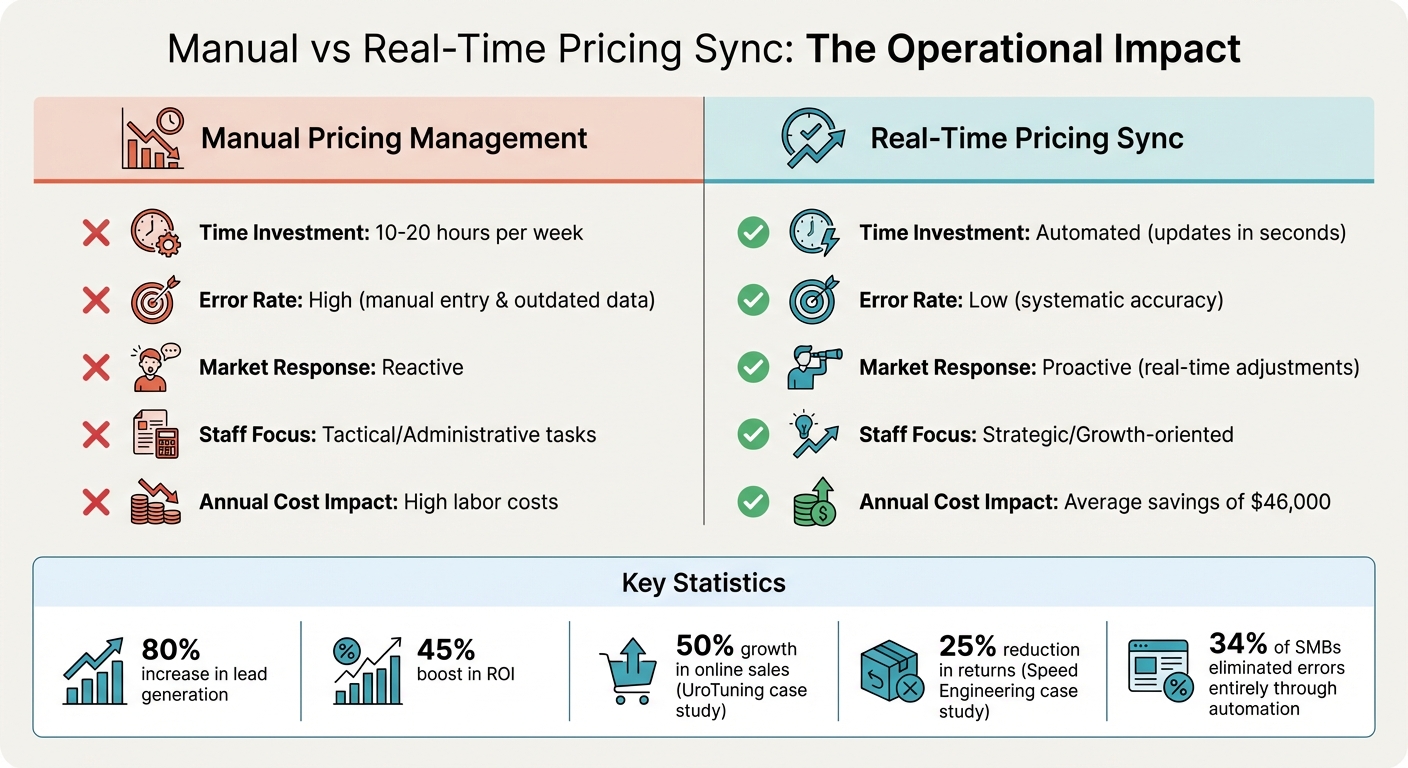
Managing prices manually is a time-intensive process, much like speeding up inventory intake for new stock. For a catalog of just 500 products across five marketplaces, it can take 10 to 20 hours per week to keep prices updated. Real-time pricing sync eliminates this burden by automating updates around the clock.
UroTuning reported saving 20 hours per week on manual updates after adopting automated data management in 2024.
Automation also drastically reduces pricing errors - an issue that often arises with manual spreadsheets. In fact, 34% of small and medium-sized businesses have reported eliminating errors entirely through automation.
Amy Snyder, cofounder of Snyder Performance Engineering, highlighted the benefits: “My team doesn’t have to wait for an order to get manually plugged in… It saved us a ton of money and time because things aren’t happening twice.”
On average, businesses using workflow automation tools save $46,000 annually.
| Operational Metric | Manual Pricing Management | Real-Time Pricing Sync |
|---|---|---|
| Time Investment | 10–20 hours per week | Automated (Seconds) |
| Error Rate | High (Manual entry/Outdated data) | Low (Systematic accuracy) |
| Market Response | Reactive | Proactive (Real-time) |
| Staff Focus | Tactical/Administrative | Strategic/Growth-oriented |
By automating pricing updates, businesses free up their teams to focus on growth-oriented tasks, while also reducing errors and improving response times.
Higher Revenue Opportunities
Real-time pricing sync opens the door to greater revenue potential. For instance, when competitors run out of stock, your system can automatically raise prices to capture higher margins on in-demand, low-stock items. By syncing these updates with your ERP and marketplace platforms, your pricing strategy remains aligned with market conditions, strengthening your competitive position.
The financial benefits are clear. Businesses that implement automation have reported an 80% increase in lead generation and a 45% boost in ROI. UroTuning, for example, saw a 50% growth in online sales within six months of adopting real-time data management. Similarly, Speed Engineering reduced returns by 25% thanks to improved pricing consistency and data accuracy across channels.
How Real-Time Pricing Sync Works in Daily Operations
Connecting Marketplaces and ERP Systems
Your ERP system acts as the central hub for pricing updates. Whenever there’s a change - like a supplier cost adjustment or inventory fluctuation - it triggers an HTTP webhook to a middleware system almost instantly.
This middleware translates ERP data into formats compatible with various marketplace APIs, such as Amazon’s Selling Partner API (SP-API), eBay’s Inventory API, or Walmart’s Marketplace API. By using delta syncs, only the updated SKUs are sent, which reduces both API calls and processing time.
“Prioritize webhooks, with syncs as a backup for any missed or delayed events.”
Marketplaces have their own processing times: Amazon typically updates listings in 5–15 minutes, eBay in 1–3 minutes, and Walmart in 3–10 minutes. To avoid overselling during peak demand, systems often use buffers, like holding back 10–15% of stock or setting price floors.
To ensure accuracy, most systems also run automated reconciliation checks every four hours. These checks compare ERP data with marketplace listings to catch any discrepancies caused by missed webhooks or API issues.
These integrations lay the groundwork for automated market checks, which help refine pricing strategies.
Automated Market Checks and Demand Verification
Once ERP and marketplace systems are synced, automated market checks can step in to fine-tune pricing strategies. These systems pull real-time marketplace data, including current listings and competitor pricing, via APIs. By analyzing historical price trends and sales data, they help identify optimal price ceilings.
For auto parts, demand verification often involves integrating Year-Make-Model (YMM) data. Compatibility filters ensure that pricing reflects the specific demand for parts that fit a buyer’s vehicle. This is particularly important since 38% of auto parts shoppers go online specifically to compare prices.
Another tool, AutomaSnap, enhances this process during inventory intake. By photographing nameplates on incoming spare parts, AutomaSnap extracts structured data - such as brand, MPN, and serial number - and provides instant market checks with direct links to platforms like eBay. This allows you to confirm pricing and demand before items even reach your ERP system, ensuring competitiveness from the start.
Advanced analytics also play a role by identifying areas where margins are leaking or stock is moving slowly. For example, calculating the “Sell-Through Rate” (units sold divided by units listed) helps you quickly decide whether to adjust prices, launch promotions, or initiate liquidation workflows.
Common Problems and Solutions When Implementing Real-Time Pricing Sync
Maintaining Data Accuracy and Quality
Poor data quality isn’t just a nuisance - it can cost companies millions each year and seriously damage customer trust. For businesses selling spare parts, the stakes are even higher. Automated pricing systems demand over 97% accuracy for core SKUs to avoid costly mistakes and margin losses.
One major issue is product title drift, where identical parts are listed with slight variations across different retailers. Add to that inconsistent formatting - like mismatched date formats, currency symbols, or phone numbers - and you’ve got a recipe for integration headaches. These discrepancies can lead to mismatches, and 95% of businesses report that such issues negatively affect customer trust.
Here’s a real-world example: In early 2026, a consumer goods brand faced a problem where false undercut alerts triggered unnecessary price drops, eating into their margins. By introducing accuracy filters, they reduced these errors by 38%. Another case involved a fashion retailer whose automated product matching system mistakenly merged size and color variants into single SKUs. They fixed this by implementing tiered matching rules for their key SKUs, eliminating the confusion.
“Pricing data accuracy is not about perfection. It is about knowing where your data is strong, where it is weak, and how much decision risk you are willing to accept.” – tgndata
To tackle these challenges, Master Data Management (MDM) systems can serve as a single source of truth, minimizing conflicting information. Regular audits are also essential. Techniques like cross-source verification, manual sampling of high-revenue SKUs, and outlier detection can help catch unusual price changes before they spiral out of control.
For example, a consumer electronics brand expanded its monitoring from 12 to 60 retailers, which caused a significant drop in SKU matching confidence. They introduced confidence scoring to flag reliable data points for automated pricing decisions, while sending questionable ones for human review. This approach helped them avoid expensive errors while staying competitive.
Overcoming Technical Integration Issues
Accurate data lays the groundwork for solving technical integration challenges. Retailers lose a staggering $1.77 trillion annually due to out-of-stocks and overstocks, often caused by data delays. For spare parts sellers, connecting ERP systems to online marketplaces can be tricky, but these hurdles often have straightforward fixes.
Here’s a breakdown of common integration methods, their costs, and timelines:
- Store plugins: A one-time cost of $650–$2,600 with a setup time of 1–2 weeks. Best for standard processes and small catalogs.
- Middleware solutions: Monthly fees of $260–$650 plus a setup cost of $650–$2,600. These offer visual data mapping and pre-built connectors for multi-channel sellers.
- Direct API integration: Costs $6,500–$19,500 and takes 4–8 weeks. Ideal for tech-savvy teams that need maximum flexibility.
- Enterprise custom development: Starts at $13,000 and can exceed $39,000 for complex systems like SAP S/4HANA.
“The technology is rarely the problem. Data quality almost always is.” – Lasse Lung, CEO & Co-Founder, Qualimero
Before syncing data, make sure it’s clean. Align product numbers and category structures between your ERP and marketplaces to avoid errors from mismatched identifiers. A useful tactic is running a “shadow mode” test for 1–2 weeks. This allows the system to log intended updates without actually applying them, helping you catch bugs before they impact customers.
For larger catalogs (500+ items), leverage Sync APIs that combine multiple write operations into a single HTTP request. This helps manage API rate limits efficiently. Use real-time updates for fast-moving items and batch processing for slower-moving ones to strike the right balance.
Conclusion: Getting the Most from Real-Time Pricing Synchronization
In 2026, real-time pricing synchronization has become a game-changer for spare parts sellers. Competitive repricing strategies have been shown to increase Buy Box attainment by 23% within just 30 days. On top of that, retailers using AI-powered dynamic pricing see profit gains of 10–15% compared to those relying on simple rule-based systems.
To fully leverage these benefits, successful implementation is key. The foundation of real-time pricing synchronization is a combination of advanced technology and clean, reliable data. Start by using your ERP as the single source of truth, then integrate automated market checks and demand verification into your processes. Protect your margins by setting strict price floors that factor in return costs, and adjust pricing based on inventory thresholds as stock levels fluctuate. This approach ensures competitiveness without sacrificing profitability, as highlighted in earlier discussions on operational efficiency and market positioning.
For distributors managing extensive catalogs, tools like AutomaSnap simplify the process. By extracting structured data from nameplate photos and generating ERP-ready spreadsheets, AutomaSnap eliminates the need for manual data entry, which can take up to 16–25 hours per week for 500 products. The platform supports ERP systems like SAP, Odoo, and Dynamics 365 while enabling quick market checks with direct search links to platforms such as eBay and Automanet.
“The question isn’t whether you can afford to automate your pricing. In today’s competitive landscape, the real question is whether you can afford not to.” – Repricer.com Editorial Team
This quote perfectly captures the urgency of adopting automation to stay ahead in spare parts pricing.
Additionally, it’s worth noting that 67% of B2B buyers are willing to switch suppliers for a more modern, consumer-like digital experience. Real-time pricing synchronization not only meets these expectations but also fuels long-term growth and success.
FAQs
What’s the fastest way to start real-time price syncing across channels?
The fastest method to achieve real-time price syncing is by implementing an event-driven system that updates inventory immediately after a sale occurs. This system connects your sales channels through APIs, ensuring stock levels are refreshed instantly. By cutting down on delays, this setup helps lower the chances of overselling and handles high-traffic events like Black Friday or flash sales with ease.
How do I prevent automated repricing from hurting my margins?
To keep your profits intact, consider using AI-powered repricing tools. These tools automatically adjust your prices based on real-time market trends while staying within the minimum and maximum price limits you set. By using AI, you can fine-tune your pricing strategy to stay competitive without cutting into your profits.
What data needs to be clean before connecting my ERP to marketplaces?
Before connecting your ERP to marketplaces, make sure your product data is accurate and current. Focus on critical details like prices, stock availability, and product specifications. Keeping your data clean minimizes risks such as listing rejections, account suspensions, or accidental overselling. This ensures smoother operations and improves your marketplace performance.