On this page
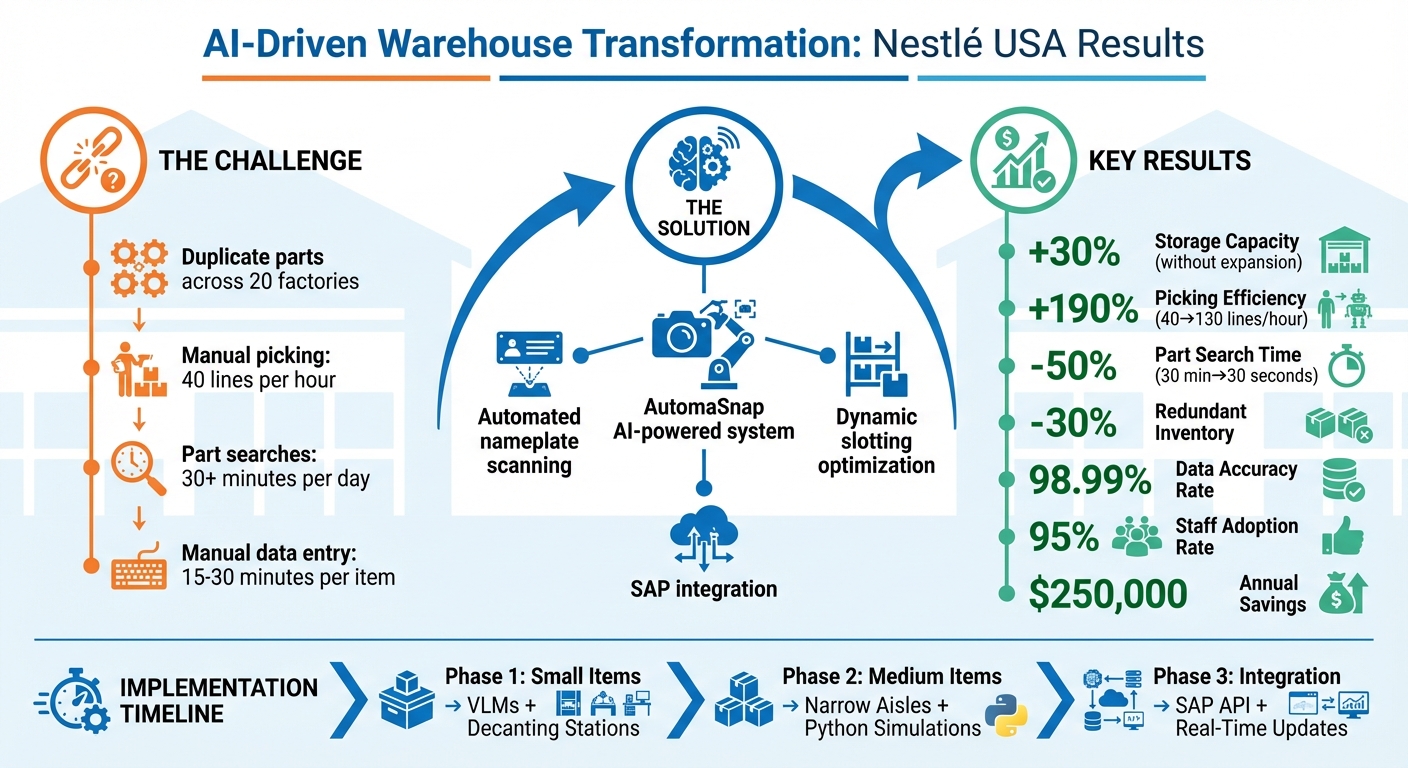
AI is reshaping spare parts warehousing. Nestlé USA used AutomaSnap to tackle inefficiencies in its 20-factory network, cutting redundant inventory by 30%, speeding up part searches by 50%, and achieving $250,000 in annual savings. Here’s how they did it:
- Problem: Duplicate parts, wasted space, and low picking efficiency.
- Solution: AutomaSnap’s AI-powered tools streamlined inventory management, automated data entry, and optimized storage layouts.
- Results: 30% more storage capacity, 190% faster picking rates, and real-time inventory visibility across the network.
This case study breaks down how Nestlé USA implemented these changes step-by-step, from upgrading data accuracy to integrating AI with SAP systems. The transformation highlights the potential of AI to solve space and inventory challenges in spare parts warehouses.
Optimizing Warehouse Operations with AI and Digital Twins
Space Utilization Problems in Spare Parts Warehouses
Before adopting AI, Nestlé USA’s warehouse network faced major challenges with space management, leading to higher costs and stunted growth. A key issue was the duplication of parts across their 20 factories, where the same item was stored under different material numbers. This duplication occurred both within individual facilities and across the network, resulting in wasted space, poor SKU management, and limited capacity for expansion.
Wasted Floor Space
Traditional warehouse setups led to inefficiencies like slotting drift, where high-demand items were misplaced outside of optimal picking zones. Without dynamic adjustments, pickers had to walk extra miles during each shift, significantly reducing efficiency. Manual updates to address these issues took over 40 hours every quarter, allowing inefficiencies to pile up over time. On top of that, poor SKU handling practices further exacerbated the use of floor space.
Managing Different SKU Types
The warehouse also struggled with the classic spare parts dilemma: half of the stocked parts remained unused. Traditional systems failed to distinguish between bulky and smaller items, meaning prime picking areas were often wasted on low-priority inventory. Manual picking rates were stuck at around 40 lines per hour, and technicians frequently encountered delays because SAP entries lacked critical manufacturer part numbers.
Growth Limitations
These inefficiencies became roadblocks to growth. Without visibility across their inventory network, Nestlé couldn’t centralize high-cost, critical spare parts. This lack of coordination forced the company to hold redundant inventory at multiple locations, tying up working capital and preventing efficient scaling. Resolving these foundational issues was essential for enabling AI-powered strategies that reshaped their inventory management approach.
AI Solution: Dynamic Space Optimization with AutomaSnap
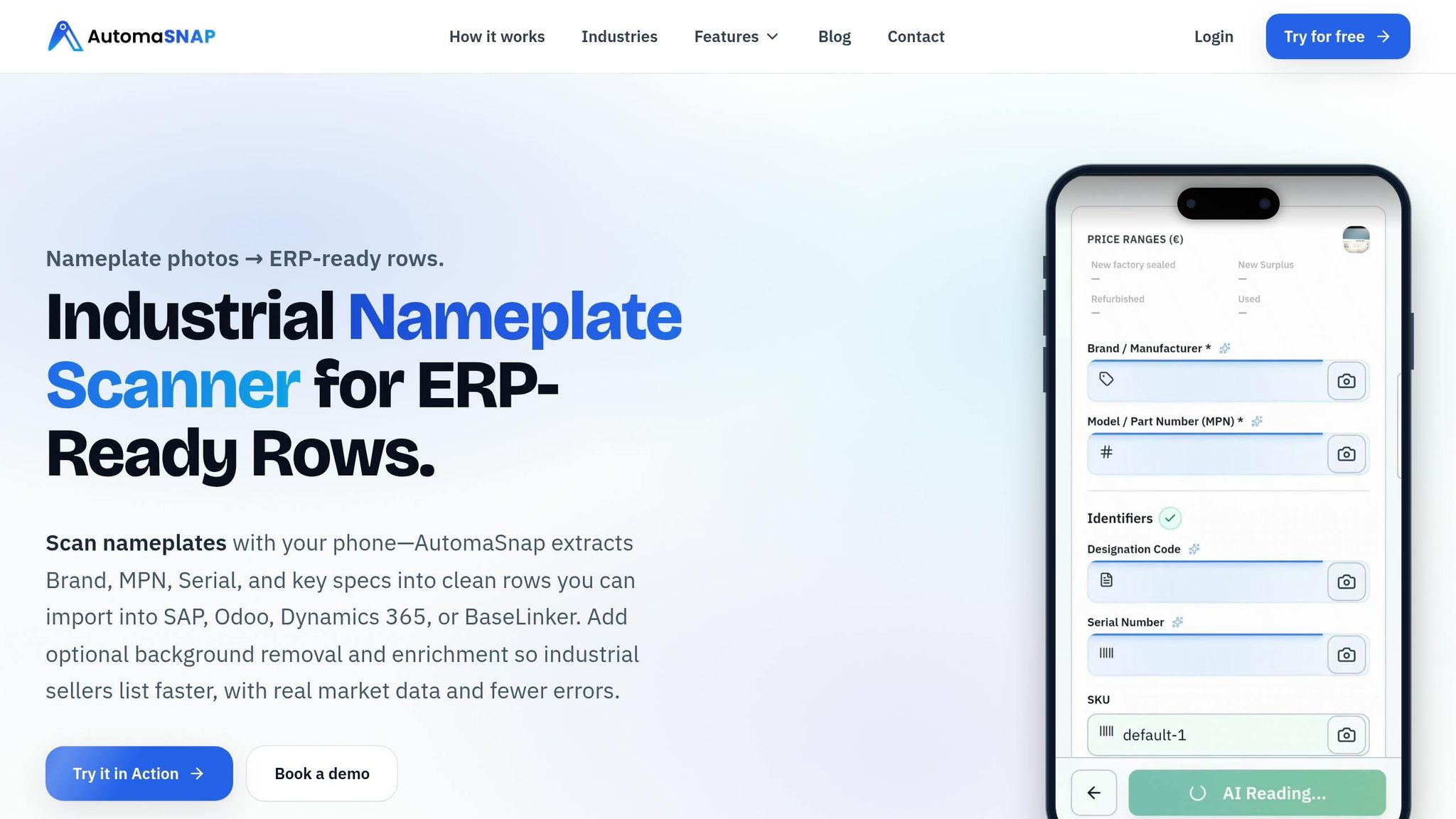
Faced with challenges in space utilization, the spare parts warehouse adopted AutomaSnap, an AI-powered tool designed to streamline inventory management. Instead of relying on manual SAP data entry, staff could simply take a photo of a nameplate - even if it was dirty or scratched - and instantly extract key details like Brand, MPN, and Serial Number. By removing the guesswork from inventory tracking, this approach paved the way for smarter storage decisions and precise, automated data handling. This innovation directly addressed issues like wasted space and poor SKU management.
Automated Data Extraction for Better Storage
AutomaSnap completely changed how the warehouse handled incoming inventory. Previously, onboarding a single asset required 15–30 minutes of manual data entry and verification. With AutomaSnap, this process now takes less than 2 minutes per item - and maintains an impressive 98.99% accuracy rate. The platform generates ERP-ready spreadsheets that integrate seamlessly with SAP, eliminating the need for tedious reformatting. It also identifies duplicate entries, helping reduce redundant inventory by about 30%. This newfound clarity allowed the warehouse to better utilize its floor space and plan storage more effectively.
Dynamic Slotting and Layout Changes
Once the data was structured and accurate, the warehouse implemented dynamic slotting, a system that adjusts storage locations based on real-time demand patterns. High-demand items were moved to easily accessible zones, while less frequently used parts were relocated to secondary areas. AutomaSnap’s insights revealed which SKUs were frequently accessed and which were rarely touched. As a result, search times plummeted from 30+ minutes per day to under 30 seconds. Managers could now make layout adjustments based on current data instead of relying on occasional manual audits. This shift turned the warehouse into a flexible and continuously optimized operation, driven by real-time data.
Implementation Process: 3 Phases
The warehouse rolled out AutomaSnap in three distinct phases, ensuring minimal disruption to daily operations while introducing new systems. Each step built on the previous one, creating a structured approach to revamp space optimization.
Phase 1: Optimizing Small and Fast-Moving Items
The first phase focused on small, high-turnover items that were putting a strain on both floor space and staffing. To address this, the warehouse introduced Vertical Lift Modules (VLMs) alongside existing shelving. This setup allowed staff to continue managing older inventory while transitioning new stock into the automated system. Before entering the VLMs, items were processed at decanting stations, where AutomaSnap captured nameplate data and created ERP-compatible records in SAP. The items were then repacked into standardized containers and labeled for AI-driven storage. This “goods-to-person” system eliminated the need for workers to spend time walking long distances to locate parts.
A similar phased installation at Rebuy, involving 36 Modula VLMs between August 2022 and June 2023, boosted picking rates from 200–250 items per hour to over 300. This setup allowed a single worker to manage up to six lifts, demonstrating the efficiency of this approach.
Phase 2: Narrow-Aisle Setup for Medium Items
After addressing small items, the next step tackled medium-sized inventory. This involved narrowing aisle widths and optimizing routing strategies. Using Python simulations, the warehouse evaluated thousands of layout configurations against historical picking data. These simulations generated heat maps to identify the best SKU placements, enabling managers to reorganize inventory step by step. To keep the floor space clear during this process, ceiling-mounted conveyor systems were installed to transport items efficiently.
This strategy mirrors an approach taken by Knorr-Bremse, where the use of an OSR Shuttle Evo system combined with ceiling-mounted conveyors led to a 300% improvement in small parts warehouse performance.
Phase 3: ERP Integration for Real-Time Updates
The final phase focused on integrating AutomaSnap with SAP through API connections. This allowed for real-time synchronization and quarterly re-optimization without requiring manual data entry. The warehouse adopted a “one part, one reference” policy across all operations to eliminate duplicate entries. Data quality and system adoption were monitored using Power BI dashboards, ensuring smooth implementation.
Nestlé USA achieved similar results with their integration, reporting a 95% monthly adoption rate and a 50% reduction in the time spent searching for parts. Steven Gould, Senior Engineering Maintenance Manager at Nestlé USA, highlighted the system’s collaborative benefits:
“It’s not about what’s happening now in my store. I know my sister factory has it.”
Results: Measured Improvements and Cost Savings
The integration of AI-driven systems brought measurable benefits in space utilization, picking efficiency, and overall cost savings.
30% Boost in Space Utilization
By leveraging AI-powered layout optimization and high-density storage systems, the warehouse increased its storage capacity by 30% without expanding its physical footprint. This improvement was quantified through product volume and storage bin counts within the existing space. Using AI genetic algorithm simulations, thousands of potential layouts were analyzed against historical picking data and SKU dimensions. This process identified configurations that maximized both vertical and horizontal storage, while eliminating wasted aisle space.
A comparable system was implemented at Siemens Mobility’s Braunschweig, Germany facility in 2026. Under the leadership of Project Manager Kai-Christian Greve, a grid-based automated system was introduced. This system housed 31,700 bins and operated with 16 robots within a 1,000 m² (approximately 10,764 ft²) area. The results were striking: a 30% increase in both storage capacity and throughput, 99.6% system reliability, and the ability to process 300 containers per hour.
190% Improvement in Picking Efficiency
At Meat&Doria in Trofarello, Italy, COO Marco Lacastellana spearheaded a shift from manual picking to an AI-integrated automated system. This transformation boosted picking performance from 40 to 130 lines per hour per station - an impressive 190% increase. Additionally, automating data extraction eliminated manual errors and standardized part references, enabling technicians to locate items more efficiently.
$250,000 in Annual Savings
The financial impact was equally compelling. By avoiding costly facility expansions and addressing operational inefficiencies, the warehouse achieved $250,000 in annual savings. These savings were attributed to streamlined software systems, reduced manual labor, and a 50% reduction in accounting staff.
A similar success story came from Heckler, a tech furniture manufacturer in Phoenix, Arizona. In January 2026, Technical Solutions Manager Marshall Hardwick and Owner Dean Heckler transitioned from a fragmented system - comprising NetSuite, Shopify, Xero, and Katana - to the Odoo ERP platform. This move not only saved approximately $250,000 annually but also eliminated a six-month order backlog. Dean Heckler shared:
“We reduced the headcount in our accounting department by 50%, thanks to automation and accuracy. We’re achieving more with fewer people, no chaos, no consultants.”
These results highlight the transformative potential of AI in optimizing spare parts warehousing operations.
Lessons Learned and Scaling Considerations
Optimizing a warehouse with AI involves learning to manage data quality, adapting to real-world challenges, and preparing for future growth.
High-Quality Data is Critical
A solid foundation of accurate data is essential for effective warehouse optimization. If SKU dimensions, material numbers, or part specifications are unreliable, AI algorithms can’t deliver precise storage layouts or slotting suggestions. For instance, standardizing data entry into a “one part, one reference” system boosted part-finding speeds by 50% and achieved a 95% staff adoption rate.
To uphold data accuracy, the warehouse restricted the creation of new material numbers to storeroom supervisors. This measure avoided duplicate entries and ensured each item had a single, approved record in the ERP system. This disciplined approach to data management made it easier to navigate the complexities of real-world operations.
Handling Damaged or Dirty Nameplates
In the warehouse, many nameplates were obscured by grease, scratches, or corrosion. AutomaSnap’s AI tackled this issue using confidence scoring and human-in-the-loop validation. The system assigned confidence levels to data fields, ranging from “very_high” (0.95) to “very_low” (0.25). Clear, high-confidence scans were automatically approved, while unclear data from damaged nameplates was flagged for manual review.
The warehouse adopted practical steps to address these challenges. Technicians cleaned nameplates before scanning, captured images at a resolution of at least 300 DPI, and performed quick visual checks of AI-extracted data to catch errors like confusing a “B” with an “8.” For fields where the AI lacked confidence, the system returned “null” values, ensuring uncertain data was flagged for human verification. This approach minimized the risk of introducing errors from illegible nameplates.
Scaling to Larger Operations
With a strong data framework and operational strategies in place, the warehouse turned its attention to scaling. Expanding operations required both a solid technical infrastructure and a cost-efficient pricing model. AutomaSnap’s token-based pricing allowed the system to grow from a basic plan to an enterprise-level solution as demand increased.
Scaling success hinged on achieving cross-site visibility. The warehouse transitioned from managing individual plants to a network-wide strategy, which centralized inventory and reduced working capital. By identifying duplicate parts stocked under different material numbers across 20 factories, the system streamlined operations significantly.
For warehouses planning to expand, conducting a data audit of 12–24 months of historical pick lists and SKU dimensions is a crucial first step. Additionally, assigning specific approvers at each site helps maintain consistency and prevents slotting inefficiencies as operations grow.
Conclusion
This case study shows how AI-driven space optimization can significantly improve the efficiency of spare parts warehouses. One standout result was a 35% increase in technician productivity, freeing up staff to concentrate on more meaningful tasks instead of wasting time searching for parts. This improvement laid the groundwork for broader automation efforts.
AutomaSnap played a critical role by automating data extraction from nameplate photos. This ensured accurate SKU data, reduced manual errors, and supported dynamic slotting - all of which aligned perfectly with the warehouse’s optimization objectives.
The implementation followed a phased approach: starting with small, fast-moving items, moving to narrow-aisle setups for medium-sized items, and finally achieving full ERP integration. This step-by-step rollout minimized operational disruptions while allowing continuous fine-tuning of processes.
One key takeaway from this transformation is the importance of high-quality data. For warehouses managing thousands of SKUs across various locations, an AI-driven strategy proves to be a scalable and efficient solution for inventory management.
FAQs
What data do I need before using AI to optimize warehouse space?
To make better use of warehouse space with AI, you’ll need a few key pieces of information: historical pick data, SKU dimensions, and velocity details about your inventory. These data points allow AI tools to study usage trends and suggest layout changes that improve efficiency.
How do you prevent duplicate spare parts across multiple sites in SAP?
To avoid duplicate spare parts in SAP, leveraging AI tools can significantly improve data accuracy. These tools help identify duplicates and standardize data entry processes, leading to more efficient inventory management. This also enhances cross-site visibility, as seen in examples like Nestlé USA, where such practices have been successfully implemented.
How long does it take to see ROI from AI-driven slotting and layout changes?
ROI from AI-driven slotting and layout adjustments can often be seen in less than two weeks. However, the exact timeline depends on factors such as the quality of the data being used and the details of the implementation process.