On this page
Market Trends in Spare Parts Pricing Tools
- AI-powered tools analyze vast data - like sales trends, competitor prices, and demand - to set optimal prices in real-time.
- Traditional pricing methods, like cost-plus models, are outdated and prone to errors. AI offers precision, speed, and adaptability for handling large inventories.
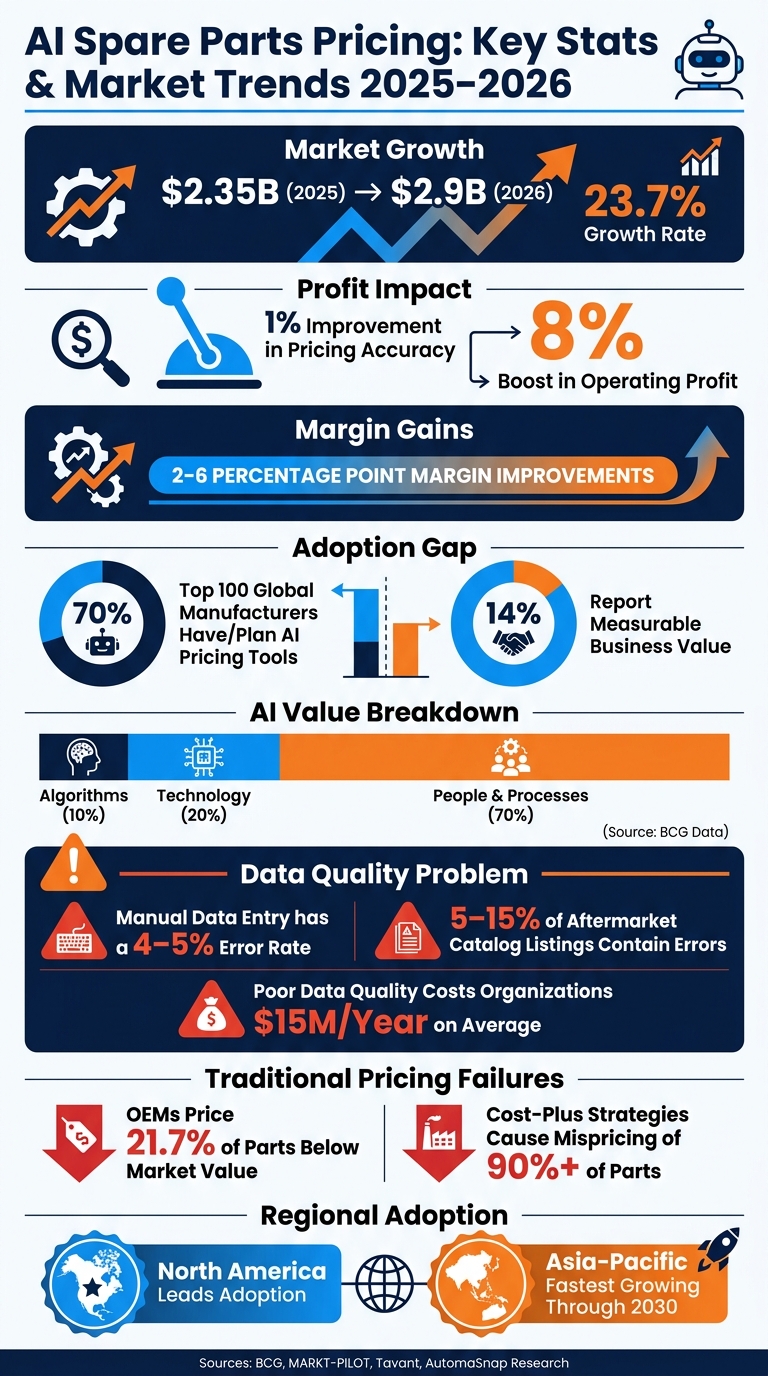
- Even a 1% improvement in pricing accuracy can boost profits by 8%. AI-driven systems often achieve 2-6% margin increases.
- The market for AI pricing tools is projected to grow from $2.35B in 2025 to $2.9B in 2026, a growth rate of 23.7%.
- Success relies heavily on clean inventory data. Tools like AutomaSnap address data issues by automating accurate part identification, reducing errors, and integrating with ERP systems.
AI pricing tools are no longer optional - they are a necessity for staying competitive in a fast-changing market.
How Spare Parts Pricing Strategies Have Changed Over Time
Older Pricing Methods and Their Drawbacks
For years, spare parts pricing followed a straightforward formula: calculate the cost, add a markup, and you had your price. This cost-plus model was easy to implement but ignored critical factors like competitor pricing, customer demand, and market trends. Companies often relied on manual methods - web scraping, spreadsheets, and gut instinct - to track market changes. While this approach worked for a time, it was slow, prone to errors, and could not handle the complexity of managing portfolios with hundreds of thousands of SKUs.
“Historically, all companies used to do cost-plus pricing for their spare parts… in today’s digital environment, the cost-plus pricing approach doesn’t work anymore.” - Tim Geyer, Head of North America, MARKT-PILOT
One major issue with this method was the lag in responding to market changes. Pricing reviews happened quarterly, leaving companies to react to shifts long after they occurred. This delay led to price leakage, where OEMs priced 21.7% of their parts below market value. Traditional cost-plus strategies caused manufacturers to misprice over 90% of their parts. At the same time, gray-market sellers on platforms like eBay and Alibaba further complicated things by undercutting prices.
“Prices in the marketplace are a black box, with real and ‘faux’ competitors (motion, eBay, Alibaba) muddying the waters and undercutting margins.” - John Orton, Manager of Pricing Strategy & Analytics, Okuma
Another challenge was inconsistent discounting practices. Sales reps often made pricing decisions on the fly, with no formal guidelines. This lack of structure meant that even when the list price was correct, margins were lost during execution. These challenges highlighted the limitations of outdated pricing methods and created the need for more agile, data-driven solutions.
The Move to Data-Driven and AI-Powered Pricing
To address the flaws of traditional pricing, companies began adopting AI-driven strategies. A key example is Okuma America, which moved away from its manual web-scraping process in November 2025. By implementing an automated market intelligence platform, Okuma shifted from quarterly to monthly data updates. This change unlocked a $1.4 million opportunity across 73% of its SKUs.
Another standout case is Jaguar Land Rover (JLR), which demonstrates the scale and impact of AI-powered pricing. As of January 2026, JLR manages a portfolio of 500,000 parts across 33 markets, processing over 60 million data points every month. For Sadiq Pumuram, JLR’s Global Head of Parts Pricing and Margin Management, the ability to act on real-time pricing signals is a game-changer.
“Every time you take that action quicker, you’re protecting margin or you’re doing the right thing for the customer. But you’re doing it there and then rather than a month later. And by then, you could have lost a lot of money.” - Sadiq Pumuram, Global Head of Parts Pricing and Margin Management, Jaguar Land Rover
Modern AI-driven pricing models combine real-time data, value-based segmentation, and human oversight to provide actionable, explainable recommendations. These advancements allow companies to stay ahead of market changes while protecting margins and delivering better outcomes for customers.
Key Market Trends in AI-Driven Pricing Tools
Industry Adoption Rates and Patterns
AI-powered pricing tools are becoming more common across industries, but usage does not always translate to measurable results. For instance, 70% of the top 100 global manufacturers have either implemented AI pricing tools or plan to do so soon. Yet, in the commercial vehicle aftermarket, only 14% of those adopting AI have reported tangible business gains.
“Among survey respondents, 70% have some level of AI in place, but only 14% are generating business value.” - Nathan Niese, Aakash Arora, Bridget Scott, and Olga Yuskevych, BCG
The appeal of AI-driven pricing is clear when you consider the numbers. Aftermarket EBIT margins typically hover around 25%, far outperforming the 10% average for new equipment. This margin gap is pushing companies to embrace smarter pricing strategies, fueling the growth of the asset spare parts optimization AI market, which is projected to rise from $2.35 billion in 2025 to $2.9 billion by 2026, with an annual growth rate of 23.7%.
Regionally, North America currently leads in adoption, while Asia-Pacific is expected to experience the fastest growth through 2030. However, true success with AI pricing tools requires more than just sophisticated algorithms. According to BCG, algorithms account for only 10% of AI’s potential value. Technology contributes 20%, but the remaining 70% depends on transforming people and processes. Companies that treat AI pricing as an operational and cultural shift - rather than just another software deployment - are the ones seeing real benefits. This growing adoption also highlights the need for constant, real-time pricing adjustments.
The Push for Real-Time Pricing Updates
Gone are the days of quarterly pricing reviews. Businesses are increasingly adopting “always-on” AI pricing systems that monitor market shifts and adjust prices in real time. This evolution is largely driven by digital price transparency, which allows buyers to compare supplier prices instantly. In such a competitive environment, outdated pricing can quickly erode margins.
The benefits of real-time pricing are hard to ignore. In the aftermarket sector, AI-driven pricing has delivered margin improvements of 2 to 6 percentage points. These tools ensure that price updates are immediately reflected across all sales channels - whether it is web stores, dealer portals, or global marketplaces - keeping pricing strategies aligned everywhere.
“In Europe’s increasingly transparent parts market, AI pricing agents turn pricing from an occasional project into a daily competitive muscle.” - Samantha Horton, Business Architect, Manufacturing, Tavant
Connecting Pricing Tools to Marketplaces and External Data
Today’s pricing platforms are far more integrated than ever before. They pull data from a wide range of external sources, including dealer portals, online marketplaces, aggregators, and even IoT and telematics signals, to create a detailed picture of demand and competitor behavior. Instead of relying on fragmented or outdated market signals, advanced platforms use IoT and telematics data to identify demand patterns that traditional methods often miss.
Modern systems also deploy specialized AI agents for specific tasks. For example:
- Scout Agents: Continuously collect and analyze competitor pricing.
- Recommendation Agents: Provide tailored pricing suggestions based on context.
- Optimization Agents: Fine-tune list prices within established strategic boundaries.
These integrations allow businesses to dynamically price every SKU, creating a competitive edge. This capability also emphasizes the importance of inventory accuracy and data quality, which will be discussed further in the next section.
“The companies that win will treat AI not as a technology project but as a core operational capability embedded across pricing, supply chain, and service operations.” - Nathan Niese, Aakash Arora, Bridget Scott, and Olga Yuskevych, BCG
Why Accurate Inventory Data Matters and How AutomaSnap Helps
Data Problems That Affect Spare Parts Pricing
Getting pricing right in real-time hinges on one key factor: accurate inventory data. Unfortunately, manual data entry often compromises this accuracy. Even the smartest AI pricing systems will not work properly if the data they are fed is flawed. And here’s the issue - manual transcription of complex alphanumeric strings from physical nameplates is prone to mistakes. Research shows that manual data entry has a 4-5% error rate. When scaled across large operations, these errors can snowball into major problems. Martin Weber, CEO of SPARETECH, highlights the challenge:
“The biggest issue is human error. The reason for this poor data is how factories do data entry today. The human needs to key in every part themselves without making mistakes. At that scale, it makes sense that there are errors.”
The financial impact of poor data quality is staggering, costing organizations an average of $15 million annually. Furthermore, 5-15% of aftermarket catalog listings are estimated to have at least one error - whether it is an incorrect fitment year, a missing attribute, or a misidentified part number. These errors do not just slow down operations; they also make parts harder to find for buyers and can mislead pricing systems. Without clean, accurate inventory data, automated pricing adjustments simply cannot work as intended.
How AutomaSnap Supports Pricing Workflows
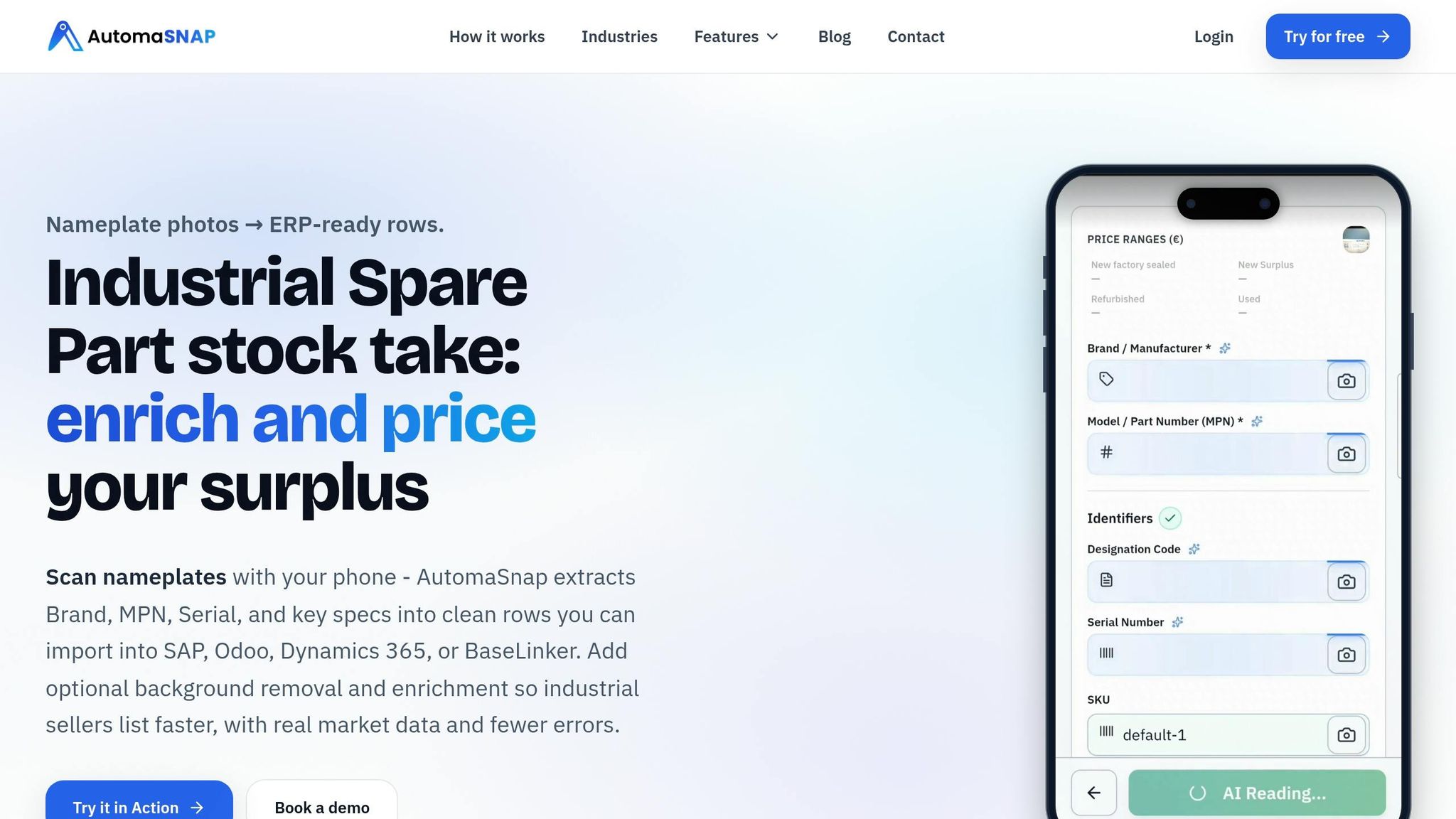
Fixing these data issues is critical, and that is where AutomaSnap steps in. It tackles the problem right at the source, replacing error-prone manual transcription with AI-driven image recognition. By extracting structured data - like Brand, MPN, and Serial Number - directly from nameplate photos, AutomaSnap ensures accuracy even when labels are damaged. Why is this important? Because every pricing decision depends on having the correct part identifiers from the start.
Once the data is captured, AutomaSnap creates export-ready spreadsheets that integrate seamlessly with popular ERP systems like SAP, Odoo, and Dynamics 365. Each record includes a photo for traceability - something manual entry cannot match. To further streamline pricing workflows, the platform offers quick market checks, linking directly to eBay and Automanet for instant insights into market value and demand.
The benefits of addressing data issues early are huge. A 1% improvement in realized price - achievable when parts are correctly identified and matched to accurate market data - can boost operating profit by 8%. Arthur Simitian from PartsAdvisory sums it up perfectly:
“The cheapest place to fix a supply chain problem is in the product feed, not on the warehouse floor. The most expensive place to discover a data problem is in your overstock report.”
For spare parts distributors, asset recovery teams, and eBay sellers managing large volumes of used or surplus equipment, AutomaSnap eliminates the data bottleneck that has long made clean, pricing-ready inventory data so difficult to maintain at scale.
Conclusion: Key Takeaways and What Comes Next
Key Takeaways on AI Pricing Trends
AI-driven spare parts pricing is moving forward quickly, but real success depends on two key factors: data quality and organizational readiness. While growth projections for AI pricing tools are promising, only 14% of adopters are currently seeing measurable business value from these tools. This disconnect highlights the importance of preparation and clean data pipelines.
BCG puts the challenge into perspective:
“Just 10% of the value of AI initiatives comes from algorithms, and 20% comes from technology. The remaining 70% stems from people and processes - changes to daily behaviors and ways of working.”
In short, the right tools are only part of the equation. Success also requires structured data and well-trained teams to make the most of AI solutions. These insights set the stage for what is next in pricing innovation.
What the Future Holds for Spare Parts Pricing
Looking ahead, pricing tools are evolving to do much more than periodic price updates. The next wave includes automated AI agents capable of tracking competitor prices, simulating demand, and adjusting prices in real time. This shift is already happening. For example, Jaguar Land Rover processes over 60 million data points monthly for 500,000 parts across 33 markets. Their AI systems enable immediate action on pricing risks. As Sadiq Pumuram of JLR explains:
“Every time you take that action quicker, you’re protecting margin or you’re doing the right thing for the customer. But you’re doing it there and then rather than a month later. And by then, you could have lost a lot of money.”
The foundation for these advancements remains unchanged: clean, structured inventory data. Future pricing tools will likely integrate with IoT/telematics and service lifecycle management systems, enabling more precise demand forecasting and pricing strategies. For distributors and asset recovery teams, the priority is clear: focus on accurate inventory data. Tools like AutomaSnap, which streamline data extraction, are essential for staying competitive in this growing AI landscape. The opportunities are immense, but only those with reliable data infrastructures will be ready to seize them.
Use case of AI in Procurement - Spare-Parts Automation!
FAQs
What data do I need before using AI pricing for spare parts?
To make the most of AI pricing for spare parts, start with clean and reliable data. Here’s what you will need:
- Accurate part identifiers: Ensure details like brand, MPN (Manufacturer Part Number), and serial numbers are precise.
- Historical data: Include past sales or quotes to give the model a strong foundation.
- External price signals: Factor in competitor pricing and other market influences.
- Demand drivers: Consider elements like seasonality or promotional periods that might affect demand.
- Inventory details: Keep your stock levels updated for accurate pricing decisions.
- Custom rules: Define any specific guidelines the model should follow.
For easier part identification, tools like AutomaSnap can be a game-changer. It extracts details from nameplate photos and exports them in an ERP-ready format, saving time and improving accuracy.
How often should AI-driven spare parts prices update?
AI-powered spare parts pricing works best when updated continuously or at least in near real-time to reflect current market conditions. With dynamic pricing, leveraging real-time monitoring and alerts ensures that any threshold breaches are addressed immediately - sidestepping the inefficiencies of waiting for month-end adjustments. According to McKinsey, AI makes it possible to implement quick SKU-level updates as soon as relevant data signals emerge.
How does AutomaSnap improve pricing accuracy?
AutomaSnap improves pricing precision by automating the extraction of data from nameplate photos and converting it into structured, ERP-compatible formats. It also conducts real-time market checks to validate pricing and assess demand. By simplifying inventory intake and boosting data quality, it helps businesses make more accurate, data-informed pricing decisions.