On this page
How MPNs Improve Spare Parts Search Visibility
When searching for spare parts online, precision is everything. Buyers often rely on Manufacturer Part Numbers (MPNs) - unique alphanumeric codes assigned by manufacturers - to find the exact items they need. Listings that include MPNs consistently outperform those that don’t, improving search visibility, reducing errors, and driving higher sales. Here’s why:
- MPN Accuracy: MPNs act as a product’s “fingerprint”, ensuring exact matches in search results. This reduces incorrect orders and returns.
- Indexing Power: Platforms like Google and eBay prioritize MPN+Brand combinations for better search ranking and product comparison visibility.
- Scalability: For large inventories, MPNs prevent catalog fragmentation and enhance search engine performance.
Manual entry of MPNs can be error-prone, but tools like AutomaSnap automate the process, extracting data quickly and accurately from product nameplates. This approach combines the precision of MPNs with the efficiency of AI, making it easier for sellers to maintain accurate listings at scale and improve their marketplace performance.
Key takeaway: Including MPNs in your listings is essential for better search visibility, fewer errors, and increased sales.
1. MPN-Based Listings
Search Accuracy
When buyers type in a specific query like “AC Delco 41-110”, they are looking for an exact match - no guesswork, no unrelated results. That is where MPN-based listings shine. An MPN, or Manufacturer Part Number, is a unique alphanumeric code assigned to a specific product variant. This makes it easier for search engines to pinpoint the exact listing instead of showing a mix of loosely related options.
“An MPN is like a product’s digital fingerprint…” - Tom Bukevicius, Scube Marketing
This level of precision is especially crucial in industries like automotive parts. Two components might appear identical in photos but could be designed for entirely different vehicles. The MPN often becomes the only reliable way to ensure you are selecting the right part.
Indexing Efficiency
Major platforms like Google and eBay rely heavily on the MPN+Brand combination to anchor listings. This pairing determines whether a listing appears in price comparison panels or even in AI-generated search summaries. Without both fields filled out accurately, a listing might technically be indexed but fail to connect to relevant queries.
Formatting consistency is key. For example, the same part number entered as “41-110”, “41 110”, or “41110” could be treated as three different products. Standardizing MPNs - removing extra spaces, using uppercase, and applying consistent rules for dashes - ensures all variations consolidate into a single listing. This not only merges sales history and reviews but also strengthens the listing’s overall performance.
“MPN normalization is the unsexy fix that makes everything else work better.” - Arthur Simitian, Founder, PartsAdvisory
Proper indexing does not just improve relevance - it also plays a big role in reducing buyer mistakes.
Error Reduction
Relying solely on keywords in listings leaves too much room for error, leading to incorrect orders and higher return rates.
“If your catalog represents one part as many, you are forcing every downstream system to guess. Buyers guess too. Returns follow.” - Arthur Simitian, Founder, PartsAdvisory
MPN-based listings eliminate that ambiguity. For instance, a computer parts seller saw a 15% jump in sales after adding MPNs to their product listings. This improvement was directly linked to customers being able to find the exact components they needed. Fewer wrong orders result in fewer returns and a stronger reputation for the seller.
Minimizing errors becomes even more critical as inventory sizes grow.
Scalability
Managing search visibility for massive inventories - think 50,000+ SKUs - without MPNs is next to impossible. Often, the same physical part arrives from different vendors, each with its own internal SKU codes. Without a “Master SKU” that maps all these variants to a single MPN, catalogs become fragmented, and search engines struggle to process the data.
To maintain visibility across large, ever-changing catalogs, distributors often pair MPNs with frameworks like ACES (fitment data) and PIES (product attributes). This structured approach ensures that even as inventories scale, search relevance and SEO performance remain intact. Consistent use of MPNs is the backbone of this entire system.
Adding Manufacturer Part Number (MPN) to eBay Listings Through eLink for Search Engine Optimization
2. Keyword-Only Listings
Keyword-only listings, while simple, often struggle with indexing, accuracy, and scalability compared to MPN-based listings.
Search Accuracy
Keyword-only listings might work for casual browsing but fall short when buyers are looking for an exact match. Without the precision of an MPN, search engines often return mixed or irrelevant results, making it harder for buyers to find the right part amid the noise.
Indexing Efficiency
Platforms like Google, eBay, and Amazon prioritize structured identifiers to ensure accurate matches. Keyword-only listings, lacking this structure, often miss out on key features like price comparison tools or knowledge panels. This “silent underperformance” leaves these listings at a disadvantage in competitive marketplaces.
Error Reduction
The absence of an MPN increases the risk of buyers purchasing the wrong item. Keywords like “compatible” or “fits most models” are too vague to guarantee an exact match. As inventory grows, this lack of precision can lead to more frequent errors and dissatisfied customers.
Scalability
As inventories expand, keyword-only listings face even bigger challenges. Variations in title formatting - like inconsistent use of dashes or spaces - can result in duplicate SKUs. This not only fragments reviews and sales history but also creates operational inefficiencies.
“If your catalog has duplicate SKUs, you do not just have a messy spreadsheet. You have a revenue leak.” - Arthur Simitian, PartsAdvisory
At scale, these issues can evolve from minor inconveniences into significant operational and revenue problems.
3. AI-Assisted MPN Integration via AutomaSnap
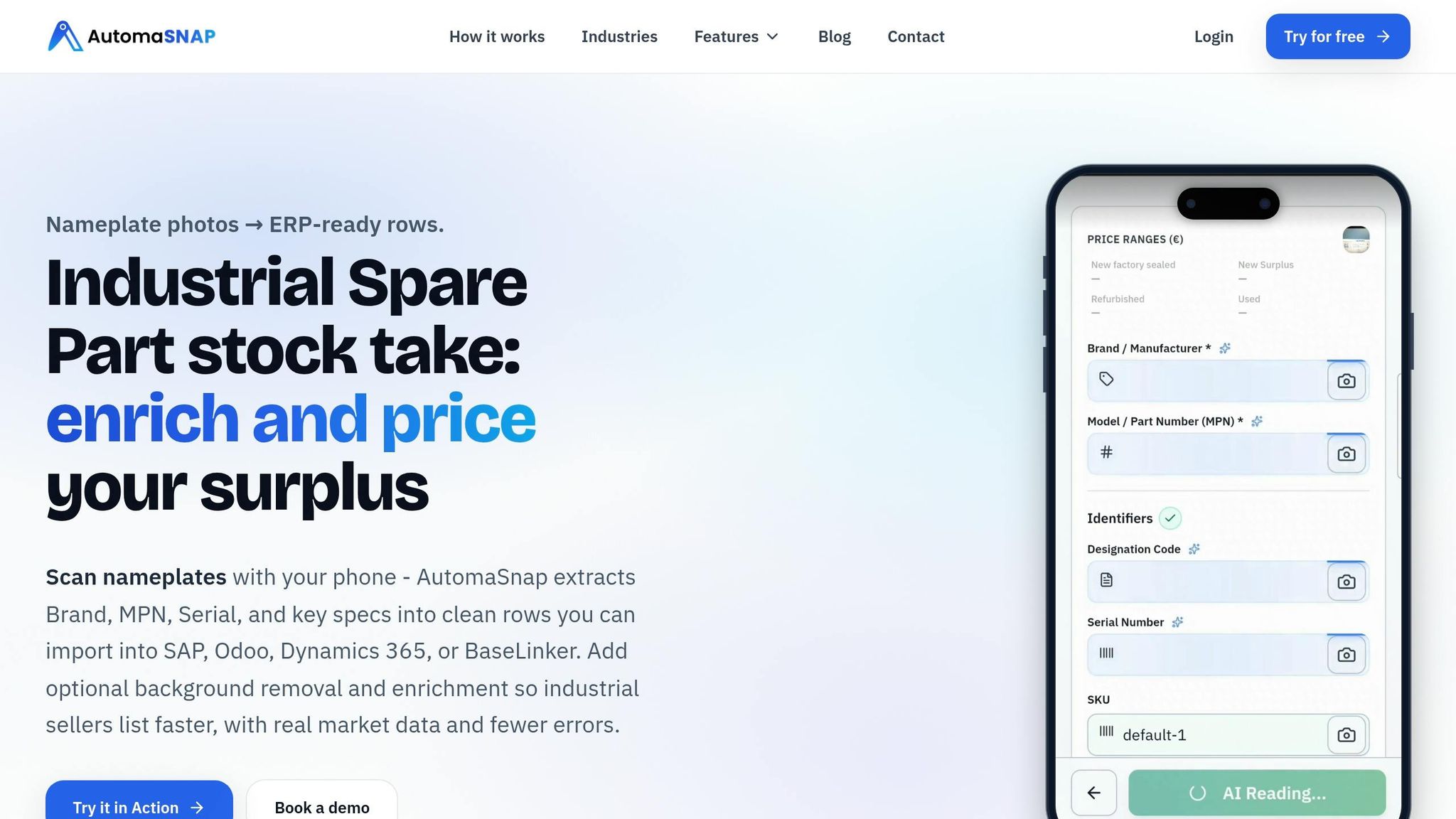
When keyword-only listings fall short and manual data entry introduces errors, AutomaSnap steps in to streamline the process. This tool automates the extraction of Manufacturer Part Numbers (MPNs) from a simple photo of a nameplate using its AI nameplate scanner. By leveraging AI, AutomaSnap improves both the precision and speed of creating MPN-based listings, making them more accurate and scalable.
Search Accuracy
AutomaSnap does not just enhance search visibility - it automates and standardizes the entire extraction process. Its AI is specifically trained to read industrial nameplates, identifying key details like the brand, MPN, and technical specifications. Once the data is extracted, it cross-references an extensive product database to fill in missing attributes and automatically generate SEO-friendly titles and descriptions.
This approach addresses a common issue: listings that technically appear in search results but fail to connect with the right product due to incomplete or incorrect identifiers.
“These manufacturer part numbers are the identifiers used for internal and external searches. They aid product visibility and discoverability.” - Brij Purohit, Co-Founder, SellerApp
Accurate MPN matching can lead to significant improvements. Products correctly identified in a global catalog can see up to 40% more clicks, with conversion rates increasing by as much as 20%.
Indexing Efficiency
AutomaSnap simplifies the process with a streamlined three-step workflow: extract, enrich, export. This ensures clean, standardized identifiers that search engines can confidently link to a specific product. The output files are compatible with platforms like Shopify, Odoo, WooCommerce, eBay, and BaseLinker, making integration seamless.
Error Reduction
Manual data entry often leads to mistakes, such as confusing “O” with “0” or mistaking serial numbers for MPNs. AutomaSnap’s AI eliminates these errors by accurately distinguishing between characters and identifying the correct data, ensuring error-free entries.
Scalability
AutomaSnap’s batch processing capabilities take efficiency to the next level. It can handle multiple nameplates in one go, exporting the data in structured formats like CSV, XLSX, or JSON. In a 2026 case study, industrial reseller Gal-Industry transitioned from manual data entry to AutomaSnap and saw a 15x increase in listing speed. This shift allowed them to go from listing 20 parts per hour to an impressive 300 - without adding staff or compromising data accuracy.
Pros and Cons
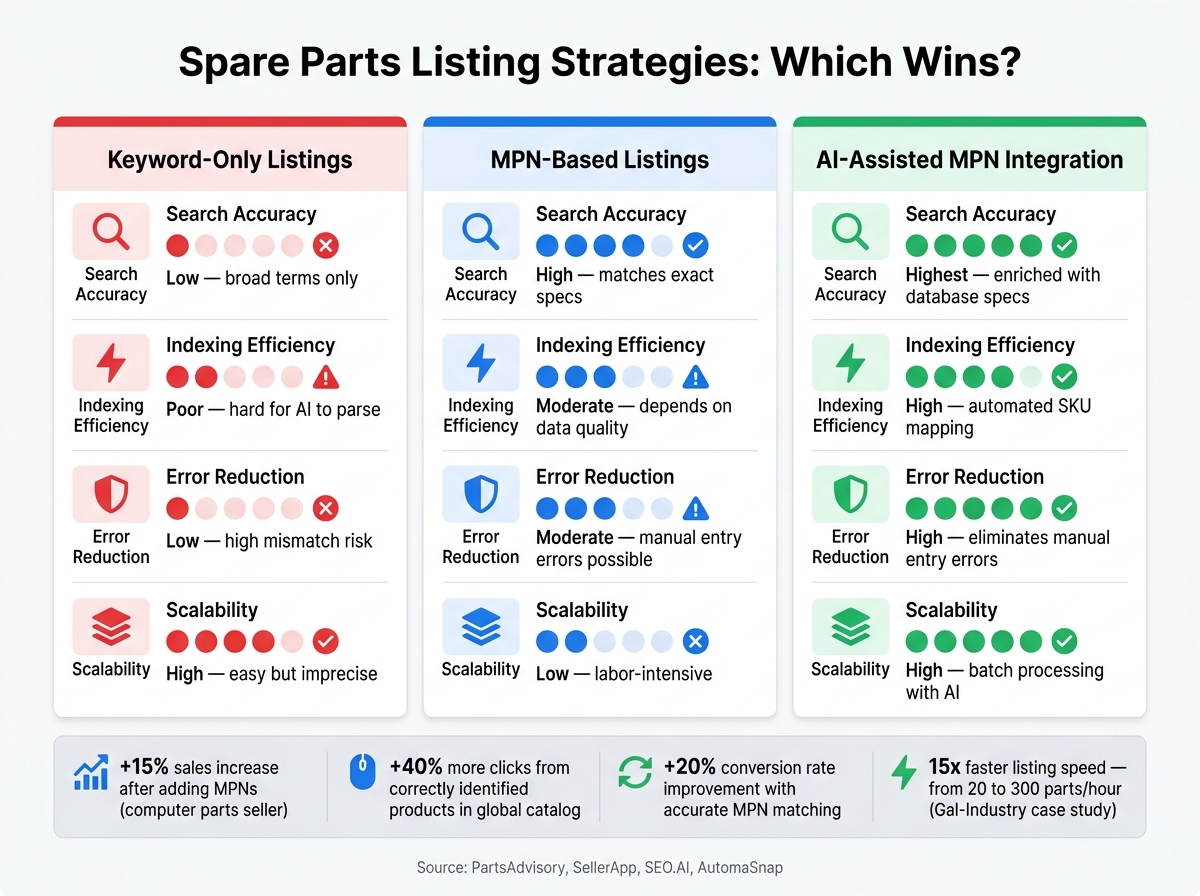
Let’s break down the key takeaways from the different listing approaches and how they impact search visibility and operational workflow.
Each method has its strengths and weaknesses:
MPN-based listings rely on technical identifiers to ensure precise product matching. This approach minimizes return rates caused by fitment errors and enables advanced search features like price comparison panels. However, building these listings manually can be time-consuming and error-prone. Even small formatting differences, like an extra dash or a misplaced zero, can lead to duplicate SKUs, splitting sales history and weakening search signals.
Keyword-only listings are quick to create and work well for broad searches. But they fall short for spare parts buyers who rely on precise searches. Without structured identifiers, search engines struggle to anchor listings to specific products, leading to lower accuracy, higher return rates, and missed opportunities in AI-driven search results. These drawbacks directly impact both SEO performance and operational efficiency for spare parts.
AI-assisted MPN integration bridges the gap between accuracy and scalability. It combines the precision of MPN-based listings with the speed and efficiency of automation. Tools like AutomaSnap streamline the process by transforming catalog data into structured listings, delivering faster workflows, improved accuracy, and better search visibility.
“GTINs and MPNs act like a passport for your products, telling platforms exactly which item you’re selling.” - Oskar Mortensen, SEO Content Editor, SEO.AI
Here is a quick comparison of the three approaches:
| Feature | Keyword-Only Listings | MPN-Based Listings | AI-Assisted MPN Integration |
|---|---|---|---|
| Search Accuracy | Low; relies on broad terms | High; matches exact specs | Highest; enriched with database specs |
| Indexing Efficiency | Poor; hard for AI to parse | Moderate; depends on data quality | High; automated SKU mapping |
| Error Reduction | Low; high risk of mismatches | Moderate; manual entry errors possible | High; eliminates manual entry errors |
| Scalability | High; easy but imprecise | Low; labor-intensive | High; batch processing with AI |
This table highlights the value of structured product data in optimizing search performance, especially for spare parts.
Conclusion
Performance data shows that MPN-based listings consistently outperform keyword-only strategies. For spare parts resellers, this difference can determine whether a part gets noticed or remains hidden.
The success of MPN-based listings, however, hinges on the accuracy of the data. As Arthur Simitian of PartsAdvisory explains:
“MPN normalization is not a data hygiene project. It is a marketplace performance project. Marketplaces reward consistency. They punish fragmentation.”
This underscores the importance of high-quality data. Entering MPNs manually increases the risk of errors - something as small as a misplaced dash can hurt a listing’s performance. Tools like AutomaSnap help tackle this challenge by using AI to extract Brand, MPN, and Serial Number directly from nameplate photos. This approach reduces errors and speeds up the listing process, making it easier to maintain accuracy and efficiency.
With more than 50% of aftermarket purchases happening on major marketplaces, having well-structured product data is critical for strong search performance. Accurate MPNs, paired with reliable brand data and automated tools, give resellers a better chance to stand out - whether in traditional search or on AI-powered platforms.
Ultimately, without precise MPNs, spare parts listings risk losing clicks, conversions, and sales.
FAQs
Where can I find the correct MPN on a spare part?
The Manufacturer Part Number (MPN) is usually located on the product packaging, labels, manufacturer catalogs, official product websites, or reliable online databases. If you are unsure about the correct MPN, reaching out to the manufacturer directly is the best approach. Make sure to use the manufacturer-assigned code and not a vendor’s internal SKU, which might include extra prefixes or suffixes.
How should I format MPNs to avoid duplicates and missed searches?
To avoid duplicates and missed searches, it is crucial to format MPNs (Manufacturer Part Numbers) exactly as the manufacturer prints them and apply consistent standards. Here’s how:
- Trim whitespace: Remove any extra spaces before or after the MPN.
- Use consistent case: Stick to one format, typically uppercase.
- Remove hidden characters: Watch out for invisible characters that might cause mismatches.
- Standardize separators: Decide on a single rule for dashes, spaces, or other separators, and apply it uniformly.
Additionally, always verify suffixes like R, REV, or KIT directly with the manufacturer to avoid errors. Pair each MPN with the correct brand name, and double-check that your schema and feed data are accurate and properly aligned.
What’s the fastest way to add MPNs across thousands of listings?
Taking photos of nameplates on all items is the fastest way to get started. With AutomaSnap, you can automatically extract and organize Brand and MPN data from these photos. Each image creates a new row in an exportable spreadsheet, making it easy to review and integrate into your listing process. This approach removes the need for manual data entry, ensures consistent MPNs, and boosts search visibility - helping you perform better on marketplaces.
Try it yourself
Scan your first nameplate free — no card required
Open the scanner in your browser, photograph a label and watch Brand, MPN, Designation Code and Serial come back as an ERP-ready row. No install, no credit card.